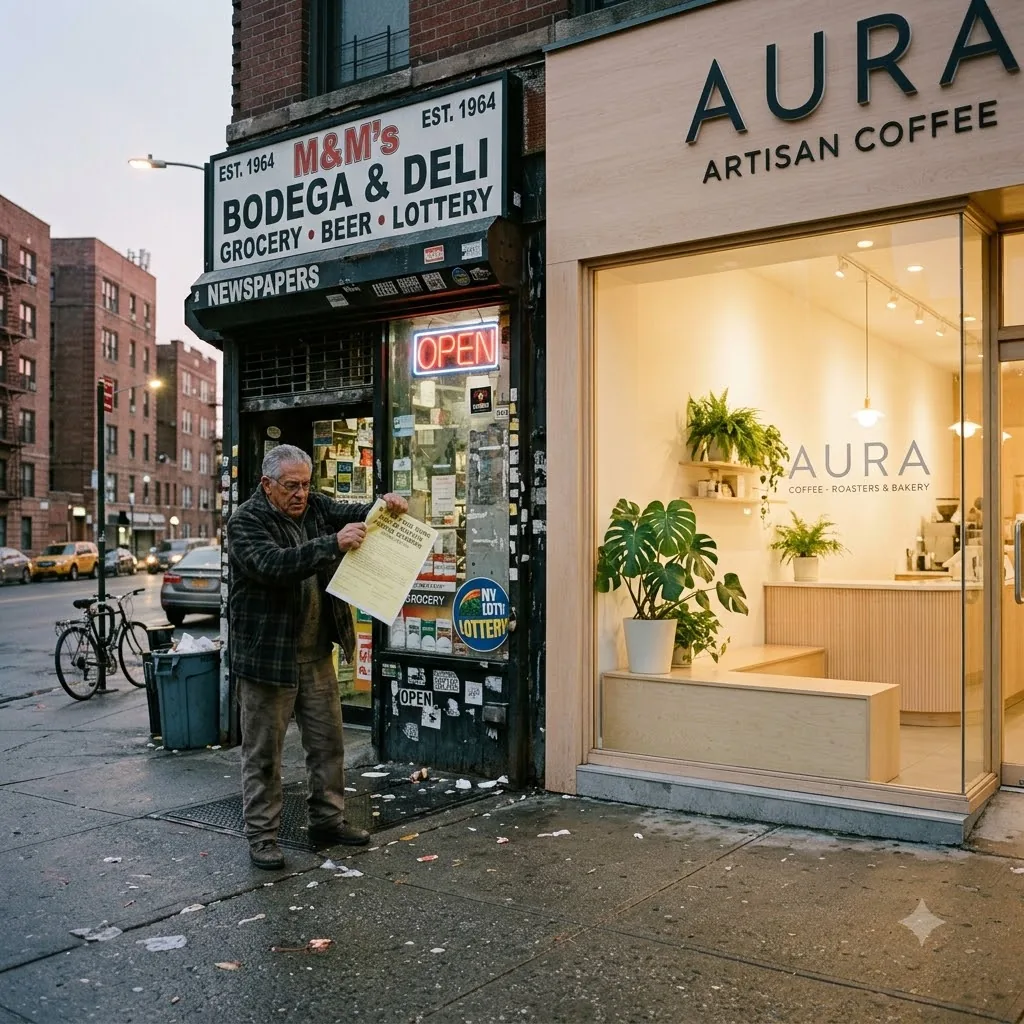
Story code: ST-000693
Part 3: The Blueprint of Ruin
The fluorescent lights of the community center basement flickered with a low, irritating hum that reminded Mateo of the condemned exhaust fan hanging uselessly in his family’s bodega. He sat in the back row of metal folding chairs, gripping a thick cardboard shipping tube so tightly his knuckles ached.
At the front of the room, Julian stood before the local community board, bathed in the glow of a PowerPoint presentation. He wore a tailored unstructured blazer over his usual crisp t-shirt.
“It is about holistic block activation,” Julian told the five board members seated behind a long plastic folding table. He clicked a remote, and a sterile, minimalist architectural rendering appeared on the screen. “Ethical Connections is applying for a commercial zoning variance to expand our footprint. Our vision is a community tasting room and wellness hub. A place for dialogue, organic connection, and restorative commerce.”
“And this expansion,” Board Chairwoman Higgins asked, peering over her reading glasses. “It requires the adjacent retail space? The current bodega?”
Julian’s expression shifted into a mask of profound, rehearsed tragedy. He placed a hand over his heart. “Unfortunately, yes. But I want to assure the board that we are handling this with the utmost sensitivity. The current tenants are… struggling. They have recently incurred severe health department violations. The property management company has informed us that the tenants will not be renewing their lease due to an inability to meet modern structural and sanitary codes. We are simply offering a soft landing by revitalizing a space that is falling into blight.”
Mateo felt a hot spike of adrenaline pierce through his exhaustion. He had spent the last thirty-six hours since Julian handed him that cream-colored buyout envelope drowning in despair. But last night, staring at the buyout offer’s letterhead-a parent company called EC Holdings LLC-Mateo had logged onto the Department of Buildings public portal. He had searched the LLC. He had paid the twenty-five-dollar processing fee to download the public structural filings for their shared commercial lot.
“Is there any public comment on this variance application?” Chairwoman Higgins asked, looking out at the sparsely populated room.
Mateo stood up. The metal legs of his folding chair shrieked against the linoleum.
Julian glanced toward the back of the room. For a fraction of a second, his serene smile vanished, replaced by a sharp, calculating stare, before the tranquil mask slid perfectly back into place. “Mateo,” Julian said softly, gesturing toward the microphone stand in the center aisle. “I am so glad you came. I know this is a difficult transition for your family.”
Mateo did not stop at the microphone. He walked straight down the center aisle, past the projector, and approached the board’s folding table. He popped the plastic cap off the shipping tube.
“Sir, public comments must be made from the microphone,” Higgins warned.
“I am not making a comment,” Mateo said, his voice remarkably steady despite the frantic pounding in his chest. “I am submitting evidence into the public record regarding an active zoning application.”
He pulled a massive, rolled-up sheet of architectural plotter paper from the tube and spread it flat across the center of the folding table, right over Higgins’s water glass and legal pad. He placed a paperweight on one corner and his own heavy hand on the other.
Higgins frowned, adjusting her glasses. “What is this?”
“These are the approved structural alteration plans for my family’s address, filed with the city,” Mateo said. “And stapled to the back is the commercial lease addendum between EC Holdings LLC and our building’s management company.”
Julian stepped out from behind the projector podium, his hands raised in his familiar, placating gesture. “Mateo, please. We understand you are grieving the end of your grandfather’s business. There is no need for theatrics. The board has a busy schedule.”
“Look at the date on the lease addendum, Madam Chairwoman,” Mateo said, ignoring Julian entirely.
Higgins flipped to the attached document. She ran her finger down the page. “This is dated October twelfth. That was three months ago.”
“Three months ago,” Mateo repeated loudly, turning to face Julian. “Three months ago, my grandfather and I were in perfect standing. Our rent was manageable. Our grill was functioning. We had zero health violations.”
The basement was dead silent. The hum of the fluorescent lights suddenly seemed deafening.
“Julian didn’t come up with this tasting room idea because our bodega was failing,” Mateo continued, his voice ringing off the cinderblock walls. “He decided he wanted our square footage, signed a backroom lease with our landlord for an expansion, and then engineered our failure to force us out.”
“That is an absurd, defamatory accusation,” Julian said. The smooth, restorative cadence of his voice was gone, replaced by a tight, reedy defensive tone. “As a business owner, I simply engaged in standard contingency planning for a neighboring vacancy-”
“A vacancy?” Mateo slammed his hand on the blueprint. “Look at the schematic! The architect’s notes detail the demolition of the load-bearing wall separating our two storefronts. You filed plans to bulldoze my grandfather’s kitchen ninety days before my lease was even up for renewal. Then you conspired with the landlord to hike our rent by four hundred percent. And when you realized we might try to fight it, you flooded 311 with anonymous health and noise complaints to bankrupt us so we couldn’t afford a lawyer.”
Higgins and the other board members were staring at the blueprints. Another board member, an older man in a tweed jacket, traced the demolition line with his pen. “He is right. The architectural commission stamp on this blueprint is dated early November. Mr. Julian, you told us ten minutes ago that you only developed this proposal after learning the adjoining tenant was struggling with recent health fines.”
Julian took a half-step back. The projector cast a harsh white square across his shoulder, illuminating the sudden, frantic swallow in his throat. “I… the timeline is complex. The management company approached me with concerns about their long-term viability-”
“You handed me a buyout offer yesterday with a forty-eight-hour exploding deadline,” Mateo interrupted, stepping closer to Julian, closing the distance until they were only feet apart. “You told me it was a lifeline. You told me you just recognized an underutilized asset.”
Julian looked at the board members. They were no longer nodding along to his holistic vision. Higgins’s face had hardened into a stony glare, her pen hovering over Julian’s variance application.
“It is about community wellness,” Julian tried, but the buzzwords hung in the stale basement air, heavy and hollow. He looked at the blueprints on the table, then up at Mateo. His hands, usually resting in open, peaceful postures, were balled into tight, white-knuckled fists at his sides.
Mateo held his gaze, feeling the weight of the last three weeks finally shift. “Your lease addendum is contingent on this board approving your variance tonight. Tell them, Julian. Tell them how our family business is a blight.”