Story code: ST-000930
Part 2: The 3:15 Deadline
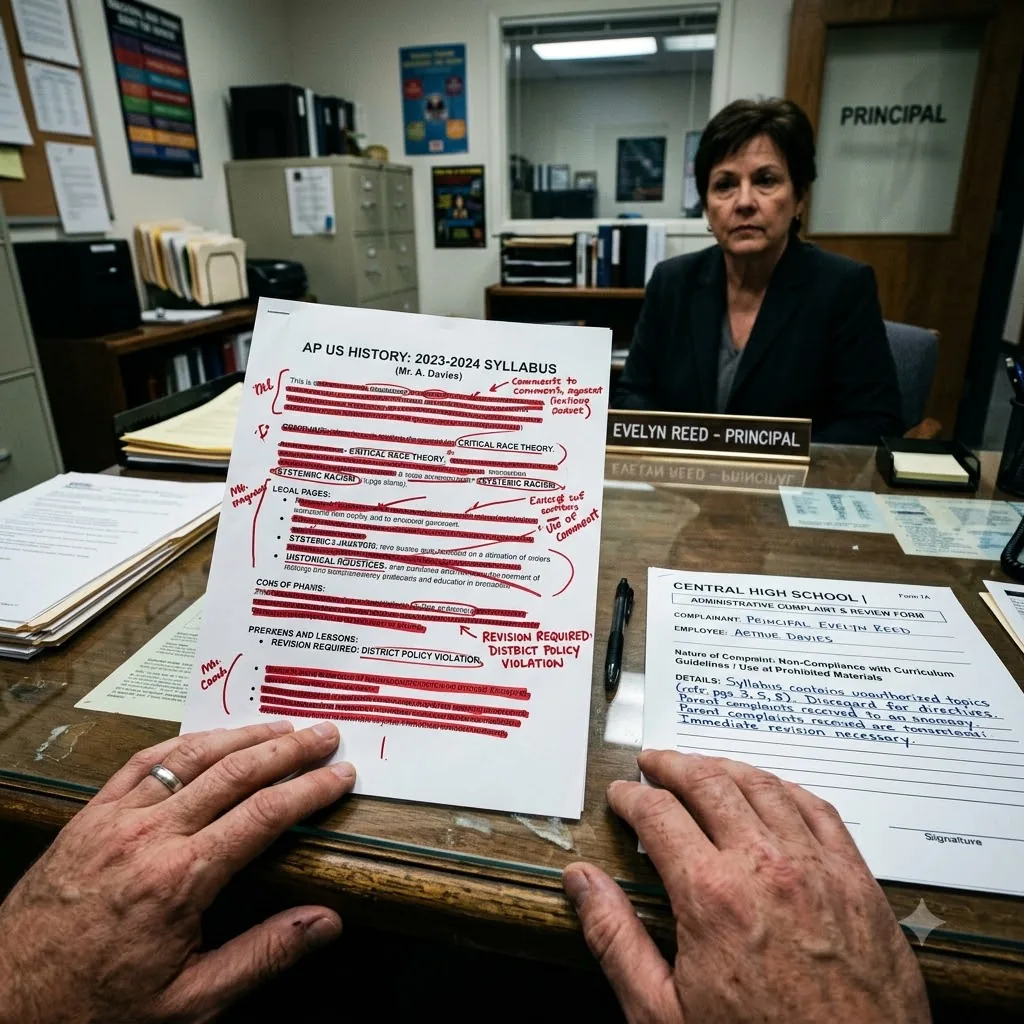
I stared at the clean, unblemished copy of my syllabus, my eyes locked on the specific lesson scheduled for the second week of October.
*October 14th. Primary Source Analysis: 1904 State Labor Commission Transcript regarding the Blackwood Mill Evictions.*
I read the sentence a third time, waiting for the hidden ideological trapdoor to reveal itself. There wasn’t one. The Blackwood Mill was a defunct textile factory that had burned down a century ago on the outskirts of our town. The transcript was a dry, state-archived document detailing the eviction of mill workers from company-owned housing during a wage dispute. It was standard, local-level industrial history. It was practically guaranteed to put half my eighth graders to sleep.
“This is a public record,” I said, my voice sounding hollow in the suffocating quiet of the office. “It’s an archival document from the state historical society. It’s been on the approved supplemental reading list since 2015.”
Miller didn’t blink. He kept his finger pressed against the black pen, pushing it another inch toward me. “Vance is arguing that by framing this specific local industry as exploitative, you are making a deliberate attempt to shame students from affluent backgrounds. He’s categorizing it under the ‘divisive concepts’ ban on teaching that any individual should feel discomfort, guilt, or anguish on account of their socioeconomic status or family heritage.”
“That is an absurd misreading of the statute,” I shot back, the panic finally giving way to a hot flash of indignation. “The law was written to stop ideological grandstanding. It wasn’t written to erase the historical reality of company towns and labor disputes. I teach the Pullman Strike. I teach the Triangle Shirtwaist Factory fire. Why didn’t he cross those out?”
“Because the Pullman Strike didn’t happen in our zip code,” Miller snapped, his patience fraying. “And George Pullman didn’t just donate two million dollars for our new STEM center. Richard Vance did.”
Miller leaned forward, the leather of his chair squealing in protest. The exhausted, sympathetic principal act was gone. In his place was the ruthless district administrator whose only job was to protect the institution from a public relations nightmare.
“Listen to me, Sarah,” he said, his voice dropping to a harsh whisper. “It doesn’t matter what the law actually says. It only matters how Vance uses it. If you fight this, he doesn’t just file a quiet complaint. He goes to the school board. He goes to the local news. He goes to the parents’ Facebook groups and posts that you are violating state law by indoctrinating eighth graders with anti-capitalist, anti-American propaganda.”
I looked down at the formal complaint. The gold crest of the district board seemed to mock me. “Where is my union rep? You shouldn’t even be asking me to sign a disciplinary acknowledgment without representation.”
“I’m not asking you to sign a disciplinary acknowledgment,” Miller countered smoothly. “I’m asking you to sign a revised curriculum map. A simple administrative update. If you demand a rep, if you make this a formal grievance, I have to suspend you with pay by the end of the day. The district lawyers will open a full investigation into your classroom conduct to ensure compliance with Statute 42-A. You’ll be the test case for the new law, Sarah. Do you want your face on the six o’clock news? Do you want a mob of angry parents outside your classroom every morning?”
The threat hung in the air, heavy and suffocating. Six years of building my career, of meticulously crafting lesson plans, of staying late to grade papers and write recommendations. All of it could be torched in an afternoon by a bored millionaire with a thick red marker. The isolation was absolute. The district wouldn’t protect me. The union was terrified of the new state law and would likely advise me to comply.
I stared at the pen. My hand moved toward it, my fingers twitching. Just sign it. Erase the Blackwood Mill. Teach the sanitized version. Survive to teach another day.
But my eyes drifted back to the ruined syllabus, to the violent, frantic red scribbles that had bled through the paper. It was too aggressive. If Vance merely wanted to score cheap political points about “divisive concepts,” he would have complained about the entire unit. He wouldn’t have surgically targeted a single, obscure document about a local mill from 1904.
I pulled my hand back from the pen.
“I need time to review this,” I said, my voice trembling slightly.
Miller’s jaw clenched. “You have until the final bell. 3:15 PM. If this isn’t signed and on my desk by then, I am filing the suspension paperwork and notifying the board.”
I stood up, gathered my clean syllabus, and walked out of the office without another word. The hallway was a chaotic blur of slamming lockers and shouting teenagers as the period transition began. I navigated through the sea of backpacks, my heart pounding a frantic rhythm against my ribs.
When I finally reached my classroom, I stopped dead in my tracks.
Waiting by my door, clutching her leather-bound journal to her chest like a shield, was Chloe Vance.
She looked up as I approached. The quiet, observant girl usually blended into the background, but today she looked terrified. Her knuckles were white where she gripped the book.
“Ms. Davis?” she asked, her voice barely a whisper. “My dad said I’m getting an independent study packet for the rest of October. He said I’m not allowed to sit in for the Industrial Revolution unit.”
I forced a reassuring smile, trying to mask the absolute dread spiraling in my stomach. “We’re just working out some scheduling details with your father, Chloe. It’s nothing you need to worry about.”
Chloe looked nervously up and down the busy hallway, checking to see if anyone was listening. She stepped closer to me, shrinking into the alcove of the doorway.
“He went through my backpack last night,” she said, her voice shaking. “He said he was looking for a missing permission slip. But he found my folder for the local history project. The one we started last week.”
I frowned, my mind racing. The local history project was just a soft introduction to primary research. The students were supposed to pick a historical site in town and find three primary sources about it.
Chloe unzipped her leather journal with trembling fingers. She pulled out a folded piece of paper, the edges singed and blackened, as if it had been rescued from a fireplace.
“He took all my notes,” Chloe whispered, her eyes wide with a fear that had absolutely nothing to do with classroom politics or ‘divisive concepts.’ “He burned my whole folder in the fire pit on the patio. He thought he got everything. But I had tucked this one inside my math book.”
She shoved the half-burned paper into my hands.
I unfolded it. It was a photocopy of an 1899 county land deed, heavily annotated in Chloe’s neat handwriting. My eyes scanned the blackened edges, tracing the faded, century-old cursive script until I reached the signature line at the bottom.
I stared at the name on the deed, and the ticking clock of Miller’s 3:15 deadline suddenly felt like a bomb.