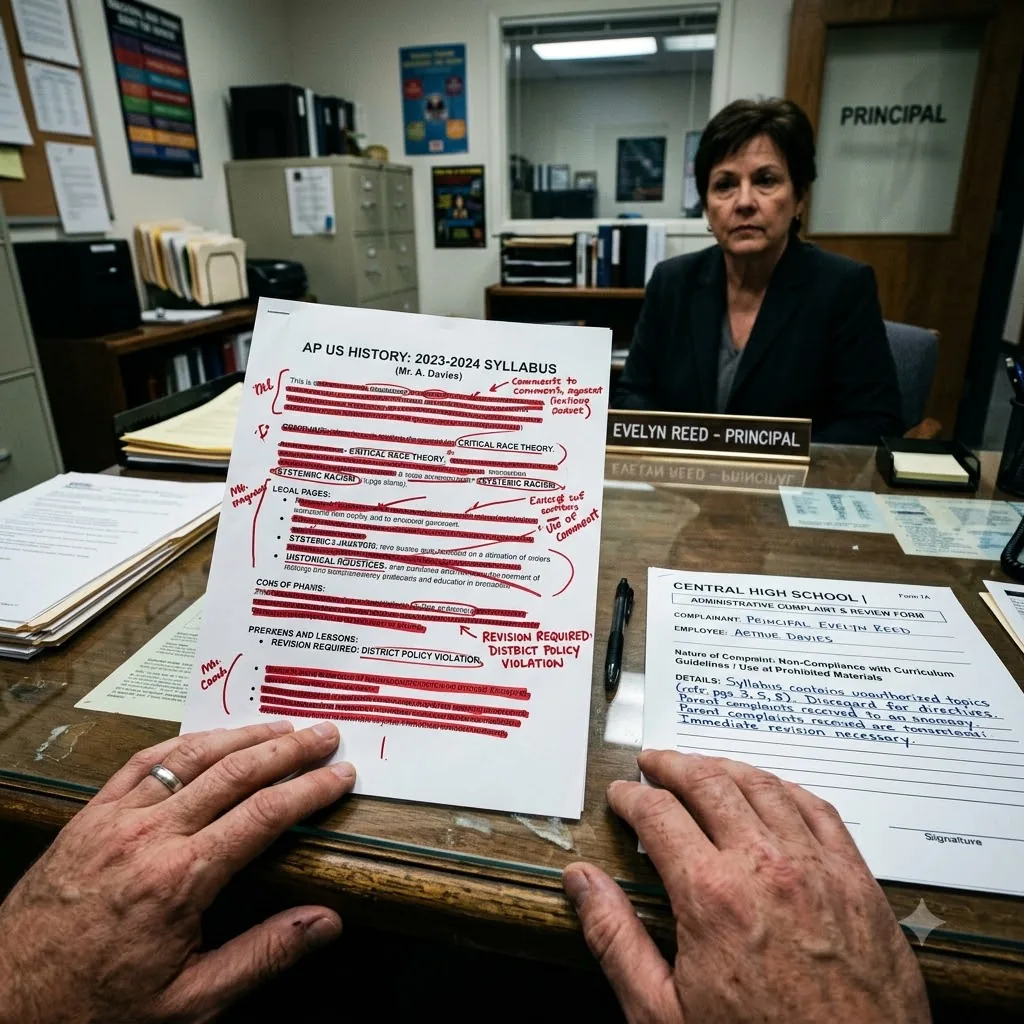
Story code: ST-000930
Part 4: The Machinery
The fluorescent lights buzzed. Vance stared at the spreadsheet. The silence wasn’t the dramatic, breathless kind you see in movies. It was the heavy, suffocating silence of a man rapidly calculating his exposure. He didn’t look embarrassed. He looked inconvenienced.
Vance picked up the spreadsheet. He didn’t tear it up or throw it. He simply folded it in half, then in quarters, and slid it into the inner pocket of his cashmere sweater. He reached out and casually slid the singed 1899 land deed over to join it. I didn’t stop him. I had already made my point.
“You seem to think you’ve accomplished something here, Ms. Davis,” Vance said. The volume of his voice had dropped, shedding all the performative, parental outrage he had carried into the room. What remained was a cold, bureaucratic absolute. “You think you’ve caught me out.”
“I think your daughter did her homework,” I said.
Vance looked at Principal Miller, ignoring me entirely now. “This district relies heavily on discretionary funding, David. We both know the board’s budget for the new STEM annex is running a twenty percent deficit. I also sit on the county zoning committee that needs to approve your new stadium lights next month.”
Miller visibly swallowed, his eyes darting between Vance and the desk.
Vance turned his gaze back to me. His eyes were like flat gray stones. “You have tenure. That makes you difficult to terminate immediately without a lengthy union grievance. But it doesn’t make you impossible to reassign. There are always budget shortfalls. There are always curriculum reshuffles. Let’s see how much you enjoy teaching remedial geography in the windowless basement of the South Annex next year.”
He stood up, smoothing the front of his sweater. He didn’t wait for a response. He walked out of the office, the heavy mahogany door clicking softly shut behind him.
The silence rushed back in. Miller exhaled a long, shaky breath and sank into his leather chair. He looked older than he had an hour ago, his shoulders slumped in defeat. He reached out, picked up the formal complaint bearing the district’s gold crest, and slowly tore it in half. Then he tore it again, dropping the pieces into the mesh wastebasket beneath his desk.
“Keep the 1904 transcript on your syllabus,” Miller said, his voice hollow, not meeting my eyes. “Teach the mill eviction. You won.”
“And Chloe’s local history project?” I asked.
“Cancelled,” Miller said instantly. “For the entire eighth grade. We will pivot to a generic unit on national monuments. I am not taking a zoning hit and losing the STEM funding over a middle school research fair.”
He looked up at me, his expression a mix of resentment and exhaustion. “You get to walk out of here feeling righteous, Sarah. But he’s going to make my life a living hell. And he wasn’t bluffing about the South Annex. You made a very powerful, very quiet enemy today. I’d watch your back.”
I gathered my unredacted syllabus and my empty folder. “I’ll see you tomorrow, David.”
The 3:15 final bell rang just as I stepped out of the office. The doors banged open all along the hallway, flooding the corridor with a chaotic wave of shouting, laughing teenagers. I scanned the sea of faces, looking for Chloe. I wanted to tell her she wasn’t in trouble, that her research was brilliant.
I spotted her at the far end of the hall, walking with her head down, her leather-bound journal clutched tightly against her chest. I started to call out to her, but stopped. She pushed through the double doors and walked out into the afternoon sun, heading directly toward a gleaming black SUV idling in the parent pickup line. I watched her climb into the passenger seat next to her father. The tinted windows rolled up, swallowing her entirely.
I had survived the meeting. I kept my lesson plan. But I had failed to protect my student from the reality of her own house.
Twenty minutes later, I was in my own car, driving the familiar route home. The adrenaline that had kept me sharp in Miller’s office was finally burning off, leaving behind a cold, sickening dread. My hands gripped the steering wheel, my knuckles white.
I turned onto Quarry Road. I didn’t usually look closely at the landscape on this stretch of my commute, letting it blur past in the periphery. Today, I couldn’t look away.
The Elm County Correctional Center loomed at the edge of the town limits. 8400 Quarry Road. The high concrete walls were topped with glinting coils of razor wire, casting long, sharp shadows in the late afternoon sun. The massive floodlights were already buzzing on, illuminating the sterile, windowless blocks where the old textile mill used to stand.
I slowed down as I drove past the main gate. I looked at the concrete, the wire, the imposing guard towers. I thought about the thousands of people locked inside, the families scraping together cash, someone picking up a receiver at this exact second and paying fourteen dollars just to hear their child’s voice for fifteen minutes through a connection provided by Vance Comm-Tech LLC.
Vance hadn’t just threatened my career. He had reminded me of the sheer scale of the machine he operated. I had fought a desperate battle over red ink on a piece of copy paper, thinking I had secured a victory for historical truth. But out here, in the physical world, the machinery of extraction was massive, silent, and totally unbroken.
I pressed the accelerator, driving faster, unable to shake the crushing weight of the concrete as it faded in my rearview mirror.