Story code: ST-000930
Part 1: The Redacted Syllabus
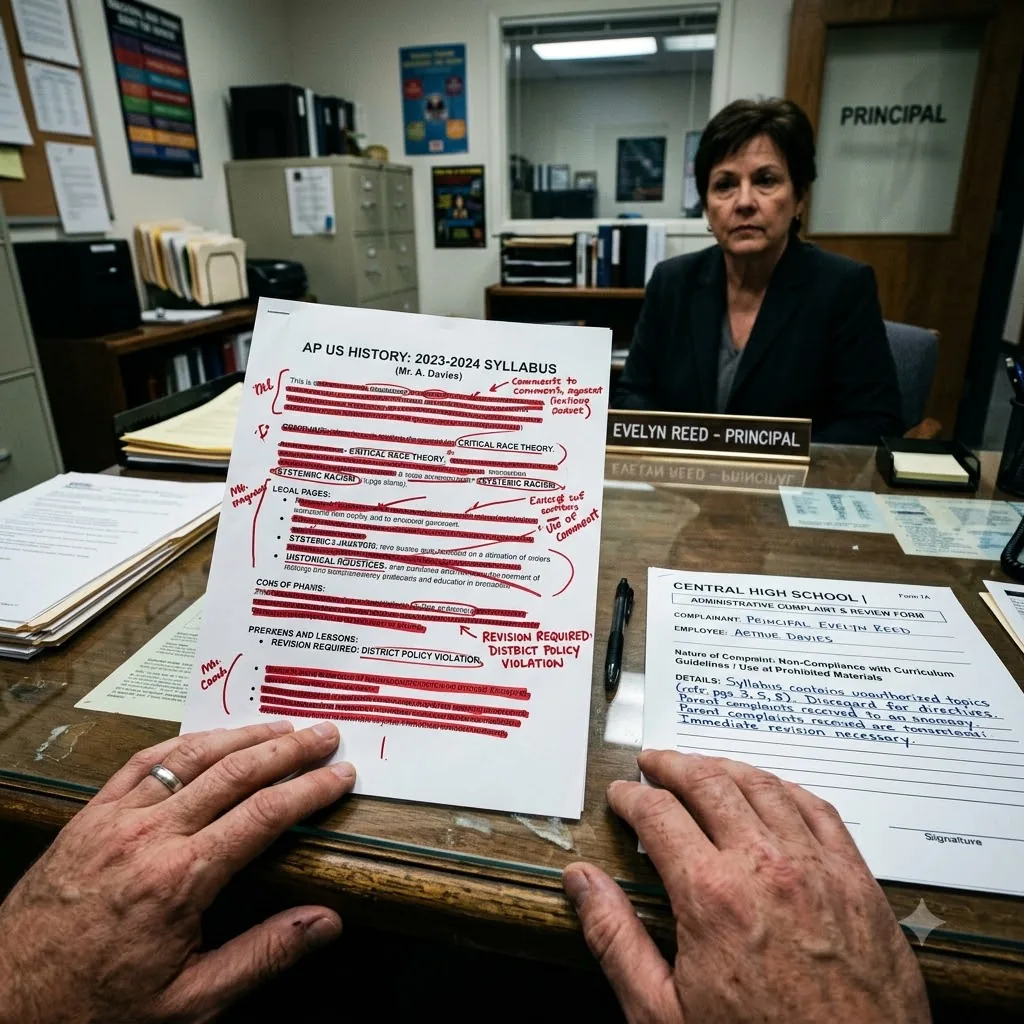
The red ink on my history syllabus was still wet, pooling in thick, glossy lines across the second page. I sat in the cracked leather chair in Principal Miller’s office, staring at the absolute massacre of my fall lesson plan. The fluorescent lights overhead buzzed, a low, constant hum that seemed to sync with the tightening in my chest. Miller sighed, leaning heavily across his oversized mahogany desk. He wasn’t looking at me. He was looking at the stack of paperwork he had just finished signing, deliberately refusing to meet my eyes.
Standard culture war theater, I assumed. I had taught eighth-grade American history in this district for six years, and lately, every syllabus review felt like walking through a minefield blindfolded. Parents were on high alert for anything they deemed inappropriate, scanning our reading lists with a magnifying glass. The administration was terrified of bad PR, terrified of angry board meetings, terrified of the loud voices that dominated the town’s social media groups. I understood the game. I had learned to play it.
But this was different. The sheer volume of red ink crossing out entire weeks of my curriculum was completely unprecedented. Someone had taken a thick marker and brutally dragged it across my meticulously planned lessons, pressing down hard enough to tear the fibers of the cheap copy paper.
Miller slid a single sheet of paper across the desk. It wasn’t my syllabus. It was a formal administrative complaint. The header bore the official gold crest of the district board, and the text below was dense, intimidating legal jargon.
I scanned the bolded section in the center of the page. *Violation of State Statute 42-A: Promotion of Divisive Concepts in Public Education.*
The phrase jumped out at me, cold and official. We had all sat through the agonizing, mandatory professional development seminars about the new state law just last month. The district lawyers had stood at the front of the auditorium, sweating through their suits, telling us to stick to the textbook, avoid subjective framing, and strip our lessons of anything that could cause discomfort. I had been careful. I had spent my entire summer paring my lessons down to cold, hard dates, names, and verified primary source documents. I had built a fortress of objectivity around my classroom.
I picked up the formal complaint. The paper felt unnaturally heavy in my hands. My fingers were shaking, just a little, but enough that the overhead lights caught the tremor. I looked back down at my bleeding syllabus. The red lines weren’t just crossing out words. They were obliterating them. The ink had bled through the page, staining the desk beneath with tiny crimson dots. I tried to decipher the text underneath the thick red marker strikes, but it was impossible.
“Mr. Vance filed it this morning,” Miller said, his voice flat and exhausted.
I recognized the name instantly. Richard Vance. He was the kind of wealthy parent who didn’t just donate baked goods to the PTA. He funded the entire new wing of the athletic department. His name was on the bronze plaque outside the gymnasium. His daughter, Chloe, was in my third-period class. She was a quiet, observant girl, mostly staring out the window or taking meticulous notes in a leather-bound journal. I had never had a single interaction with the man until this exact moment.
“He is demanding a full curriculum audit,” Miller continued, rubbing his temples with his thumbs. “He claims your unit on the Industrial Revolution directly violates the divisive concepts statute.”
I stared at the formal complaint again, my mind struggling to process the accusation. The Industrial Revolution. It was the most straightforward, dry unit of the entire academic year. It was coal, steam engines, textile mills, and the expansion of the railroad. It was gears, smoke, and factory schedules. There was nothing subjective about it.
“I teach from the board-approved textbook,” I told him, keeping my tone perfectly level, refusing to show the panic spiking in my chest. “Every single assignment is cross-referenced with the state standards.”
Miller tapped a blunt finger against the bottom of the formal complaint. “He doesn’t care about the textbook. He cares about the supplementary material. He states in the complaint that you are introducing historical narratives specifically designed to make students feel personal guilt and distress.”
I tried to wrap my head around the concept. Personal guilt over the invention of the cotton gin or the assembly line made no logical sense. I looked at the heavily redacted syllabus again, flipping carefully to the third page. The red ink was heavily concentrated on the second week of October. It was a solid block of red, a violent, desperate erasure of a specific set of primary source readings.
I reached for the original copy of my syllabus in my own folder, the master copy that hadn’t been vandalized by Vance’s heavy hand. I needed to see exactly what he had crossed out with such frantic energy. I traced my index finger down the clean page, matching the week and the day to the ruined document on the desk.
Miller shifted in his seat, the leather squeaking loudly in the quiet office. He reached out, his hand hovering over the desk, palm down, as if to block my view.
“I wouldn’t focus on the specific wording,” Miller said, his tone shifting abruptly from tired to deeply tense. “The board just wants you to sign the acknowledgment. Agree to the revised, sanitized version of the schedule, and this all goes away.”
I ignored his hand, finding the exact date on my clean copy. October 14th. Primary Source Analysis. I read the single line of text that had provoked a formal administrative complaint, a demand for censorship, and a violent display of red ink from the most powerful parent in the district.
I read the sentence twice.
The silence in the principal’s office stretched out, thick and heavy.
Miller cleared his throat and slid a black pen across the mahogany desk, stopping it right on top of the formal complaint.
The red ink on my history syllabus was still wet, pooling in thick, glossy lines across the second page. I sat in the cracked leather chair in Principal Miller’s office, staring at the absolute massacre of my fall lesson plan. The fluorescent lights overhead buzzed, a low, constant hum that seemed to sync with the tightening in my chest. Miller sighed, leaning heavily across his oversized mahogany desk. He wasn’t looking at me. He was looking at the stack of paperwork he had just finished signing, deliberately refusing to meet my eyes.
Standard culture war theater, I assumed. I had taught eighth-grade American history in this district for six years, and lately, every syllabus review felt like walking through a minefield blindfolded. Parents were on high alert for anything they deemed inappropriate, scanning our reading lists with a magnifying glass. The administration was terrified of bad PR, terrified of angry board meetings, terrified of the loud voices that dominated the town’s social media groups. I understood the game. I had learned to play it.
But this was different. The sheer volume of red ink crossing out entire weeks of my curriculum was completely unprecedented. Someone had taken a thick marker and brutally dragged it across my meticulously planned lessons, pressing down hard enough to tear the fibers of the cheap copy paper.
Miller slid a single sheet of paper across the desk. It wasn’t my syllabus. It was a formal administrative complaint. The header bore the official gold crest of the district board, and the text below was dense, intimidating legal jargon.
I scanned the bolded section in the center of the page. *Violation of State Statute 42-A: Promotion of Divisive Concepts in Public Education.*
The phrase jumped out at me, cold and official. We had all sat through the agonizing, mandatory professional development seminars about the new state law just last month. The district lawyers had stood at the front of the auditorium, sweating through their suits, telling us to stick to the textbook, avoid subjective framing, and strip our lessons of anything that could cause discomfort. I had been careful. I had spent my entire summer paring my lessons down to cold, hard dates, names, and verified primary source documents. I had built a fortress of objectivity around my classroom.
I picked up the formal complaint. The paper felt unnaturally heavy in my hands. My fingers were shaking, just a little, but enough that the overhead lights caught the tremor. I looked back down at my bleeding syllabus. The red lines weren’t just crossing out words. They were obliterating them. The ink had bled through the page, staining the desk beneath with tiny crimson dots. I tried to decipher the text underneath the thick red marker strikes, but it was impossible.
“Mr. Vance filed it this morning,” Miller said, his voice flat and exhausted.
I recognized the name instantly. Richard Vance. He was the kind of wealthy parent who didn’t just donate baked goods to the PTA. He funded the entire new wing of the athletic department. His name was on the bronze plaque outside the gymnasium. His daughter, Chloe, was in my third-period class. She was a quiet, observant girl, mostly staring out the window or taking meticulous notes in a leather-bound journal. I had never had a single interaction with the man until this exact moment.
“He is demanding a full curriculum audit,” Miller continued, rubbing his temples with his thumbs. “He claims your unit on the Industrial Revolution directly violates the divisive concepts statute.”
I stared at the formal complaint again, my mind struggling to process the accusation. The Industrial Revolution. It was the most straightforward, dry unit of the entire academic year. It was coal, steam engines, textile mills, and the expansion of the railroad. It was gears, smoke, and factory schedules. There was nothing subjective about it.
“I teach from the board-approved textbook,” I told him, keeping my tone perfectly level, refusing to show the panic spiking in my chest. “Every single assignment is cross-referenced with the state standards.”
Miller tapped a blunt finger against the bottom of the formal complaint. “He doesn’t care about the textbook. He cares about the supplementary material. He states in the complaint that you are introducing historical narratives specifically designed to make students feel personal guilt and distress.”
I tried to wrap my head around the concept. Personal guilt over the invention of the cotton gin or the assembly line made no logical sense. I looked at the heavily redacted syllabus again, flipping carefully to the third page. The red ink was heavily concentrated on the second week of October. It was a solid block of red, a violent, desperate erasure of a specific set of primary source readings.
I reached for the original copy of my syllabus in my own folder, the master copy that hadn’t been vandalized by Vance’s heavy hand. I needed to see exactly what he had crossed out with such frantic energy. I traced my index finger down the clean page, matching the week and the day to the ruined document on the desk.
Miller shifted in his seat, the leather squeaking loudly in the quiet office. He reached out, his hand hovering over the desk, palm down, as if to block my view.
“I wouldn’t focus on the specific wording,” Miller said, his tone shifting abruptly from tired to deeply tense. “The board just wants you to sign the acknowledgment. Agree to the revised, sanitized version of the schedule, and this all goes away.”
I ignored his hand, finding the exact date on my clean copy. October 14th. Primary Source Analysis. I read the single line of text that had provoked a formal administrative complaint, a demand for censorship, and a violent display of red ink from the most powerful parent in the district.
I read the sentence twice.
The silence in the principal’s office stretched out, thick and heavy.
Miller cleared his throat and slid a black pen across the mahogany desk, stopping it right on top of the formal complaint.