Story code: ST-000930
Part 3: The Vendor Contract
I stared at the elegant, looping cursive at the bottom of the 1899 land deed. The ink was faded, the paper reeking of woodsmoke, but the name was unmistakable. *Arthur Vance*. Richard’s great-grandfather. But it wasn’t just the signature that made my pulse pound; it was the entity he was transferring the Blackwood property to. *The Elm County Department of Corrections.*
I sent a trembling Chloe to the library with a hall pass and locked my classroom door. I had forty-five minutes until Miller’s 3:15 deadline. The threat of suspension still hung heavy in my chest, but the geometry of the situation had fundamentally shifted.
I opened my laptop, pulling up the district’s Wi-Fi. Chloe’s local history project required students to trace a historical site from its origins to its present-day function. If she had followed the Blackwood Mill address-8400 Quarry Road-where would she have ended up?
I typed the address into the county assessor’s database. It was the exact location of the modern Elm County Correctional Center.
The mill workers weren’t evicted in 1904 just over a wage dispute. They were evicted so the Vance family could pivot from textiles to leasing land to the state for a jail.
But why would Richard Vance burn his daughter’s homework over a century-old real estate pivot? Unless the pivot never ended.
I opened a new tab and accessed the county’s public vendor registry. I searched for Richard Vance. Then, I searched the business addresses registered to his name, cross-referencing them with the county’s municipal contracts.
It took twenty minutes to find the spreadsheet.
It was a quarterly revenue report from the county commissioner’s office, buried in a massive, unindexed PDF from last month’s open board meeting. It detailed the exclusive vendor contracts for the county jail. My eyes locked onto the line item for inmate telecommunications.
*Vance Comm-Tech LLC.*
The rates were laid out in a sterile, grid-lined column. Fourteen dollars for a fifteen-minute phone call. Exorbitant connection fees. Mandatory deposit minimums. It was a predatory pricing model extracted entirely from families desperate to speak to incarcerated loved ones. It was a massive, quiet monopoly, yielding hundreds of thousands of dollars a year in guaranteed, captive revenue.
The picture snapped into brutal, perfect clarity.
Richard Vance didn’t care about “divisive concepts.” He didn’t give a damn if the 1904 eviction made his daughter feel an ounce of guilt about her wealthy heritage. He was terrified of what would happen if his bright, meticulous eighth-grader stood up in front of a classroom of local parents-some of whom likely had family caught in the local justice system-and presented a straight, unbroken timeline. From the historic eviction of the working class to her own father’s modern-day exploitation of the county’s poorest residents.
He had weaponized a vague, terrifying new state education law to stop a middle school history project.
I looked at the clock. 3:12 PM.
I printed the spreadsheet, grabbed my folder, and walked out of the classroom. The hallway was empty, the quiet amplifying the steady strike of my shoes against the linoleum. The fear that had paralyzed me an hour ago was entirely gone, burned away by a cold, anchoring fury.
When I walked into the principal’s office, Richard Vance was already there.
He sat in the chair next to mine, wearing a quarter-zip cashmere sweater, his legs crossed comfortably. He radiated the casual, relaxed confidence of a man who had never been told “no” in his entire life.
Miller looked incredibly relieved to see me. “Sarah. Good. You’re just in time. Mr. Vance wanted to be here to personally ensure we reached an amicable resolution to this misunderstanding.”
Vance offered a tight, patronizing smile. “It takes a big person to admit when a lesson plan crosses the line into political indoctrination, Ms. Davis. I appreciate your willingness to adapt to the new legal realities.”
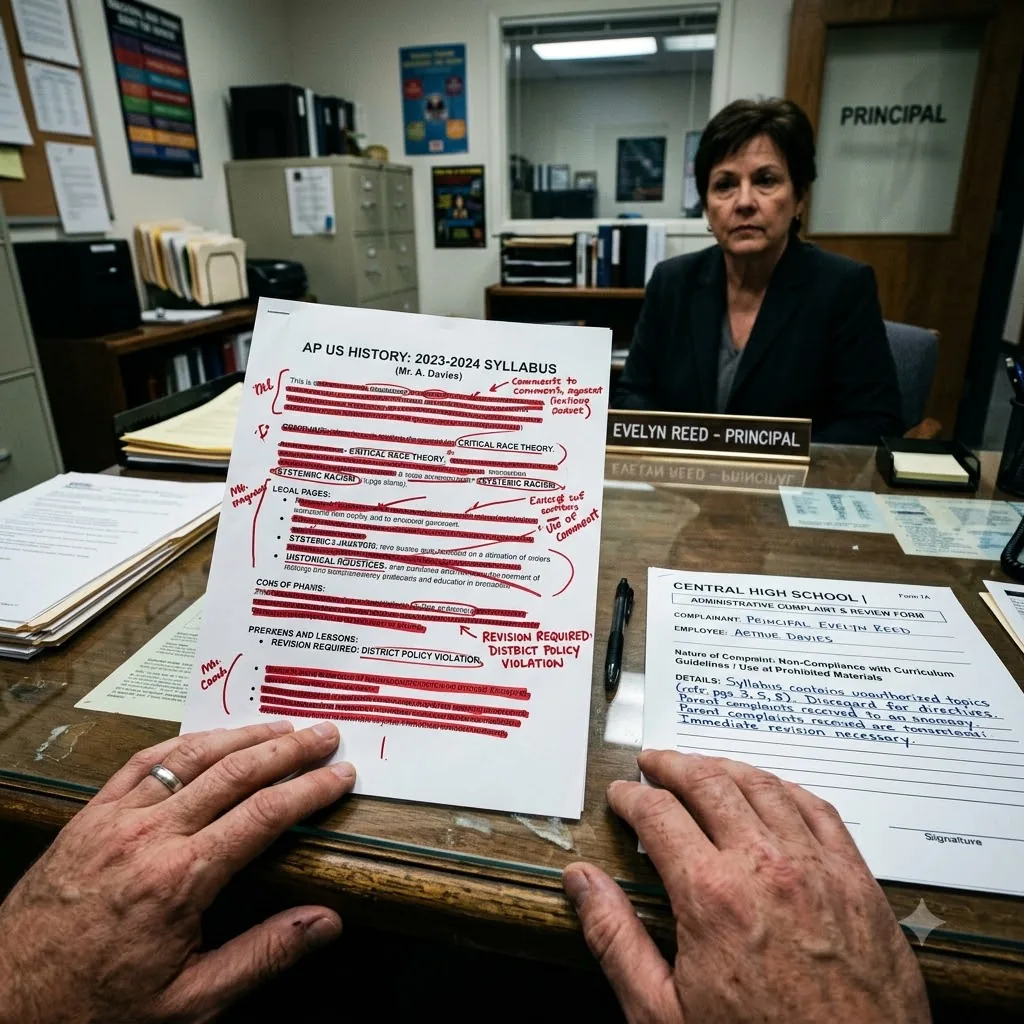
Miller tapped the black pen resting next to the revised, sanitized syllabus. “Just sign at the bottom, Sarah. Then we can all move on.”
I didn’t sit down. I didn’t reach for the pen.
“I’m not signing that,” I said. My voice was perfectly level.
Miller’s face flushed a deep, warning red. “Sarah, we discussed the consequences of insubordination. I have the suspension paperwork-”
I reached into my folder and dropped the photocopy of the singed 1899 land deed directly on top of the sanitized syllabus.
Vance’s smug smile vanished. His posture stiffened, his eyes locking onto the blackened edges of the paper like it was a live grenade.
“Chloe is a very diligent student,” I said, watching the color drain out of Vance’s face. “She rescued this from your fire pit last night. It’s a fascinating piece of primary evidence. It shows that your great-grandfather evicted the Blackwood Mill workers to lease the land for the original county jail.”
“This is exactly the kind of targeted harassment I filed the complaint about,” Vance snapped. He recovered his composure quickly, but his voice was a fraction higher, the false politeness entirely gone. “You’re deliberately trying to shame my family-”
“I didn’t know anything about your family history until your daughter showed this to me twenty minutes ago,” I interrupted, my voice cutting through his defense. “Because I only teach the 1904 labor transcript. Chloe went further. Her assignment was to trace the historical site to its present day.”
I pulled the printed spreadsheet out of my folder. I slid it across the mahogany desk, placing it deliberately over Vance’s thick red marker strikes.
“8400 Quarry Road,” I said, tapping the printed grid. “The current Elm County Jail. And right here is the exclusive municipal contract for the facility’s phone services, held by Vance Comm-Tech LLC.”
The office fell dead silent. The fluorescent lights overhead buzzed their low, constant hum.
“She was going to present her project next week,” I continued, keeping my eyes fixed on him. “She was going to stand up in front of the PTA and proudly show how her family has maintained a continuous economic interest in that specific plot of land for over a century. You didn’t file this administrative complaint because my syllabus violates the divisive concepts statute. You filed it because my homework assignment accidentally made your daughter audit your shell companies.”
Miller leaned forward, his brow furrowing as he finally looked down at the spreadsheet. He read the highlighted vendor rates, then looked at the LLC name. The institutional protector in him was quickly doing the math, realizing the district was being used as a shield for a massive local corruption scandal.
“Mr. Vance?” Miller asked, his voice suddenly cautious, completely stripped of its previous deference.
Vance stared at the spreadsheet. The righteous indignation of the concerned, conservative parent was gone, evaporating into the thin, stale air of the office. He opened his mouth to speak, but the carefully rehearsed outrage failed him, leaving nothing but the panicked silence of a cornered man.