Story code: ST-000955
Part 4: The Crater
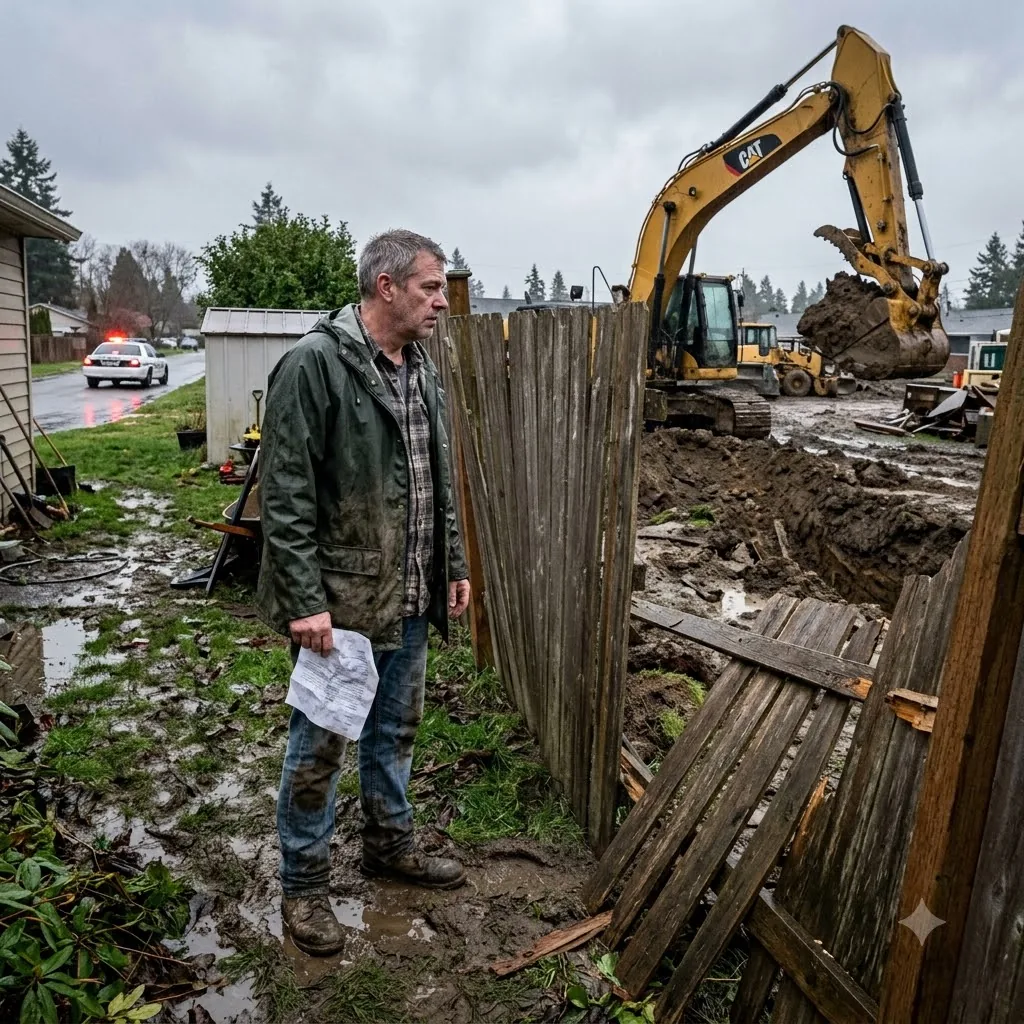
The thunder cracked again, a sharp, violent whip that rattled the loose aluminum siding of Marcus’s ruined house. The heavy first drops of rain began to fall, stamping dark, coin-sized circles into the thick dust on the hood of the DEQ pickup truck.
Arthur stood paralyzed in the mud, the pristine khaki of his trousers now a heavy, soaked brown. The concrete foreman didn’t wait for Arthur’s permission anymore. He spun around, frantically waving his arms at the line of roaring cement trucks. “Wash ’em out! Get them out of here! The mix is kicking!”
“No, wait!” Arthur shouted, his voice cracking over the mechanical din. “Just pour it!”
“I have a commercial environmental injunction on this site,” the DEQ officer said, her voice cutting through the panic with absolute, bureaucratic zero. She ripped a pink carbon copy from her citation book and slapped it onto the muddy treads of the yellow excavator. “Nobody pours a drop of anything until this machine is moved and the property line is verified by a state surveyor.”
Arthur looked at the pink slip of paper, then down at his feet. The rain was picking up, slicking his hair to his forehead. If he moved the excavator, the survey pin would instantly prove he was building in the city easement. The emergency permits would be revoked, the project dead. But leaving it meant the concrete was lost, and the trench-his perfectly dug, un-shored foundation footprint-was completely exposed to the incoming storm.
“The hydraulics are locked,” Arthur lied, his voice thin and desperate. “I can’t move it right now.”
The DEQ officer didn’t blink. “Then the injunction stands. I’m calling a state surveyor to verify the pin placement on Monday. Until then, this is a frozen site.”
The air brakes of the lead cement truck hissed violently. The massive vehicle began to back up, churning the mud in Arthur’s driveway into a deep, impassable rut. The other trucks followed suit, a parade of six-figure losses rolling away into the darkening afternoon.
Marcus didn’t say a word. He just zipped up his rain jacket and walked back toward his porch.
By nightfall, the coastal storm hit with full force. Marcus sat in the darkness of his water-stained living room, listening to the relentless drumming on his sagging roof. But beneath the familiar sound of the rain, there was a new noise coming from next door. A deep, heavy sloshing, followed by the sickening suction of collapsing earth.
When Saturday morning broke, the storm had passed, leaving behind a washed-out, brilliant blue sky. Marcus stepped out onto his back porch, a fresh bag of charcoal in his hand.
He walked to the edge of his property. The caution tape the police had torn down was still tangled in the mud, but the landscape next door was unrecognizable.
Arthur’s perfectly engineered foundation trench was gone. Without the concrete footings to hold the earth in place, the sheer walls of the excavation had catastrophically failed in the torrential rain. The multi-million-dollar footprint was now a jagged, useless crater filled with a swirling mix of brown stormwater and displaced mud.
The collapse had completely washed away the debris Arthur had piled over the municipal utility line. The ruptured blue-and-yellow-flagged casing was standing in plain view, the city’s emergency crews having capped it late in the night. More importantly, the landslide had eroded the dirt right out from under the heavy yellow excavator. The machine was tilted dangerously sideways into the flooded pit, its left tread dangling in the air.
Directly beneath it, gleaming in the morning sun, was the steel survey pin with its neon green cap. It was fifteen feet deep into the city’s no-build easement. The evidence was completely exposed for the state surveyor arriving on Monday. Arthur’s fortress was legally and physically dead.
Marcus walked back to his rusted grill. His sister-in-law’s minivan pulled into the driveway, the tires crunching softly on the wet gravel. His nieces piled out, looking hesitantly at the overturned folding tables and the scattered tools from the day before.
Marcus set to work. He righted the tables. He wiped down the plastic chairs. He poured the charcoal into the rusted basin of the grill, hitting it with lighter fluid and dropping a match. The flames flared up, catching quickly, the smoke rising into the clear air.
His brother walked up the steps, carrying a new pack of hot dogs and a case of beer. They didn’t talk about the police cruisers that had humiliated them yesterday. They just looked at the massive, flooded crater next door, where the artificial runoff that had been drowning Marcus’s yard for weeks was now completely contained within Arthur’s ruined project.
Marcus reached into his back pocket. The insurance denial letter was still there, crumpled and heavy. It hadn’t magically transformed into a check. His living room was still water-logged, his roof was still sagging, and he still had no idea how he was going to afford the materials to rebuild. The storm had taken nearly everything, and the corporation that was supposed to protect him had abandoned him.
He pulled the letter out and smoothed the deep creases against his thigh. He looked at it for a long moment. Then, he folded it in half, stepped up to the grill, and tossed the corporate boilerplate directly onto the hot coals.
The paper curled, blackened, and burst into bright orange flame. Marcus watched it burn to ash, grabbed his tongs, and began laying the food over the fire. They were still on their own, but the dirt beneath their boots belonged to them.