Story code: ST-000955
Part 3: The Pour
Marcus stared at the yellow carbon-copy paper fluttering in the humid breeze. The utility inspector tapped his pen against his ruggedized laptop, waiting for the signature that would financially bury Marcus forever.
Marcus didn’t take the pen. He looked past the inspector to his neighbor, Arthur, who was anxiously checking his heavy silver wristwatch. The sky above the coastal lots was bruising into a deep, volatile purple. The weekend storm was moving in fast, and the air was already heavy with the smell of ozone and impending rain.
“I’m not signing,” Marcus said, his voice flat.
“Then I’m calling the police to remove you from the site, and placing a hard stop-work order on both lots,” the inspector warned, his patience completely gone.
“Do it,” Marcus said.
Arthur’s head snapped up. “Whoa, hold on. My lot has nothing to do with his negligent landscaping. I have a fleet of cement mixers turning onto the avenue right now. We have a fifty-yard monolithic pour scheduled before the rain hits.”
“Until the emergency hazmat crew secures this high-pressure line, nobody is working,” the utility inspector said.
Arthur stepped off his pristine concrete patio, his smooth demeanor slipping. “That’s a localized utility rupture buried under his debris. My foundation footprint is fully shored up and isolated. You can’t freeze a million-dollar commercial pour because my neighbor dropped a stump.”
Marcus caught the slip instantly. *Commercial pour.*
Arthur was right about the utility inspector-the man looked at the chaotic mud pit, the ticking clock of the incoming storm, and the sheer wealth radiating from Arthur’s massive project. The inspector let out a long, exhausted breath. “Fine. If your trench is secure and the trucks are already here, you can pour your footings. But the excavator stays off. And Marcus, you need to vacate the property line.”
Marcus didn’t move. He pulled his phone from his back pocket. The police had shut down his family barbecue just hours ago for a residential noise complaint, thanks to Arthur. But Arthur had just admitted he wasn’t running a residential build anymore. By his own words, and by the sheer tonnage of the diesel machinery idling on the lot, this was a commercial operation.
“Who are you calling?” Arthur demanded, gesturing sharply to his foreman to start backing the first heavy cement truck down the driveway. The deep, rhythmic thud of the mixing drum vibrated through the mud, shaking the caution tape on Marcus’s ruined house.
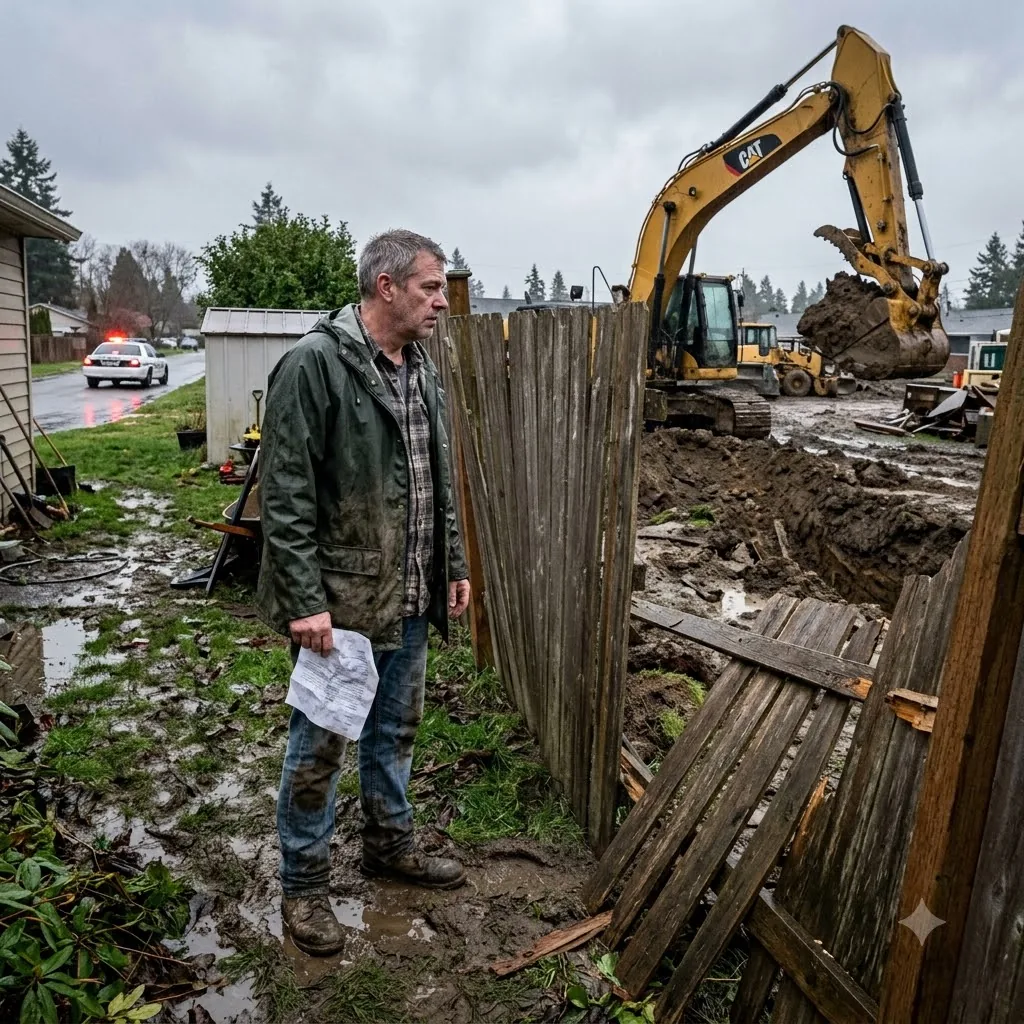
“The Department of Environmental Quality,” Marcus said, dialing the state emergency hotline. He didn’t break eye contact with Arthur. “I’m reporting an illegal commercial dumping incident. Contaminated excavation spoil intentionally pushed over a live municipal sanitary line.”
Arthur scoffed, though his eyes darted toward the street. “You’re desperate. It’s your stump.”
“The stump is on top,” Marcus said into the phone as the state dispatcher picked up. “Yes, I have a commercial developer illegally dumping hazardous mud into a ruptured city easement waterway. They’re also violating commercial decibel limits with heavy diesel machinery right on the residential property line. I need an environmental enforcement officer here immediately. They are about to pour concrete over the site to hide the evidence.”
He hung up. The utility inspector frowned, suddenly looking incredibly nervous about overriding his own stop-work order if the state DEQ was getting involved.
“Ignore him,” Arthur told his foreman, panic threading into his voice. “Back that truck up to the chute. We pour right now.”
For the next fifteen minutes, the tension in the humid air was thick enough to choke on. The massive cement trucks queued up along the narrow street, their engines roaring and drums spinning, generating a deafening mechanical chorus. The foreman was pacing the trench, yelling that the high humidity was accelerating the cure time inside the drums. If they didn’t get the concrete into the ground soon, it would harden inside the trucks, resulting in a catastrophic, six-figure loss.
Just as the first truck locked its heavy metal pouring chute into place, a white pickup truck with the green state DEQ seal on the door swerved to the curb. Its amber roof lights cut aggressively through the darkening afternoon gloom.
An environmental enforcement officer stepped out, wearing a hard hat and holding a digital decibel meter. She didn’t look tired or easily swayed like the local utility guy; she looked strictly by-the-book and furious. She marched straight past the idling cement trucks and stopped at the edge of the muddy trench.
“Who is the site manager here?” she shouted over the deafening roar of the concrete mixers.
Arthur stepped forward, flashing a practiced, easy smile. “Officer, this is a massive misunderstanding. We are doing a standard residential pour. My neighbor is just upset about a utility accident on his side of the line.”
The DEQ officer held up the decibel meter. “You’re registering at ninety-five decibels, which violates the commercial noise injunction for this zoning. More importantly, I have a report of illegal commercial dumping into a municipal waterway bypass.” She pointed directly at the massive pile of mud and the shattered oak stump resting over the hissing blue-and-yellow-flagged pipe.
“That’s his dirt,” Arthur said smoothly, pointing at Marcus. “His tree.”
“He used that excavator to push the dirt across the property line to hide the fact that his foundation is dug fifteen feet into the city easement,” Marcus said, stepping right up to the edge of the trench. “If that mud is on my property, it’s illegal commercial dumping of excavation spoil. If it’s on his property, his entire foundation is illegal.”
The DEQ officer looked between the two men, her expression hardening. She pulled up a digital plat map on her tablet. “Where is the physical property marker? The underground survey pin?”
Arthur’s easy smile vanished. The color drained completely from his face as a low, heavy roll of thunder echoed off the coast.
“It’s right there,” Marcus said, pointing directly at Arthur’s massive yellow excavator. “Under the left steel tread.”
The officer turned to Arthur. “Move the machine. Let’s see the pin.”
Arthur stood frozen in the mud. The concrete foreman jogged up, wiping sweat from his neck. “Boss, the mix is getting hot in the drums. If we don’t open the chutes in two minutes, I have to dump the load in the street and bill you for the trucks.”
“Move the machine, sir,” the DEQ officer repeated, her hand dropping to her heavy citation book. “Or I’m slapping a commercial environmental injunction on this entire fleet, which carries a ten-thousand-dollar daily fine for obstruction.”
Arthur looked at the spinning cement trucks, then at the excavator, and finally at Marcus. If he moved the treads, the exposed steel pin would prove he dug deep into the city’s no-build zone, instantly voiding his permits and killing the multi-million-dollar project. If he refused, the environmental injunction would kill his concrete pour, costing him hundreds of thousands of dollars in ruined materials and destroyed trucks, right before a major storm washed out his unsecured trench.
The loud, rhythmic thud of the concrete drums seemed to echo the sudden, trapped franticness in Arthur’s eyes as he stared at the machine he couldn’t afford to move, and couldn’t afford to leave in place.