Story code: ST-000955
Part 2: The Easement
A geyser of foul-smelling, atomized mud and pressurized air erupted from the ruptured valve in the trench, spraying a fine brown mist across the property line. The sheer force of the blast sent the neighbor stumbling backward onto his concrete patio, his pristine khaki pants instantly soaked in heavy sludge. He dropped his tablet, the screen cracking against the masonry.
Marcus didn’t flinch. He wiped a thick layer of grit from his jaw, keeping his eyes locked on the bottom of the pit.
The excavator operator scrambled out of his cab, waving his arms to clear the noxious cloud of aerosolized groundwater. “That’s an automated relief valve!” the operator yelled over the deafening hiss. “That’s the pressure casing for the municipal sanitary main!”
The neighbor scrambled to his feet, furiously wiping the mud from his face. “I told you to dig to the stakes!”
“I am at the stakes!” the operator shouted back, pointing at a line of wooden pegs the neighbor had personally driven into the mud earlier that week. “But that casing is right in the middle of our foundation footprint!”
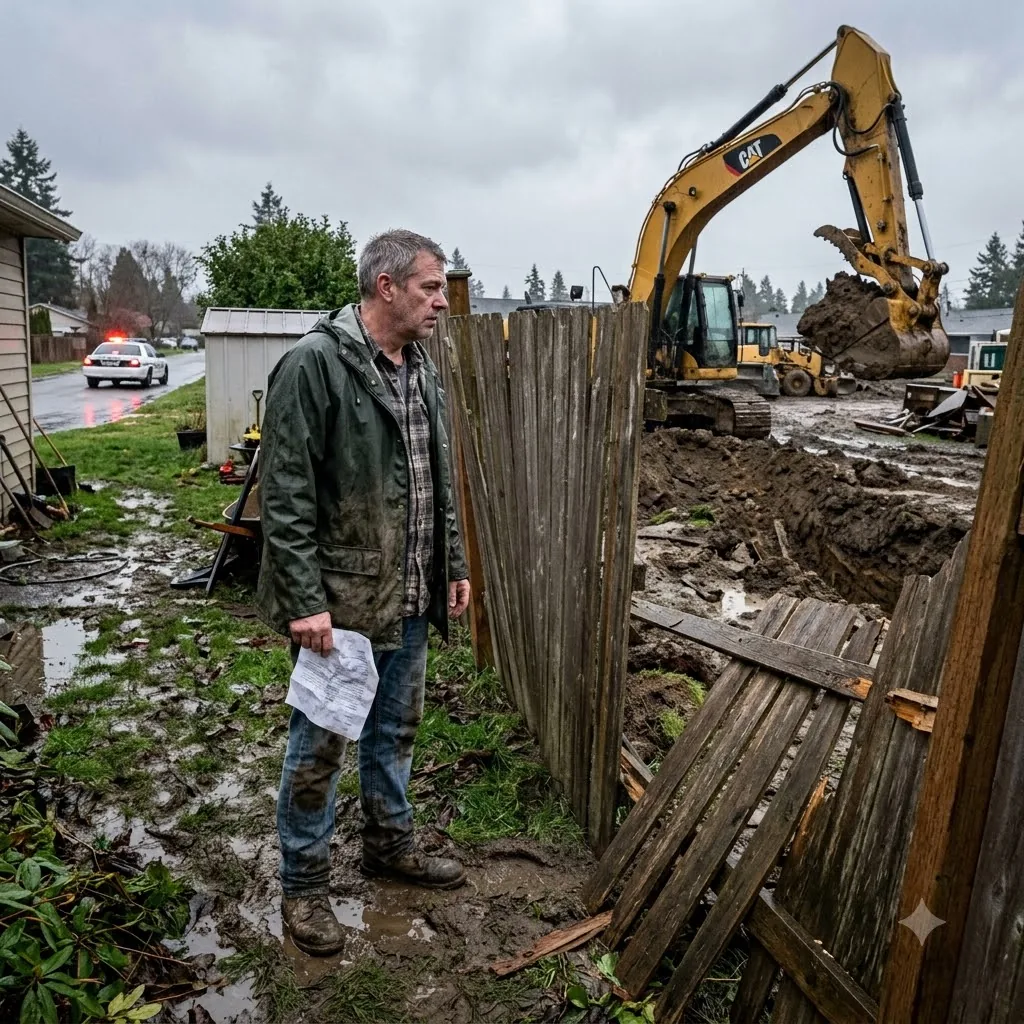
Marcus stood at the crumbling edge of his ruined yard, the crumpled insurance denial letter burning a hole in his back pocket. The roaring hiss of the pressurized pipe was the sound of a massive, undeniable truth surfacing from the dirt. He knew exactly what that blue-and-yellow-flagged casing was. Ten years ago, the city had run a high-pressure municipal bypass line through the rear of these coastal lots to handle floodwater overflow.
The municipal loophole-the fatal flaw in the neighbor’s aggressive fortress-clicked into place in Marcus’s mind. The city had issued expedited, rubber-stamped rebuilding permits after the hurricane to speed up recovery. Those emergency permits bypassed the standard, rigorous site inspections, relying entirely on the developer’s sworn plot plan. The neighbor had lied on his paperwork to maximize his mansion’s square footage, pushing his foundation trench deep into the city’s fifteen-foot no-build easement.
By city ordinance, any permanent structure built within that strict municipal setback didn’t just incur a fine; it permanently voided the property’s certificate of occupancy. If the city found out the neighbor’s trench crossed that invisible line, the entire multi-million-dollar project would be shut down, the lot rendered legally unbuildable.
The neighbor stared down into the pit, the realization washing over his face as he looked at the sheer volume of air blasting from the municipal casing. He spun toward the operator. “Bury it!”
“What?”
“Get back in the cab and dump the aggregate over it! Now!” the neighbor commanded, his voice cracking with panic. “Before the pressure drop pings the utility grid!”
“I’m not burying a live municipal main!” the operator yelled, backing away from the machine. “That’s a felony!”
Marcus watched the panic harden into something far more dangerous on the neighbor’s face. The man’s eyes darted from the hissing valve to the shattered remnants of Marcus’s oak stump, and finally to Marcus himself. The neighbor’s expression smoothed out, transforming from terrified to coldly calculating.
Down the street, the flashing amber lights of a white municipal utility truck reflected against the stagnant puddles in the road. The automated pressure alarm had already done its job.
The neighbor moved quickly. He grabbed a heavy steel pry bar from a stack of supplies and jammed it under a massive, jagged cluster of dead oak roots that the excavator had torn from Marcus’s yard. With a violent heave, the neighbor shoved the heavy root ball over the edge. It tumbled down the sheer dirt wall and crashed directly onto the broken valve, half-concealing the hissing pipe under the debris from Marcus’s property.
Marcus stepped forward, his boots sliding in the muck. “What are you doing?”
The neighbor didn’t answer. He just wiped his hands on his ruined shirt and walked out to the curb to meet the municipal truck as it parked. A city inspector in a high-visibility vest stepped out, carrying a ruggedized laptop and looking furiously at the mud-covered street.
Marcus waded through the thick mud toward the front of his property, his heart hammering against his ribs. Because of the police cruisers that had humiliated his family and shut down his barbecue just an hour earlier, Marcus’s yard looked like the site of a chaotic, drunken demolition. Discarded power tools, overturned tables, and storm debris were scattered everywhere.
The neighbor pointed a steady finger directly at Marcus. “Thank god you’re here,” the neighbor told the inspector, his voice entirely devoid of panic. “My crew was on a break. My neighbor here was trying to illegally yank a dead oak stump out of the ground with a winch. The root system tore through the trench wall and collapsed right onto the city line.”
Marcus stopped dead. “That’s a lie. Your excavator hit it.”
The inspector looked past the neighbor, eyeing the massive oak root resting squarely on top of the ruptured valve in the pit. Then he looked at the overturned beer coolers and the caution tape hanging from Marcus’s gutted house. The bias in the inspector’s eyes was instant and heavy.
“Do you have a permit for heavy debris removal on this lot, sir?” the inspector asked Marcus, his tone flat and authoritative.
“I didn’t touch that stump,” Marcus said, his voice tight. “He dug fifteen feet past the property line.”
“He’s unhinged,” the neighbor said quietly to the inspector, shaking his head. “The police were just here for a noise complaint. He’s been throwing things around all afternoon.”
The inspector tapped a few keys on his laptop, bringing up a municipal fee schedule. He glared at Marcus. “A severed high-pressure relief valve requires an emergency hazmat crew and a main-line shutdown. The repair bill for this is going to be upwards of forty thousand dollars, billed directly to the negligent property owner.”
Marcus felt the air leave his lungs. Forty thousand dollars. On top of the insurance denial, it was a death sentence for his home. He would be forced into foreclosure by the end of the month.
The inspector pulled a yellow carbon-copy citation pad from his vest. “I’m issuing a stop-work order on both lots and citing you for the repair costs,” he said to Marcus. “Sign here acknowledging liability, or I call the police back to escort you off the site while the emergency crews dig up your yard.”
Marcus looked at the yellow paper fluttering in the humid wind, then down into the trench where the neighbor’s massive yellow excavator was strategically parked, its steel treads perfectly covering the only remaining underground survey pin that could prove where the real property line was.