Story code: ST-000997
Part 4: The Weight of the Law
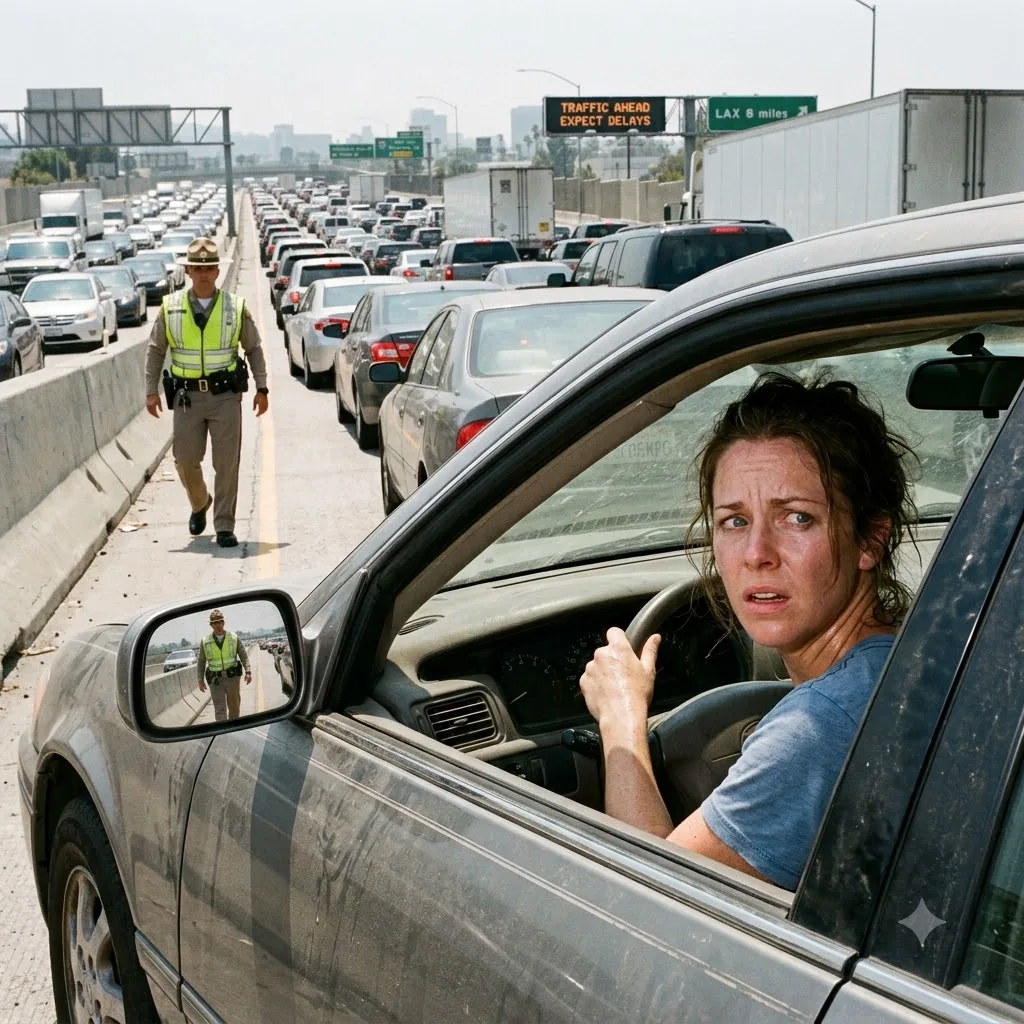
The heavy, blood-soaked towel slipped from Maria’s trembling fingers, slapping wetly onto the scorching asphalt. Her knees finally gave out. She didn’t hit the ground; she slumped hard against the heavy steel of her open car door, the searing pain in her pelvis pulling her down. She gasped for air, the 100-degree heat offering nothing but the suffocating scent of melting tar and her own copper-tinged blood.
The trooper stepped forward, his heavy boots crunching on the loose gravel. He didn’t reach for his taser. Instead, he reached past her, his mirrored sunglasses tracking the trail of blood directly into the cabin of her sedan. When Maria had lunged violently to push the door open, her purse had upended across the passenger seat. Lying face up, stark white against the faded cloth upholstery, was the thick discharge envelope from the Albuquerque reproductive clinic. The bold, blue out-of-state address was printed clearly across the top, right above the instructions for the pills she had taken the day before.
The trooper picked it up. His jaw tightened into a hard, unforgiving line as he read the letterhead.
“Albuquerque,” he said aloud. His voice dropped its confused, aggressive edge, replaced by a cold, procedural absolute. “You crossed state lines for a terminated pregnancy.”
Maria tried to reach for the envelope, but her arm felt like lead. “It’s a miscarriage,” she whispered, a desperate, hollow lie meant to shield her from the laws of Texas. “Please. Give it back.”
“The paperwork says otherwise, Ms. Torres,” he replied, folding the envelope and tucking it deliberately into his breast pocket. He keyed his shoulder microphone, his eyes never leaving her pale face. “Dispatch, upgrade EMS to priority. And send a transport unit. I have a female suspect in custody for violation of the state travel ban, actively hemorrhaging. I’ll need medical clearance before booking her into county.”
“No,” Maria choked out, the word tearing at her dry throat. “You can’t. I just lost my job. I have nothing.”
He didn’t argue. He simply grabbed her left wrist. The grip was strictly professional and entirely devoid of mercy. He spun her around, pressing her chest against the hot metal of the car roof. The sudden rotation sent a fresh, blinding tear of agony through her lower abdomen. Maria cried out, her legs buckling completely, but the trooper held her weight up by her biceps. The heavy, cold steel of his handcuffs bit brutally into her sweaty wrists, ratcheting tight and locking securely behind her back.
A massive shadow swept over the highway gridlock. The rhythmic, deafening chop of a news helicopter drowned out the idling semi-trucks. The climate protest had drawn the local affiliates, and now they had something infinitely more sensational than teenagers glued to the road. Maria squinted through the sweat stinging her eyes, spotting the belly-mounted camera pod of a chopper rotating to lock directly onto her.
A smaller local news drone buzzed ten yards away, hovering just over the interstate median, its green light blinking as it recorded. Maria was handcuffed against her sedan, stripped of all dignity, the dark, horrific stain on her jeans broadcasting live to every local news feed in the state. Gary would see it. Her landlord would see it. The state prosecutors would use the high-definition footage to build their felony case, a digital permanence to her absolute ruin.
Sirens wailed in a deafening crescendo as an ambulance finally bullied its way up the emergency lane. Paramedics spilled out, shoving through the standstill traffic with a heavy yellow stretcher. As they unspooled a blood pressure cuff and forcibly detached Maria from the side of her car to strap her down, she turned her heavy head.
The activist hadn’t rejoined his line. The trooper had left him behind on the dusty shoulder of the highway. The young man sat in the loose gravel, his knees pulled tight to his chest. Fifty yards away, his fellow protesters were being peacefully unglued and arrested, their voices rising in a unified, televised chant of defiance.
But this boy was entirely silent. He stared at the thick puddle of Maria’s blood baking into the asphalt, then looked up at her as the paramedics hoisted her stretcher into the air. Maria held his gaze, her wrists bound in steel, her life effectively over.
There was no defiance left in him, no righteous fire. His face was a mask of absolute, shattering devastation. He looked down at his own scraped, bleeding hand, as if realizing for the first time that his moral certainty had a body count. His blockade hadn’t saved the world; it had simply served her to the state on a silver platter.
The heavy ambulance doors slammed shut, cutting off the blinding Texas sun and plunging Maria into the sterile, expensive gloom of a system that now owned her entirely.