Story code: ST-001094
Part 4: The Weight of the Theft
The silence in the gymnasium wasn’t polite anymore. It was the heavy, suffocating silence of a room full of people realizing they had been used as props in a deeply ugly play. The soft, unified murmurs of approval had completely evaporated, leaving only the sharp hum of the projector’s overworked cooling fan and the faint, digital clicking of smartphone camera shutters.
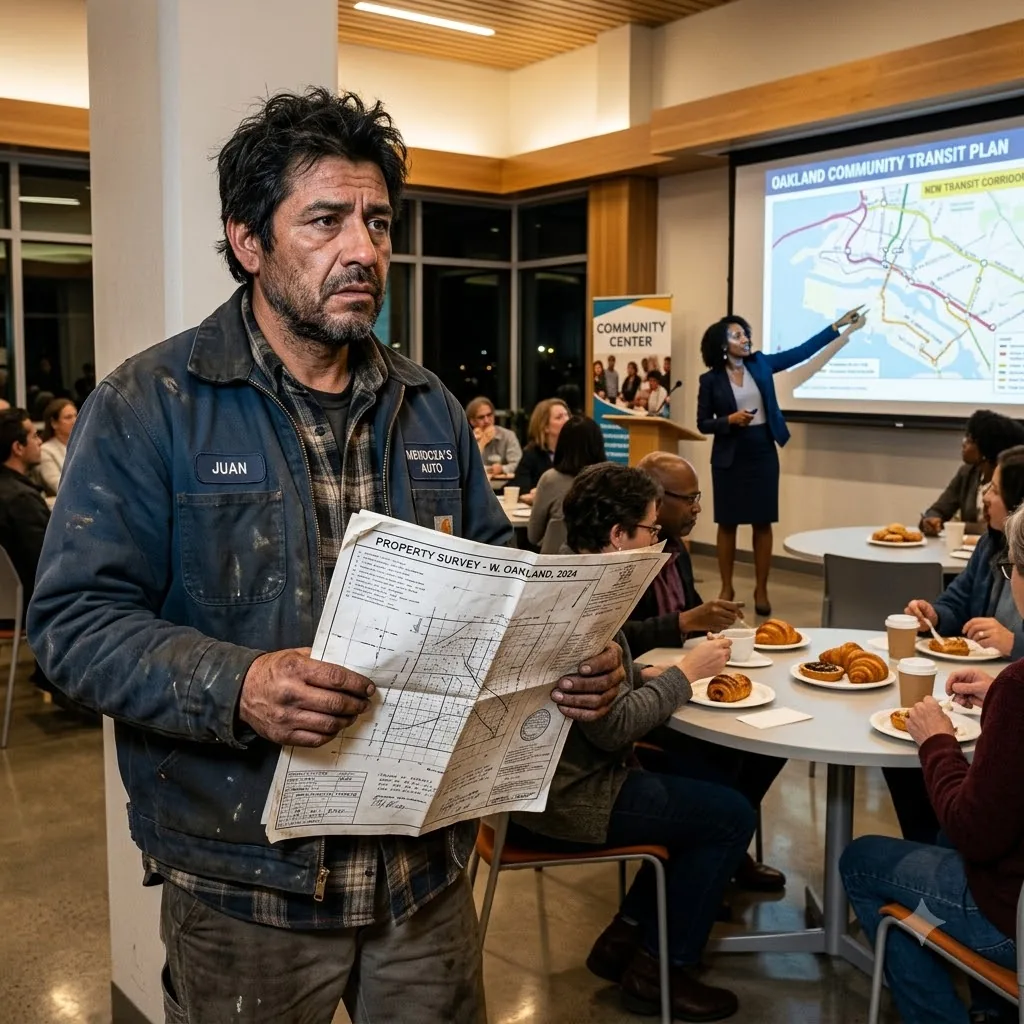
Claire remained frozen behind the podium. Her asymmetrical linen blazer suddenly looked less like a symbol of modern professionalism and more like a poorly fitted costume. She stared at the blinding white square on the wall where her hypocrisy was laid bare in harsh black elevation lines. She tried to speak, her mouth opening and closing, but the lapel mic only amplified the dry, clicking sound of her throat.
The man with the silver rings slowly lowered his compostable coffee cup to the floor. He didn’t look at Mateo, and he didn’t look at Claire. He just stared down at the polished hardwood, his shoulders hunched. The rest of the crowd followed suit, a wave of averted eyes and rigid postures. They weren’t rising up to defend Mateo. They weren’t going to march on City Hall for him. They were simply retreating into a defensive, embarrassed shell. The comfortable illusion that their artisanal bakery and birdbaths were built on environmental equity had been shattered. They now knew, with unarguable topographical proof, that their green spaces were bought with the deliberate destruction of someone else’s livelihood.
The security guard whose hand had been clamped onto Mateo’s shoulder slowly stepped back. He adjusted his heavy duty belt, his eyes flicking from the projected map to Mateo’s grease-stained shirt. The guard didn’t say a word, but the aggressive, municipal posture dissolved. He crossed his arms and took a distinct step away from the AV cart, tacitly refusing to act as Claire’s muscle any longer. The second guard simply mirrored the retreat, blending back into the shadows near the double doors.
Mateo stood in the center of the sudden vacuum. His chest still heaved from the adrenaline, but the frantic, trapped-animal panic was fading, replaced by a cold, leaden clarity.
He looked at the glaring projection one last time. The black zoning lines wrapped tightly around the Oakwood Heritage District, a perfect protective bubble funded by his grandfather’s ruin. He knew exactly what was going to happen next. Tomorrow, Claire would likely be placed on administrative leave. Maybe she would even be forced to resign in a few weeks when the recordings of this meeting circulated online. The city council would issue a grave, carefully worded statement about maintaining public trust.
But the highway was still coming.
The federal funds were already allocated. The environmental impact studies, fraudulent as they were, were already rubber-stamped. The sixty-day demolition notice in his hand was still a legally binding mandate. Exposing Claire didn’t reverse the eminent domain gears that had been turning in secret for five years. He had ripped the mask off the machine, but the machine was still going to crush his shop into dust.
Mateo reached over the document camera bed. He carefully pinched the corner of the thick, clear acetate overlay and lifted it off. The wall snapped back to the pastel, sweeping curve of artificial trees. The pastoral lie was restored, but no one in the room was looking at it anymore.
He folded the transparency and slid it back into his manila envelope, tucking the heavy, crumpled demolition notice in behind it. He wound the string closure tight.
“You’re going to tear down my shop,” Mateo said. His voice was low, devoid of the frantic shouting from minutes ago. It carried easily through the silent gymnasium. “In sixty days, your bulldozers are going to come, and you’re going to rip up the concrete my grandfather poured. You have the money, and you have the paper, and I can’t stop you.”
Claire finally looked at him. Her eyes were wide, wet with unsympathetic, panicked tears. She looked exactly like someone who had just lost everything that mattered to her-her reputation, her status, her comfortable progressive narrative.
“But you don’t get to call it healing anymore,” Mateo said, looking past her to the crowd of hand-knit cardigans and canvas tote bags. “You don’t get to pat yourselves on the back for planting trees over my family’s business. When you drive on that new artery, you’re going to know exactly why it’s on a hill. You’re going to know exactly what you paved over to keep the exhaust out of your backyards.”
He didn’t wait for a response. There was none to give. Mateo turned his back on the podium, the AV cart, and the blinding light of the projector. He walked back down the center aisle.
The crowd parted for him. People leaned away, pulling their knees in, entirely avoiding his gaze. The polite, invisible barrier of their civility was gone, replaced by the raw, uncomfortable reality of their own complicity. The heavy double doors at the back of the gymnasium swung open easily as Mateo pushed his shoulder against the crash bar.
He stepped out into the cool, damp night air. The scent of locally sourced lavender and honey muffins vanished, replaced by the familiar, comforting smell of exhaust fumes and wet asphalt. Mateo walked toward his rusted pickup truck in the parking lot. His hands were empty, his bank account was drained, and his shop was still condemned. He had sixty days to pack up three generations of sweat and grease. But as he unlocked his truck door and looked back at the community center, his jaw finally unclenched. He had lost the land, but he had forced them to carry the weight of the theft.