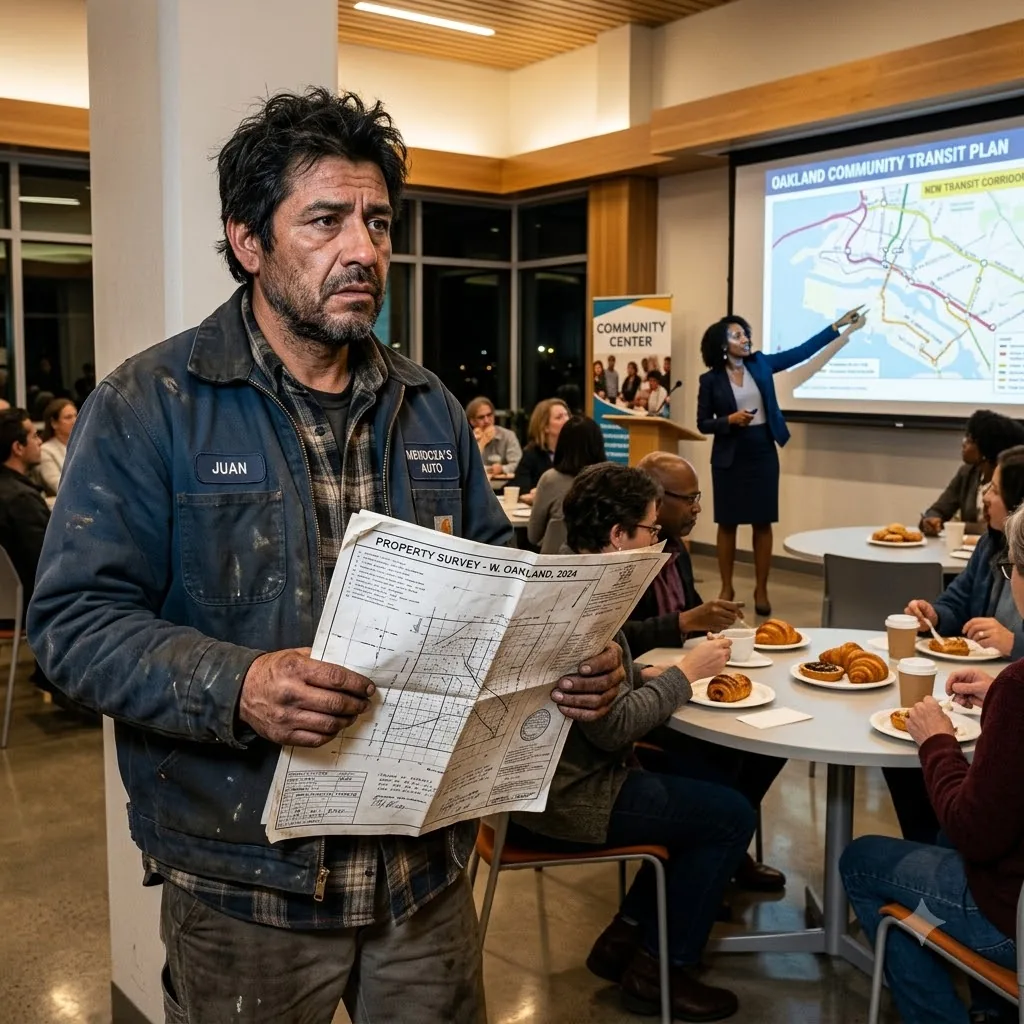
Story code: ST-001094
Part 3: The Overlay
The guard’s hand clamped down, thick fingers digging into the worn cotton of Mateo’s work shirt. Mateo didn’t pull away; he dropped his center of gravity, twisting his torso with the same violent torque he used to break rusted lug nuts loose. The guard’s grip slipped, fingers scrambling uselessly against the grease-slicked fabric. Mateo lunged forward, crashing his hips hard into the metal edge of the AV cart.
The cart lurched on its casters. The sleek presentation laptop skidded toward the edge, dangling dangerously by its power cord. Claire let out a sharp, uncurated gasp, her hands flying up to her chest as if Mateo were a bomb detonating in her safe space.
“Get him away from that!” she yelled, her lapel microphone amplifying the raw panic in her voice so it echoed harshly off the gymnasium rafters.
Mateo didn’t go for the laptop. His eyes were locked on the heavy, folding arm of the document camera bolted to the right side of the cart-a piece of dusty civic infrastructure largely ignored in the age of digital presentations. His calloused fingers found the main control panel on the projector base. He hammered the ‘Source’ button with the heel of his hand.
The blinding blue *NO SIGNAL* screen on the far wall vanished. The ceiling-mounted projector clicked, its internal mirrors shifting, and suddenly cast a stark, unforgiving square of pure white light from the document camera’s glass bed.
The second security guard was moving in from the left flank, reaching for the heavy zip-ties on his utility belt. “Sir, back away now, or you’re going out in cuffs!”
“Give me ten seconds,” Mateo growled, his breathing ragged, his chest heaving. “Just ten seconds to show you the equitable process!”
He snatched one of Claire’s glossy, tri-fold “Healing the Urban Fabric” brochures off the neat stack resting on the bottom shelf of the cart. He slammed it open onto the glowing glass bed of the document camera.
Instantly, the wall behind him was filled with the pastel, artificial trees and the sweeping, elegant green curve of the new transit artery. It was a masterpiece of corporate graphic design, engineered to look as natural as a river bending gently through a forest.
Mateo jammed his hand into the thick manila envelope containing his sixty-day demolition notice. He had spent three agonizing days down in the windowless basement of the municipal records office, squinting at microfiche and paying fifty dollars a page for certified survey copies. His fingers bypassed the legal threats and pulled out Exhibit F: a heavy, clear acetate transparency sheet.
The first guard grabbed Mateo’s shoulder again, yanking him backward with enough force to tear the collar of his shirt.
Mateo held his ground, his steel-toed boots biting into the floorboards. With his free hand, he slammed the transparent topological overlay directly on top of Claire’s glossy brochure on the camera bed.
The wall transformed.
Sharp, dense black elevation lines and municipal zoning borders snapped into focus, overlaying the soft pastel map. The sheer visual violence of the black lines cutting mercilessly across the green pastoral rendering drew a collective, involuntary breath from the room of recording smartphones.
“Look at it!” Mateo shouted, pointing his grease-stained finger at the camera bed. A massive, shadowy pointer finger appeared on the wall, stabbing at the projected map.
The crowd in their hand-knit cardigans and linen shirts leaned forward, squinting at the glaring contradiction.
“Look at the elevation lines!” Mateo’s voice was no longer a frantic defense; it was a furious prosecution. “A natural roadway follows the valley floor. The old industrial corridor is perfectly flat. But look at your beautiful green artery!”
His shadow-finger traced the pastel curve. Against the raw data of the topological overlay, the highway’s path suddenly looked absurd. Instead of following the natural flat basin, the green line took a violent, unnatural two-mile detour. It hooked sharply up a sixty-degree limestone grade, plowing directly through the dense, working-class grid of auto shops, bodegas, and laundromats, only to zig-zag needlessly back down into the valley two miles later.
It was an engineering nightmare. It made absolutely zero topographical sense.
“Why would you build a highway up a massive hill just to bring it back down?” Mateo asked, the adrenaline making his voice ring with brutal clarity. He didn’t wait for an answer. He moved his finger to the center of the massive, jagged detour-the exact space the highway was going two miles out of its way to perfectly skirt around.
The black zoning lines on his acetate overlay formed a neat, expansive circle right in the flat valley where the road should have gone.
“What is this parcel here?” Mateo demanded, staring directly at Claire over the blinding light of the AV cart.
Claire stood frozen behind the podium. The warm, modulated empathy was entirely gone from her face. Her skin was the color of old chalk. She looked at the wall, then at the floor, absolutely refusing to meet his eyes.
The man with the silver rings in the third row-the one who had warned Mateo about triggering people-squinted at the wall. “That’s the Oakwood Heritage District,” he said, his voice stripped of its patronizing softness, replaced by a slow, dawning realization.
“Oakwood Heritage District,” Mateo repeated, his chest heaving as the security guard’s grip on his shoulder went strangely slack. The guards, too, were looking up at the wall. “Average property value, two point five million dollars. Protected historic canopy trees. And…”
Mateo pulled a crumpled piece of paper from his pocket-the final sheet from his records dive. He didn’t put it on the camera. He just read it aloud, his rough voice cutting through the thick, absolute silence of the gymnasium.
“According to the public disclosure addendum of the Phase One Environmental Impact Study… Oakwood is the primary residence of our lead city planner, Claire.”
The silence in the room changed. It stopped being the tense, judgmental silence directed at a hostile mechanic, and became a heavy, suffocating vacuum pulling directly at the woman behind the podium.
Dozens of smartphone screens shifted. The glowing red recording dots pivoted slowly, smoothly, away from Mateo’s grease-stained shirt and leveled directly onto Claire’s asymmetrical linen blazer.
Mateo looked at her. Her jaw worked, but no words came out. There was no progressive terminology for this. There was no holistic integration metric that explained bankrupting a third-generation mechanic to keep the highway exhaust away from a city planner’s two-million-dollar historic colonial.
“You aren’t healing the urban fabric,” Mateo said softly, his voice echoing through the lapel mic she had forgotten to mute. “You’re just moving the bulldozers to my grandfather’s property line.”
Claire gripped the edges of the podium, her knuckles turning white. “Mateo,” she started, her voice thin, trembling, completely stripped of its professional armor. “The… the traffic flow metrics…”
She trailed off, her mouth hanging open. She had no slide for this. The polite bureaucracy was gone, replaced by the glaring, unarguable truth burned in black and white against the gymnasium wall.