Story code: ST-001207
Part 3: The Eviction
The rhythmic wail of police sirens bled through the clinic’s reinforced walls, a distant sound that grew louder with every agonizing pulse of Elias’s heart. His right arm, anchored sharply behind the bulletproof plexiglass, burned with a fierce, tearing pain. The steel track of the transaction slot bit deep into his bicep, but the physical agony was a necessary anchor. It kept the swirling, strobe-lit hallucinations of the desert at bay, tethering his fraying mind to the harsh fluorescent reality of the pharmacy waiting room.
Behind him, the older security guard kept a defensive distance, one hand hovering near his shoulder radio, warning the panicked patients to stay back. Elias ignored them. He ignored the flashing amber alarm light. His bloodshot eyes were fixed straight ahead, staring through the smudged plastic at the intake coordinator who had just sentenced him to a chemical hell.
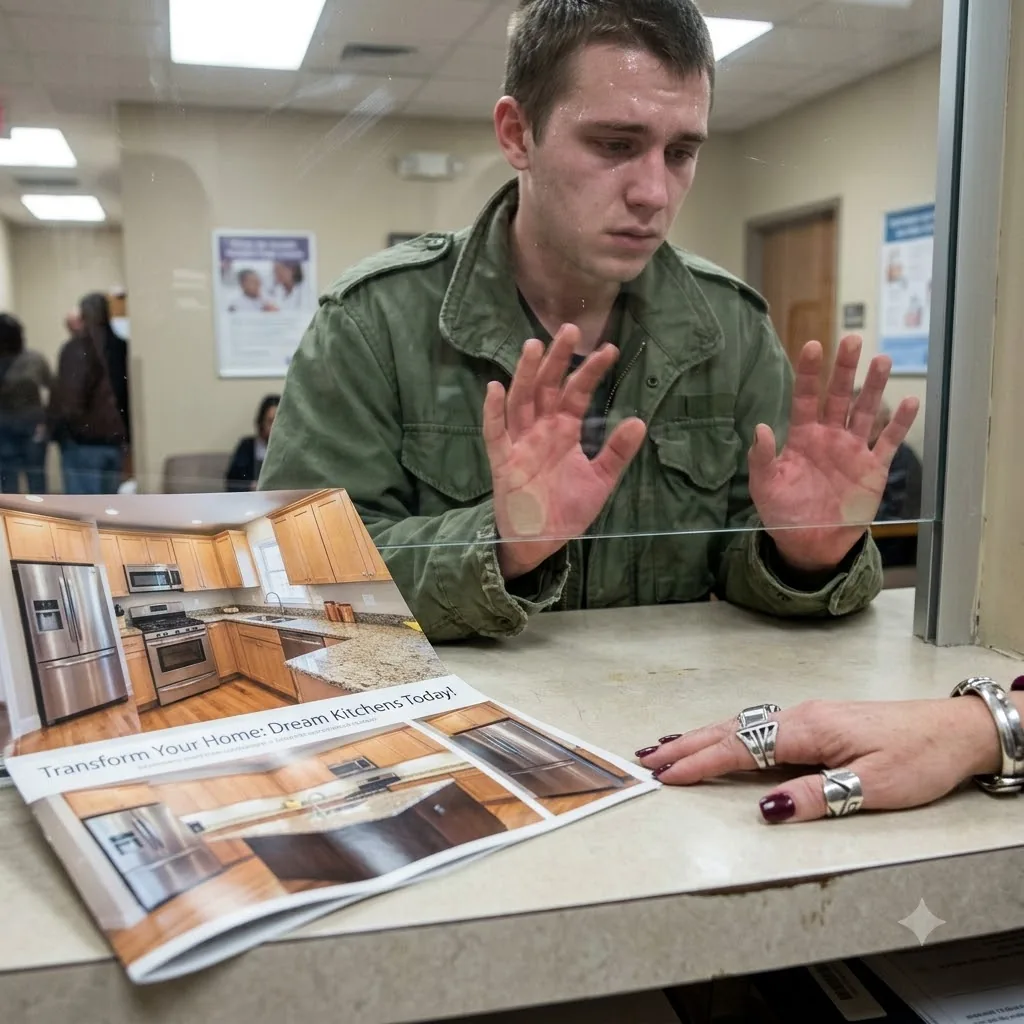
Brenda stood pressed against the grey metal filing cabinets, clutching her glossy remodeling magazine against her chest like a shield. Her breath came in short, shallow gasps. From his vantage point, trapped against the glass, Elias finally noticed the polished mahogany nameplate resting beside her monitor, free of the glare that had obscured it earlier.
*Brenda Sterling.*
The name echoed in the hollow, roaring cavern of his skull. It cut through the white noise of his withdrawal. Something cold and painfully sharp clicked into place.
Elias’s free left arm shook violently as he reached across his chest. His fingers, stiff and uncooperative, fumbled with the heavy brass buckle of the rotting canvas rucksack slung over his shoulder. The webbing was soaked with months of his sweat and engine oil. With a ragged exhale, he yanked the strap free, letting the bag slide off his back and crash heavily onto the narrow metal counter on his side of the barrier.
“Don’t move!” the younger guard barked from ten feet away. “Keep your left hand visible!”
Elias did not look back. He kept his left hand entirely visible. He grabbed the rusted zipper of the rucksack and wrenched it open. The smell of damp wool, stale truck-stop coffee, and unwashed despair wafted up, directly contesting the sterile, bleach-heavy air of the clinic.
He plunged his trembling left hand into the bag. He pulled out a crushed tin camp mug and a tangled knot of frayed charging cables. He jammed them through the remaining space in the transaction slot, dragging them past his trapped, bleeding right arm. They clattered harshly onto Brenda’s desk, knocking over a cup of pens.
“What are you doing?” Brenda shrieked, her voice pitching up in panic. “Stop it! You’re getting blood on my desk!”
Elias reached into the bag again. He pulled out a pair of stiff, mud-caked work gloves and a half-eaten sleeve of stale crackers. He shoved them through the gap. They tumbled onto her keyboard, sending a spray of dried dirt and cracker crumbs across her pristine workspace. Drops of blood from his scraped knuckles smeared across the white plastic keys.
He was methodically emptying his life onto her desk, piece by piece.
“Stop!” Brenda yelled, looking frantically toward the guards. “He’s throwing garbage at me! Get him out of there!”
“We can’t touch him without breaking his arm, ma’am,” the older guard called back nervously. “PD is pulling up now. Just step back.”
Elias dug his fingers into the very bottom of the rucksack. His hand brushed against a thick, moisture-warped manila folder. The tremors in his arm were so severe he almost dropped it, but he managed to pinch the damp cardboard between his thumb and index finger. He dragged the folder up and out of the bag.
He didn’t shove this through wildly. He laid the folder flat on the metal track. Using his thumb, he flipped it open. Inside was a stack of crisp, heavy-stock legal papers, the only things he had managed to keep relatively clean. He slid the top document through the slot. It glided over the lip and came to a stop directly on top of her open kitchen catalog, covering the photograph of the fifty-dollar-a-square-foot Carrara marble.
It was an eviction notice. Thirty days to vacate. Three months old.
Elias leaned his forehead against the cold plexiglass. He forced his lungs to expand, drawing in a jagged breath. The muscles in his neck strained as he focused his vision on the paper resting under the harsh overhead lights.
“Notice of Eviction,” Elias read aloud. His voice was a ruined, guttural scrape, barely louder than a whisper, yet it seemed to vibrate through the glass itself. “Property of Sterling Holdings, LLC.”
Brenda’s eyes darted from his trapped arm down to the document on her desk. The color rapidly drained from her face, leaving her heavy makeup looking like a mask painted on chalk. She lowered the magazine slightly.
“You,” Elias rasped, his jaw trembling as he fought through another wave of neurological misfires. He shifted his gaze from the paper to the mahogany block, and finally up to her horrified eyes. “Sterling Holdings. Managing Partner, Brenda Sterling.”
Brenda took a half-step forward, then froze. She stared down at the paper, her eyes locking onto the bold black signature at the bottom of the page.
“I…” Brenda started, her voice faltering. She swallowed hard, her throat bobbing. “That… that’s a corporate entity. I don’t handle the individual tenant notices. The management company handles the downtown complex.”
“You bought the building on 9th Street,” Elias said, the words heavy and deliberate, fighting past his chattering teeth. “You doubled the rent to flip the units. You threw me out.”
Brenda’s manicured hand gripped the edge of a filing cabinet. “Sir, I just process the paperwork here. The property management-”
“You evicted me,” Elias interrupted, his voice dropping into a dangerous, suffocating calm that completely defied his violently shaking body. “You took my apartment. You put me in a Ford F-150.”
He shifted his trapped right arm slightly, smearing a fresh streak of crimson across the metal track. The sirens outside suddenly cut off, signaling the arrival of the police, but the silence inside the clinic felt infinitely heavier.
“And now,” Elias whispered, staring through the glass at the woman who had traded his shelter for a farmhouse sink, “you won’t give me the medication I need to survive, because you say I don’t have a residential address.”
Brenda stared at the eviction notice resting on top of her luxury remodeling brochure. Her lips parted, but for the first time since Elias had approached the window, she had absolutely nothing to say.