Story code: ST-001207
Part 2: The Anchor
The red button clicked. It was not a loud sound, just a hollow plastic snap, but to Elias’s hyper-vigilant nervous system, it echoed through the clinic like a firing pin.
A second later, a shrill, pulsing alarm pierced the stale air of the waiting room. An amber strobe light mounted above the main double doors began to flash in a frantic, relentless rhythm. Every rotation of the light sent a sharp, agonizing spike through Elias’s optical nerves, slicing into the pounding pressure gathering at the base of his skull.
“I said step back,” Brenda’s voice barked through the circular speaker holes, stripped entirely of her previous lazy drawl. She rolled her ergonomic chair backward, clutching her headset to her chest.
Elias could not step back. The command simply failed to bridge the gap between his brain and his legs. His boots remained cemented to the faded linoleum. The violent tremors in his arms had escalated into full-body shudders, vibrating up his spine and rattling his teeth together. The clinic around him began to warp and distort. The harsh edges of the fluorescent lights bled into the ceiling tiles. The ambient shuffling of the waiting room dissolved into a deafening, continuous rush of white noise, reminiscent of a roaring aircraft engine. His mind was slipping, the jagged, suppressed memories fighting their way up through the cracks in his deteriorating chemical armor.
He desperately needed the medication. He needed the quiet chemical wall it built. Without it, the noise would never stop.
Heavy, rapid footsteps pounded against the floorboards behind him.
“Sir! Hands where we can see them. Step away from the partition!”
Elias did not turn his head. He kept his eyes locked on the empty transaction slot, focusing all his remaining willpower on maintaining his grip on the metal lip. If he let go, he would collapse. If he collapsed, they would drag him out to the pavement. If he ended up on the pavement, the hallucinations would completely consume him before nightfall.
“I need,” Elias forced the words through his locked jaw, the syllables grinding against each other. “The bridge. Three days. It is in the chart.”
“I am not going to tell you again!” the voice behind him shouted.
Brenda leaned toward her microphone, keeping a safe distance from the glass. “He’s refusing to leave. He doesn’t even have a residential address, he’s just a vagrant. Get him out of here.”
Elias felt the displacement of air before he felt the physical contact. A heavy hand clamped down on his left shoulder, the fingers digging sharply into his trapezius muscle, attempting to wrench him backward.
The touch acted as a live spark on a powder keg. Elias’s withdrawal-ravaged nervous system interpreted the sudden grab not as a security guard enforcing clinic policy, but as a lethal ambush. A flash of blinding, sun-scorched desert flooded his peripheral vision. The phantom smell of burning rubber and oxidized copper hijacked his sinuses, suffocating the sterile scent of industrial floor cleaner.
A primal, terrified groan tore out of Elias’s throat. He did not throw a punch-he knew, even through the dense haze of panic, that striking a guard meant a felony charge and an immediate jail cell where he would undeniably die. Instead, he made his body immovable. He dropped his center of gravity, pivoting his hips and twisting his heavy frame against the guard’s grip.
“He’s resisting! Watch his hands!” a second voice yelled.
The waiting room erupted into chaos. Plastic chairs scraped violently against the floor as patients scrambled backward to get out of the blast radius. A child started crying. Someone shouted a warning about a weapon, though Elias’s hands were entirely empty. The sheer volume of the public panic fed the roaring static in his head, amplifying the agonizing pressure behind his eyes.
“Get him off the glass!” the first guard commanded.
The hand on his shoulder pulled harder, hooking into the thick fabric of his jacket. Elias’s left hand slipped from the counter, his boots skidding an inch across the waxed floor. They were going to overpower him. They were going to throw him out into the street.
Desperation overrode reason. As the guards moved to secure his waist and drag him backward, Elias lunged forward. He flattened his right shoulder against the plexiglass and shoved his right arm straight into the narrow transaction slot.
He pushed his hand through the gap, forcing his wrist, then his forearm, and finally his elbow past the heavy steel track. The metal scraped a layer of skin off his knuckles and caught the sleeve of his thermal shirt, but he did not stop until his arm was buried up to the bicep. The moment his elbow cleared the barrier, he immediately bent his arm at a sharp ninety-degree angle, hooking his forearm vertically up behind the thick bulletproof plastic on Brenda’s side of the desk.
Brenda screamed, abandoning her chair entirely and scrambling backward against the gray metal filing cabinets. “He’s breaching the window! Get him out!”
The guards hauled backward on Elias’s torso.
Agony flared through Elias’s right arm as his humerus bone levered brutally against the unyielding steel frame of the transaction slot. His locked elbow caught the full, combined force of the guards’ pull. The plexiglass groaned under the sudden, immense strain.
“Stop!” the older guard yelled, instantly releasing Elias’s jacket. “Stop pulling! You’ll snap his arm in half!”
The younger guard let go, stumbling backward in shock.
Elias sagged against the barrier, his chest heaving, his breath fogging the glass. Sweat dripped from his eyelashes, stinging his eyes. His right arm was completely trapped, deliberately anchored behind the thick plexiglass. If they tried to drag him away now, they would shatter his arm against the steel track.
He turned his head slowly, his neck muscles spasming wildly. Through his blurred, strobe-lit vision, he saw the two security guards standing a few feet away, their hands hovering nervously over the black batons on their belts. Behind them, a dozen patients pressed against the far wall, their faces pale masks of fear and judgment. Cell phone camera lenses glared back at him like dozens of tiny, unblinking electronic eyes, recording a monster in the making.
“I am not leaving,” Elias whispered, though his ragged voice was completely drowned out by the flashing alarm.
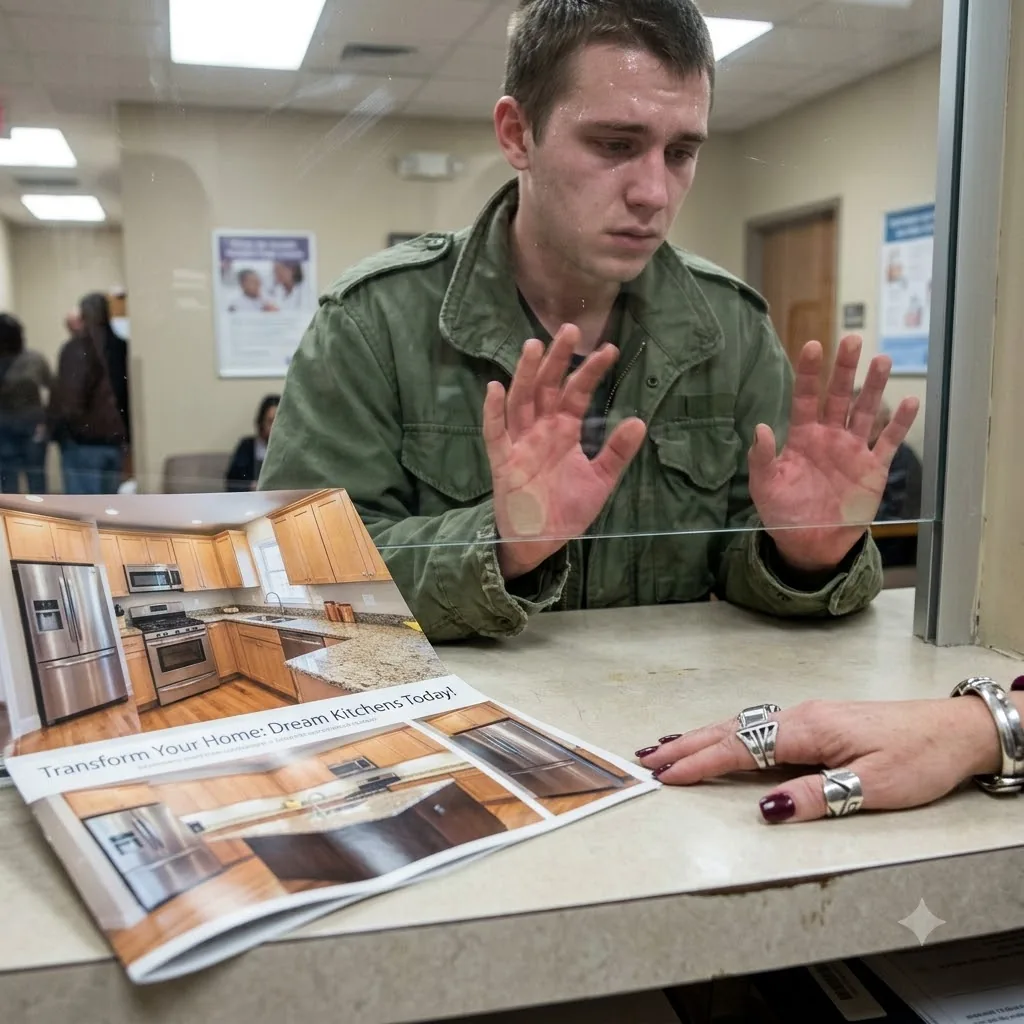
He looked through the smudged plastic at Brenda, who was clutching her remodeling magazine to her chest like a shield. Drops of blood from his scraped knuckles began to fall onto her pristine desk, landing just inches from her keyboard.
“Call the police,” the older guard said into his shoulder radio, his eyes locked on Elias’s trembling, trapped arm. “Tell them we have an EDP barricaded at the pharmacy intake. Tell them to bring the restraints.”
Elias closed his eyes as the roaring in his head finally drowned out the wailing alarm, leaving him entirely alone in a sea of crushing, absolute noise.