Story code: ST-001207
Part 4: The Residue
The heavy double doors of the clinic flew open with a violent crash, the sound cutting sharply through the roaring white noise in Elias’s head. Heavy tactical boots squeaked against the waxed linoleum, beating out the rapid, syncopated rhythm of approaching authority. Two federal police officers in dark blue uniforms swept into the waiting room, their hands resting cautiously on the heavy equipment belts strapped to their waists.
“Everyone back! Clear the center aisle!” the lead officer ordered, his voice carrying the booming, practiced cadence of crowd control.
Elias did not turn his head. His right arm was still wedged violently behind the bulletproof plexiglass, the steel track digging a deep, purple bruise into his bicep. The pain was the only thing keeping his fractured consciousness tethered to the room. If he let go, the blinding desert sun and the phantom smell of burning copper would swallow him whole, dragging him back into the nightmares he was desperately trying to outrun.
Through the smudged plastic, Elias watched Brenda. She was still frozen against the gray metal filing cabinets, her chest rising and falling in rapid, shallow jerks. Her eyes were locked onto the eviction notice resting on her desk, the bold black signature of her own corporate LLC damning her in plain ink.
“Sir,” the lead officer said, stopping three feet behind Elias. The officer’s tone was firm but remarkably calm, instantly recognizing the rigid, trembling posture of a veteran trapped in an escalating flashback. “I need you to slowly remove your arm from the partition. We’re not going to hurt you, but you need to disengage.”
Elias’s jaw locked. His left hand, still hovering over the rotting canvas rucksack on the counter, shook violently. His fingers brushed against a small, hard object buried deep in the side pocket. He closed his fist around it.
“Sir, listen to my voice,” the officer repeated, stepping one pace closer.
Around them, the dynamic of the waiting room suddenly shifted. The terrified civilians had already pressed themselves against the far walls to avoid the police, but a different group began to move forward. An older man leaning heavily on an aluminum cane, wearing a faded green 101st Airborne ballcap, stepped out of the corner. A younger woman with a carbon-fiber prosthetic leg stood up from her plastic chair. A heavy-set man in a worn mechanic’s jacket joined them.
They did not interfere with the police. They did not shout or raise their hands. They simply walked forward and formed a line parallel to the pharmacy counter. A dozen veterans, standing shoulder-to-shoulder, creating a silent, intimidating wall of solidarity behind Elias. Their eyes were fixed entirely on Brenda behind the glass.
Elias felt the shift in the air, a familiar, unspoken brotherhood that cut through the agonizing static of his withdrawal. He drew a ragged, shuddering breath, the air whistling through his clenched teeth.
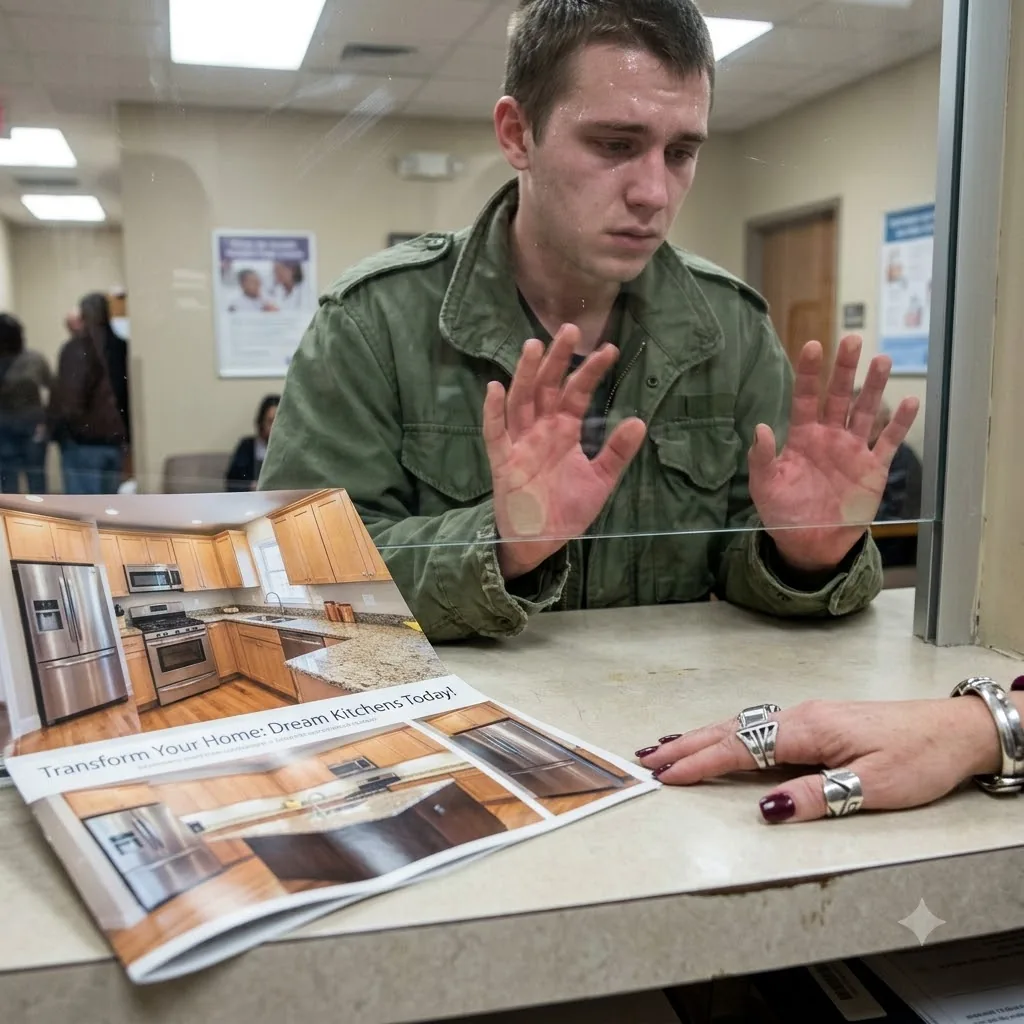
With his trembling left hand, Elias pulled the small, scuffed leather box from his bag. He slid it through the transaction slot. His blood-smeared knuckles knocked heavily against the metal track. The box tumbled onto Brenda’s desk, hitting her open remodeling catalog. The rusted hinge popped open on impact.
The gold profile of George Washington, set against deep purple enamel, gleamed under the harsh fluorescent lights. The Purple Heart rested directly on top of the glossy photograph of the fifty-dollar-a-square-foot Carrara marble, surrounded by the dried mud, stale cracker crumbs, and fresh smears of Elias’s blood.
Brenda let out a choked, muffled sob. She pressed her heavily ringed hand against her mouth, hyperventilating as she stared at the medal. Her manicured, comfortable reality was violently fracturing before Elias’s eyes, the undeniable weight of what she had done finally crashing through her willful ignorance. She had evicted a wounded man to fund a luxury kitchen renovation, and now she was weaponizing his homelessness to deny him the medicine he needed to survive the aftermath of his service.
“Okay, son. Time to let go,” the lead officer said softly, stepping up to Elias’s left side. “Let’s get the arm out.”
Elias closed his eyes. The desperate fight drained out of his spine all at once, his overtaxed muscles turning to water. He relaxed his shoulder, unhooking his elbow from behind the plexiglass. The officer caught his weight as he stumbled backward, gently but firmly guiding Elias’s shaking hands behind his back. The cold steel of handcuffs clicked around his wrists, a heavy, definitive sound that signaled the end of the standoff.
As the officers turned him around to guide him toward the exit, Elias looked back through the glass one last time.
Brenda had sunk slowly down the front of the filing cabinets, her knees giving out. She was trapped in her sterile glass box, gasping for air, entirely unable to look away from the debris field of Elias’s ruined life scattered across her pristine desk.
Elias was escorted down the center aisle. The wall of veterans did not move. They stood at attention, silent and unblinking, their eyes tracking the intake coordinator as Elias was marched out the double doors and into the freezing air, leaving nothing behind but the heavy, crushing silence of consequence.