Story code: ST-001211
Part 4: The Hush Money
Clara walked out of the civic center the exact same way she had walked in: entirely alone. The heavy, suffocating silence at her back didn’t break until the glass doors hissed shut behind her. She didn’t stick around to hear the panicked murmurs or the hurried scraping of folding chairs. She drove her dented sedan to the absolute edge of the county line, parked beneath a grove of scorched pines, and turned off the engine. She slept in the passenger seat that night, still wrapped in her flour-stiffened apron.
It took less than forty-eight hours for the viral momentum to shatter and pivot. The teenager in the hoodie had not put his phone away completely. He had recorded the audio of her tearing into the town and, more importantly, into Apex Mutual. Guilt was a powerful motivator, but displaced guilt was even stronger. The town of Oakhaven, desperate to scrub the stain of their own cruelty, redirected their unified, performative outrage directly at the corporate logo of the insurance giant.
By Thursday morning, Clara’s phone buzzed on the dashboard. It wasn’t the local adjuster who had coldly denied her claim. It was a regional vice president from Apex Mutual.
The man’s voice was as smooth and sterile as the civic center’s air conditioning. He didn’t apologize. He didn’t admit a single fault regarding the proximate cause loophole. Instead, he framed the call around “unprecedented community hardship” and “corporate goodwill.” The sudden wave of negative press was a nuisance, and Apex was prepared to make it go away. They offered Clara an immediate, one-time hardship grant of sixty thousand dollars.
It was barely ten percent of her original policy limit. It wouldn’t rebuild her brick-and-mortar bakery, nor would it replace the fifteen years of heavy commercial equipment lost in the ash.
But there was a catch, neatly outlined in the PDF contract he emailed her while she sat in the sweltering car. A strict non-disparagement clause. A full, legally binding release of all future claims regarding the fire. It was hush money, dressed up in a cheap suit of corporate empathy.
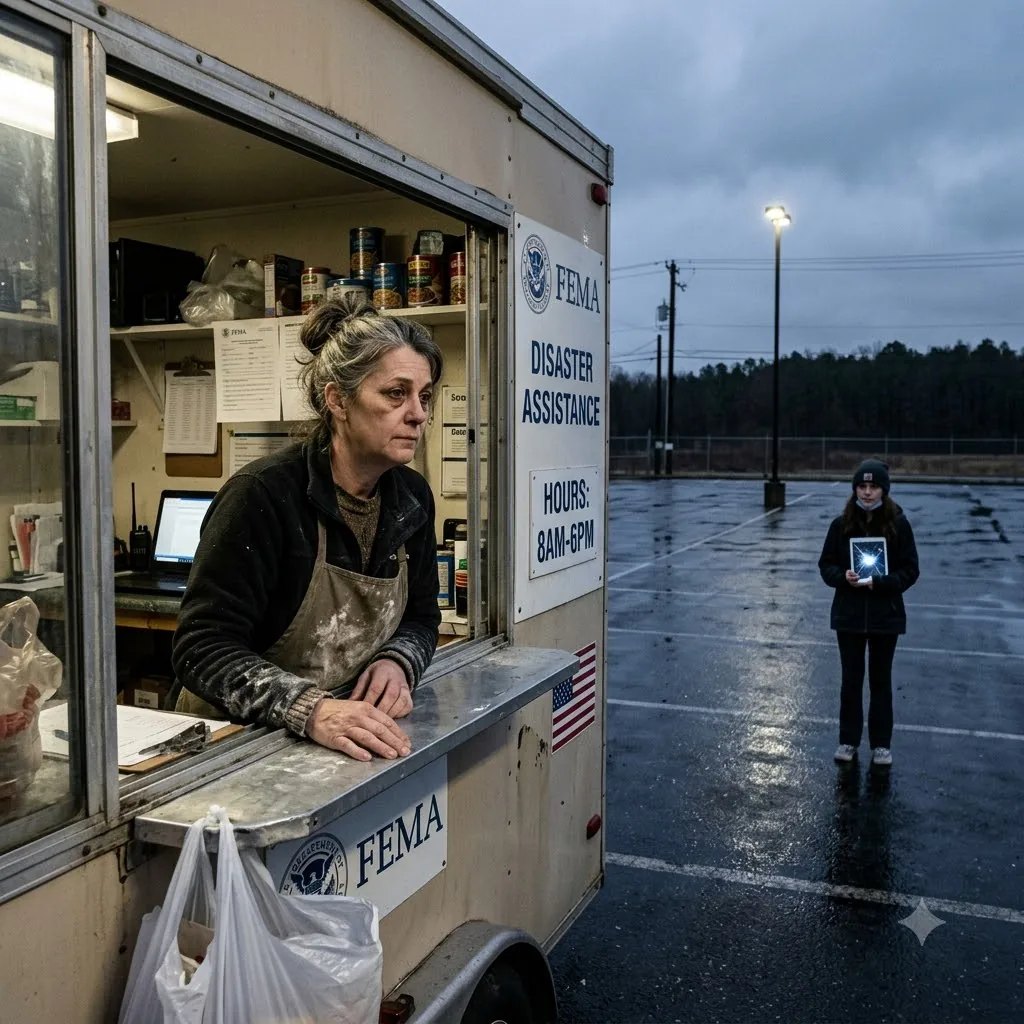
Clara stared at the absolute zero balance on her banking app. She looked at the sedan’s gas gauge hovering just above the red line, and then at the fading bruises on her hip from the cramped FEMA trailer. She didn’t fight. She didn’t have the energy or the capital to sue for the full half-million. She traced her signature on the phone screen with a flour-stained finger and hit send. The money cleared into her account by Friday afternoon.
With the funds secured and the town’s collective conscience in overdrive, the county miraculously found a way to “lose” the eviction notice. Mr. Henderson left a voicemail, his tone dripping with a nervous, overly friendly deference, offering her the spot in the dirt lot back without any further permit fees.
Clara deleted the voicemail.
Instead, she spent Saturday morning hitching the white FEMA trailer to a rented truck. She was ratcheting down the final nylon tow straps when a pristine silver Buick rolled slowly into the empty lot. The gravel crunched as Mrs. Gable parked and stepped out. She wasn’t carrying her fussy dog. She was holding a small, foil-wrapped plate and a handwritten card.
Mrs. Gable stopped a few feet away, her eyes darting nervously to the permanent soot smudge on the trailer’s display glass. “Clara,” she started, her voice thin and wavering. “We… the neighborhood association wanted to bring this by. To say how deeply sorry we are. We didn’t know about the insurance. That awful flyer just made everyone so angry, and we didn’t stop to-”
“You didn’t want to stop, Mrs. Gable,” Clara said. She didn’t raise her voice. The burning, adrenaline-fueled anger from the town hall had cooled into a dense, impenetrable ice. “It felt good to have someone to hate. It made the fire make sense.”
“Please,” the older woman whispered, holding out the plate with trembling hands. “We want you to stay. You’re a part of Oakhaven.”
Clara looked at the foil plate. A week ago, she would have done absolutely anything for this exact moment-the community rallying, the safety net finally catching her. Now, she just felt a hollow, crushing exhaustion.
“I was only a part of Oakhaven when I was serving you,” Clara said softly. She turned back to the winch, pulling the strap tight with a heavy metallic click. “Keep the plate. I don’t really have a sweet tooth anymore.”
Mrs. Gable stood in the dirt for a long time before retreating to her Buick. Clara didn’t watch her drive away.
Clara left Oakhaven that afternoon. She drove three towns over, far past the county line, and used the hush money to lease a tiny, windowless commercial kitchen in a gray concrete strip mall. There was no bright chalkboard menu. There were no smiling customer interactions, no community apps, and no free pastries for regulars. She baked in total isolation, selling wholesale goods to anonymous coffee shops down the highway. The work was brutally quiet, the bills were paid, and the massive convection ovens kept her warm. But the thick scent of cinnamon and caramelized sugar never felt like home again. It just smelled like survival.