Story code: ST-001211
Part 2: The Digital Ghost
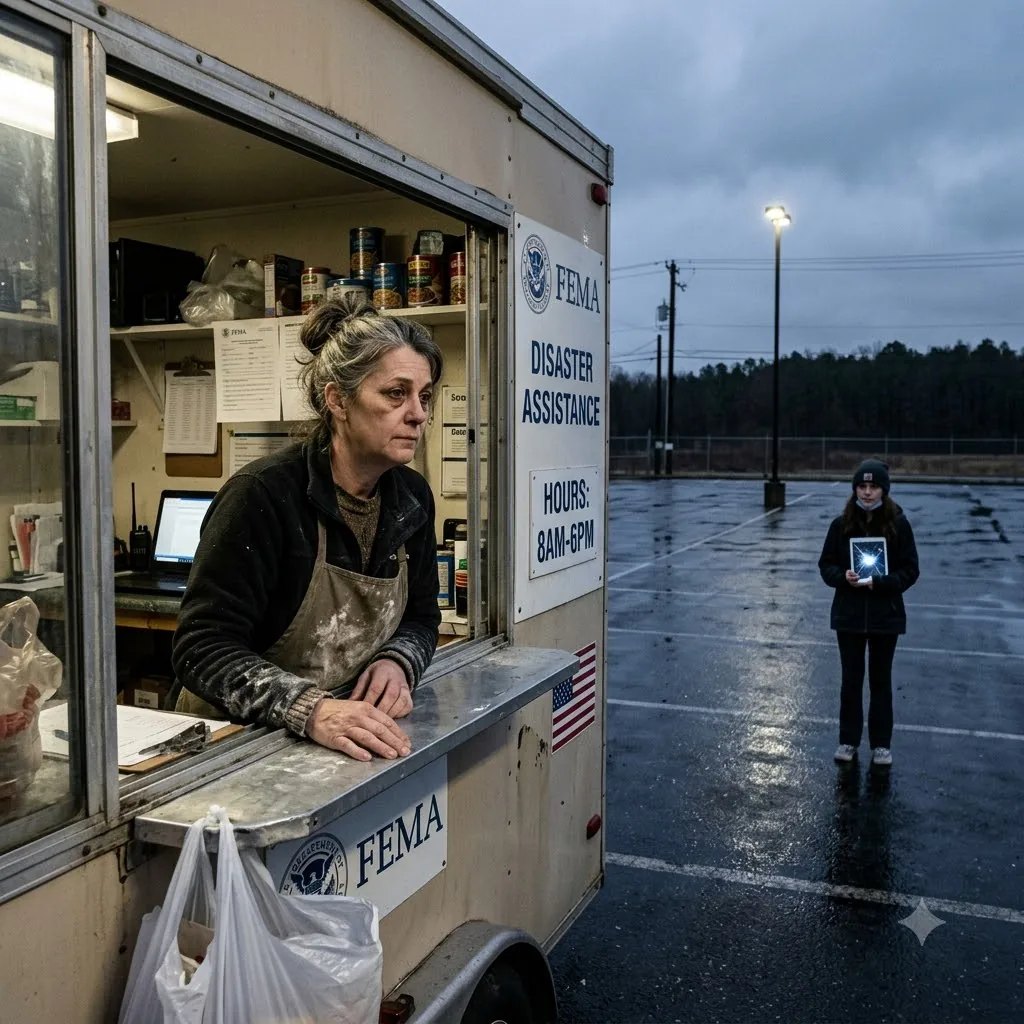
The crunch of the boy’s sneakers against the dry gravel was the only sound in the sprawling, empty lot. Clara watched him close the distance, her heart hammering a frantic rhythm against her ribs. She forced her muscles to relax, pinning a desperate, welcoming smile onto her face. The heat radiating off the aluminum sill of the service window was beginning to burn through the thin fabric of her apron, but she didn’t dare step back.
“Good morning,” Clara called out, her voice overly bright, trembling just enough at the edges to betray her panic. “Did you want to grab a coffee? First customer of the day gets a free pastry.”
The teenager stopped three feet from the window. He didn’t answer. He kept his phone raised, the camera lens staring at her like an unblinking, mechanical eye. With a sharp flick of his wrist, he slapped the top flyer onto the metal counter. The paper was a violently bright neon green, the black text slightly smeared from a cheap home printer.
Clara’s gaze dropped to the counter. The smile froze on her face, then slowly crumbled.
It was a blown-up screenshot of a social media post. Her own name and a decade-old profile picture sat at the top-a photo of her at twenty-two, her hair dyed much darker, wearing a sarcastic smirk she hadn’t worn in years.
Beneath the photo was a single, devastating sentence: *Honestly, this backward town is a suffocating trap. If the whole west side burned to the ground tomorrow, I wouldn’t even spit on it to put it out. I’d just buy graham crackers and marshmallows. Good riddance.*
The date stamp in the corner read exactly ten years and two months ago.
The air vanished from the cramped FEMA trailer. Clara gripped the edge of the counter to keep her knees from buckling. A sickening wave of vertigo washed over her as the memory surfaced through the fog of a decade. She had been young, furious after a screaming match with the local zoning board over her original bakery permits, and drunk on cheap wine. She had typed the angry, hyperbolic joke to what she thought was a private circle of friends, and deleted it the next morning in a haze of regret.
But the internet never actually forgot. A digital ghost had been waiting in the dark for ten years. And now, three weeks after a very real wildfire had literally reduced the entire west side of Oakhaven to gray ash, her old words had been weaponized.
“Enjoying the marshmallows, Clara?” the teenager asked, his voice cracking with adolescent indignation. He took a half-step closer, leaning in to capture her ashen face on his screen. “My aunt lost her house on Elm Street. Mr. Abernathy lost his hardware store.”
“I… you don’t understand,” Clara stammered, shaking her head. Her throat felt lined with sandpaper. “That was ten years ago. I was just a stupid kid who was mad at the zoning board. I didn’t mean it. I lost everything in the fire, too. My bakery. My apartment. My entire life.”
“Bull,” the kid scoffed, his upper lip curling in disgust. “Everybody knows commercial property insurance pays out the nose for total fire loss. You got a massive check from the adjusters, and now you’re out here playing dress-up in a FEMA trailer to milk people for sympathy tips. You think we’re stupid?”
Clara’s breath hitched. *They think I got paid.* The town didn’t just hate her for a tasteless, resurfaced joke; they hated her because they believed she was a wealthy, greedy hypocrite gloating over their shared tragedy.
“No, wait, I didn’t get anything!” Clara frantically dug into her apron pocket, her flour-dusted fingers trembling as she pulled out the crumpled insurance denial letter. She flattened it against the hot aluminum counter, trying to push it toward the camera lens. “Look! Read it! It’s a proximate cause exception. Because a power pole fell first, they claimed it was electrical. They denied my claim. I have two hundred dollars left to my name! I’m sleeping in my car!”
The boy didn’t even glance at the paper. He stepped back, keeping the camera focused on her frantic, pleading expression. “Save the fake legal garbage. The Oakhaven Watch group already warned everyone. We know what you are. We’re making sure nobody buys a single crumb from you. Have a great grand opening.”
He dropped the remaining stack of neon green flyers into the dirt, letting the morning breeze scatter them across the empty lot. Then he turned and jogged away, his phone still held high.
Clara stood paralyzed in the sweltering trailer. The sweet, heavy scent of caramelized cinnamon rolls-the inventory she had spent her absolute last dollar to bake-now smelled nauseatingly rich. She mechanically picked up her phone from the prep table and opened the local community app.
Her screen instantly froze under the weight of the notifications. There were over four hundred comments on a single thread. The top post was a picture of her white trailer, circled in bright red. *DON’T FEED THE VULTURE,* the caption read.
She scrolled, her vision blurring with tears. *Saw her laughing with the adjusters last week,* one neighbor lied. *Probably going to buy a condo in Florida with our misery,* wrote a regular customer who used to buy blueberry scones every Friday. *Someone should call the county and complain about her generator noise. Shut her down.*
The crunch of heavy tires on gravel pulled Clara’s eyes away from the screen. For a split second, a wild spark of hope flared in her chest. A customer. Someone who didn’t care about the internet.
But it wasn’t a customer. It was a white pickup truck bearing the blue seal of the County Planning Commission.
The truck parked diagonally across the lot. Mr. Henderson, the exhausted lot manager who had kindly expedited her temporary pop-up permit just last week, stepped out. He walked toward her window with heavy, dragging steps, a clipboard clutched tightly to his chest. He refused to look her in the eye, keeping his gaze firmly fixed on the scattering neon flyers in the dirt.
“Mr. Henderson, please,” Clara begged, her voice cracking as she leaned out the window. “I have fifty dozen rolls. I used the very last of my money. The insurance denied me. I have the letter right here.”
Henderson stopped ten feet away. He sighed, a sound of deep, bureaucratic defeat, and finally looked up. His expression was a mix of pity and rigid discomfort.
“I’m sorry, Clara,” he said, his voice flat. “The mayor’s office got flooded with calls this morning. People are claiming your propane tank is a fire hazard. Claiming you’re dumping grease in the runoff drains.”
“That’s a lie! I haven’t even served one person!”
“I know it’s a lie,” Henderson said softly, glancing nervously back toward the street as if worried someone was watching them. “But my boss’s hands are tied by the volume of complaints. They’re classifying you as a public nuisance and a safety risk. I’ve been ordered to revoke the temporary permit.”
Clara stared at him, the buzzing of the generator suddenly deafening in her ears. “Revoke it? For how long?”
“Permanently,” Henderson said, taking a step back toward his truck. “You need to shut the awning, Clara. I need this trailer towed off county property by sunset, or we’ll have to impound it.”