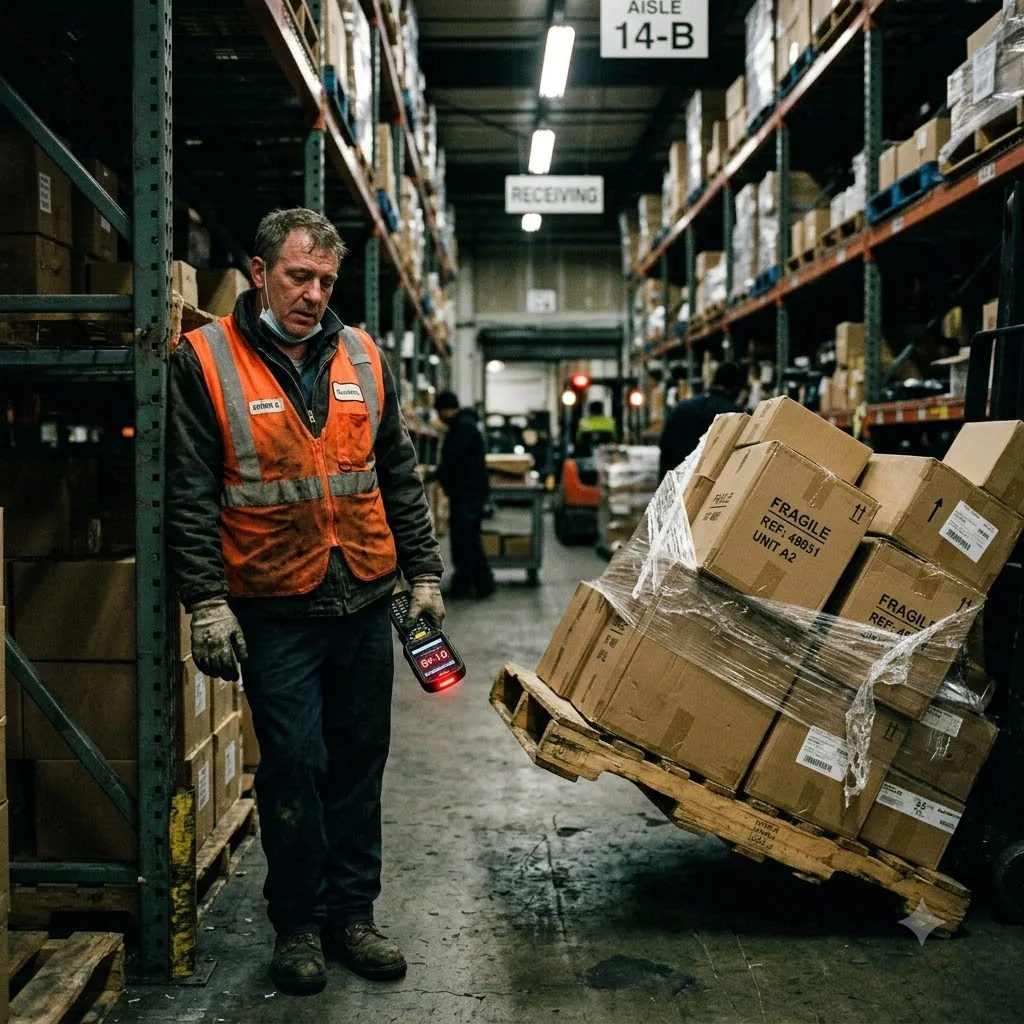
Story code: ST-001379
Part 2: The Purple Directive
Marcus stared at the oscillating green line. The ambient roar of the facility-the endless grind of overhead conveyor belts, the rhythmic beeping of reversing forklifts, the hydraulic hiss of robotic arms in the distant sorting bays-seemed to fade beneath the sharp, static-laced frequency emanating from his wrist.
The handheld scanner was supposed to be a closed system. It was a dumb terminal, receiving data payloads from the central server to display pick locations and timers, and sending back telemetry data: GPS coordinates, accelerometer readings, barcode scans. It didn’t have a two-way audio client. It wasn’t built for communication.
“Cat got your tongue, Marcus? Or did those two little capsules get stuck in your throat?”
Marcus scanned the cavernous ceiling. The black glass domes of the surveillance grid hung like clusters of spider eyes every fifty feet. Which one was looking at him? Which one had the optical zoom necessary to see the tiny amber bottle in the shadow of his hunched body?
“You can’t see me,” the voice said. The synthetic quality of the tiny speaker clipped the high frequencies, but the tone was undeniably human, dripping with calm amusement. The waveform on the screen spiked with each syllable. “But I can see you. I’m looking at a very high-resolution thermal overlay right now. Your core temperature spiked two seconds before you kicked the pallet. A classic adrenaline surge. It was premeditated. You planned the accident.”
Marcus swallowed hard. His vocal cords felt like dry sandpaper. He brought his forearm closer to his mouth, terrified that speaking into the device would somehow trigger a secondary alarm. “Who are you?” he whispered.
“Someone who appreciates a creative workaround,” the voice replied. “The automated system flagged your little tumble as a Class-3 Hazard. Standard protocol. It froze your timer and alerted a floor manager. But I intercept the manual review queues before they hit Human Resources. I like to see what the algorithms miss. And they missed a lot here, didn’t they?”
The serrated pain in Marcus’s lower abdomen gave another vicious, twisting spike. The medication usually took twenty minutes to dissolve in his stomach and begin blocking the nerve receptors. He squeezed his eyes shut, leaning his weight against an intact fifty-pound bag of water softener salt.
If Human Resources saw the raw footage, he was terminated. Gross misconduct. Zero tolerance. The separation of employment would be processed automatically, and his health insurance would be severed by midnight. The surgery he needed next month-the one keeping the necrosis from spreading through his bowel-would vanish. He would be dead within a year.
“Please,” Marcus said, his voice cracking. He hated the pathetic sound of it, but survival overrode pride. “I just needed a minute. The pick timer… it doesn’t account for-”
“I know about your timer, Marcus. I know your rolling average pick rate is hovering at 94.2%. I know you have an undisclosed chronic medical condition that you’ve been hiding during your pre-shift biometric screenings. And I know you just committed a fireable offense to illegally self-medicate on the active warehouse floor.” The voice paused, letting the silence hang heavy over the radio link. “But I haven’t pressed the ‘Submit’ button on this violation report. Yet.”
Marcus opened his eyes. The green waveform pulsed gently in the darkness of the screen. “What do you want from me?”
“You demonstrated initiative. You understand the camera blind spots. You know how to manipulate the sensors without triggering an immediate localized lockdown,” the voice said smoothly. “I have a logistical problem. A discrepancy in inventory that needs to be… relocated. Without the central system noticing.”
“I’m just a Tier 1 picker,” Marcus breathed, shaking his head. “I don’t have clearance for anything outside the bulk aisles. If I go off-route, the floor sensors will flag me.”
“You have precisely forty-five seconds before Supervisor Reynolds turns his electric cart down Aisle 402,” the voice interrupted, the tone hardening. “I am watching his GPS beacon on the tracker. If he sees you looking like this, and my incident report hits his tablet, facility security will escort you to the perimeter gates before your shift ends.”
Marcus scrambled up, his injured leg protesting loudly. He grabbed the torn blue plastic of the salt bag, frantically trying to heave the fifty pounds of dead weight back onto the pallet. Coarse white crystals poured onto the concrete, sounding like rain.
“Leave it,” the voice commanded. “It needs to look like a genuine structural failure. Sit back down. Bleed on the floor a little if you have to.”
Marcus hesitated, then dropped the torn bag. He sank back down to the concrete, pulling his knees up to his chest. His heart hammered violently against his ribs.
“Here is the deal, Marcus. You are going to do exactly what I tell you, when I tell you. If you comply, this footage degrades into a corrupted data file, lost in the server purge. If you refuse, or if you tell Reynolds one word about this conversation, I hit submit. Do we have an agreement?”
Thirty seconds. The faint, high-pitched whine of an electric cart motor echoed from the main cross-aisle.
Marcus stared at the scanner. The device that had chained him, whipped him with dual-motor vibrations, and timed his bathroom breaks to the exact second had now become an instrument of blackmail. He was trapped between an unfeeling algorithm that would fire him for being sick, and an unseen human who was turning him into a thief.
“Yes,” Marcus rasped. “Yes, I agree.”
“Excellent,” the voice said. “Look miserable. It shouldn’t be hard.”
The green waveform vanished instantly. The screen flashed black, then immediately reverted to the bright, glaring yellow warning: *HAZARD PROTOCOL INITIATED – STAND BY*.
Ten seconds later, the flashing amber strobe light of a supervisor’s cart rounded the corner of Bay 42. Reynolds, a man who looked ten years younger than Marcus but carried the exhausted, hollow-eyed authority of a warehouse middle manager, parked the cart and stepped out, swiping his ruggedized tablet.
“Christ, Marcus,” Reynolds muttered, looking at the spilled mountain of salt. “You okay? The system threw a heavy-impact hazard alert.”
“Tripped,” Marcus lied, his voice trembling-partly from the lingering physical agony, mostly from the adrenaline spike. “The stack was loaded off-center by the night shift. Bag caught the toe of my boot.”
Reynolds sighed heavily, tapping his screen without looking at Marcus. “Yeah, night shift has been rushing the pallets. You need a pass to the clinic?”
“No. No, I’m okay. Just rolled my ankle a bit. I can keep picking.”
Reynolds looked at him critically for a second, then reached down and swiped his physical RFID manager card directly over Marcus’s wrist scanner. The scanner let out a sharp beep. The yellow screen cleared.
“Alright. I’ll get the automated sweepers to clear this aisle. Be careful. One more safety ding this quarter and the algorithm is going to put you on mandatory unpaid probation.”
“Understood,” Marcus said.
Reynolds climbed back into his cart and drove away, the amber strobe fading into the labyrinth of cardboard.
Marcus waited until the cart turned the far corner. He looked down at his scanner, expecting the familiar green countdown for his next task in the bulk water aisle.
Instead, the screen was a solid, deep purple-a color code Marcus had never seen in his three years at the facility. Text scrolled across the display, bypassing the standard picking software entirely.
*NEW ROUTING DIRECTIVE.*
*DESTINATION: SECTOR 7 – HIGH-VALUE SECURE CAGE.*
*PICK WINDOW: 4 MINUTES.*
*FAILURE IS NOT AN OPTION, MARCUS.*
The dual-motor vibrated violently against his forearm, and a new, blood-red countdown timer began to tick down from 4:00.