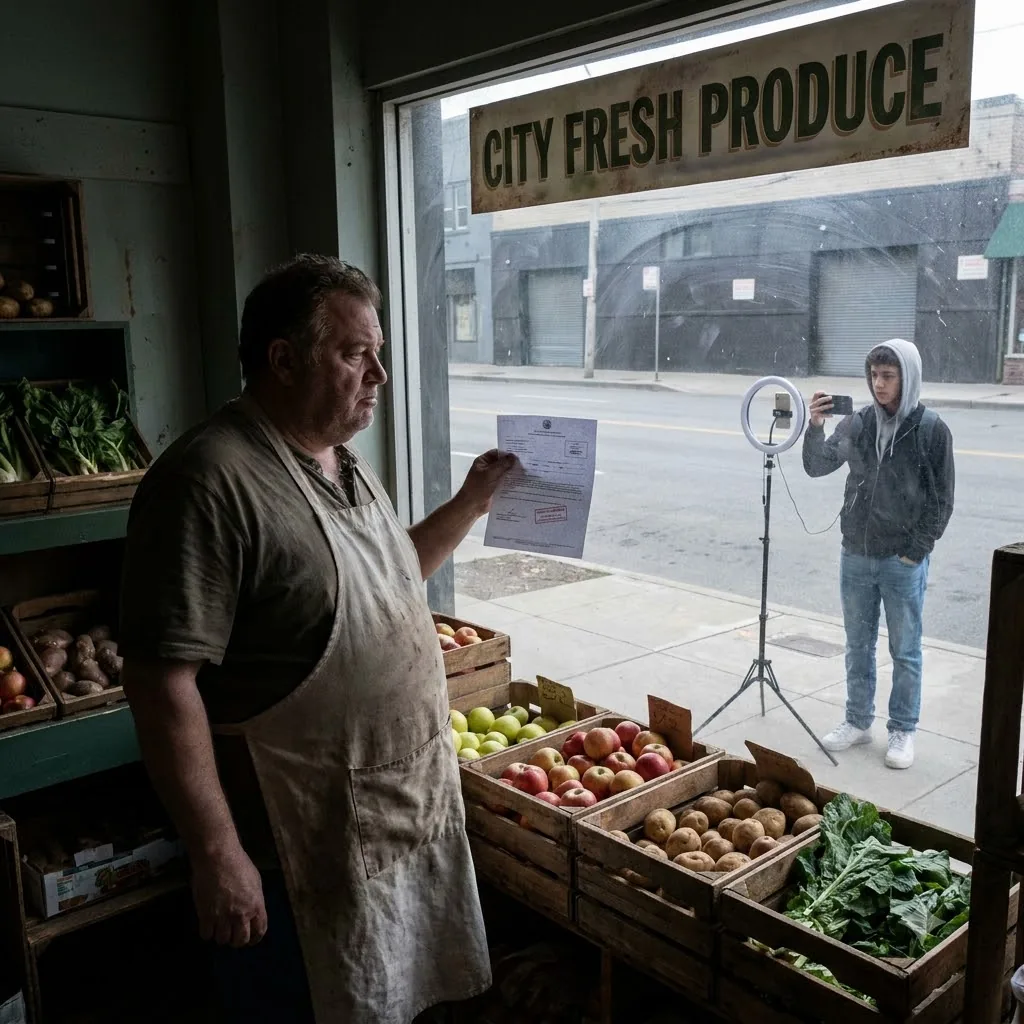
Story code: ST-000030
Part 3: The Ghost of Tenth Avenue
Marcus lunged forward, grabbing the thick nylon shoulder strap of the boy’s tactical vest. The fabric felt cheap and stiff, digging roughly into his palm. “Move!” Marcus barked, violently yanking the teenager toward the heavy steel loading door of the pantry. “Get inside before the cruisers block the intersection.”
The boy stumbled, his heavy black boots tangling over the crushed oranges slicking the concrete. He was entirely paralyzed by the approaching wail of the police sirens, his weapon dangling uselessly at his side. Marcus reached into his pocket for the heavy ring of brass keys to unlock the deadbolt, keeping his body positioned between the teenager and the open street.
A deafening, high-pitched screech of tires tore through the muggy air, completely drowning out the distant police sirens.
It wasn’t a patrol car. A battered, matte-black Dodge Charger violently hopped the curb, its undercarriage violently scraping against the concrete before it slammed on the brakes. The vehicle skidded to a halt at a severe angle, completely blocking the alley’s narrow exit to the avenue. The smell of burning rubber and hot asphalt instantly filled the tight space between the brick walls.
Marcus froze, the keys biting sharply into his clenched fist. The boy behind him let out a sharp, terrified gasp, frantically scrambling backward until his spine slammed hard against the pantry’s brick exterior.
The Charger’s rear windows slid down with a smooth, mechanical hum.
Three dull, black steel gun barrels instantly protruded from the shadowed interior. Two were handguns with extended magazines; the third was a short-barreled rifle. They didn’t sweep the alley looking for targets. They locked instantly onto the glowing white ring light of the tripod, and then directly onto the boy trembling beside it.
Marcus understood instantly. The live stream. The boy had been broadcasting his exact coordinates to the entire city, desperate to prove how tough he was on enemy territory. The rival gang hadn’t needed to hunt him down; they had simply followed the digital map straight to his makeshift stage.
“Light him up!” a muffled voice screamed from the driver’s seat of the Charger.
The lasers activated, casting bright green dots that danced erratically across the boy’s tactical vest. The teenager didn’t raise his own weapon. He didn’t shout a defiant lyric. He dropped to his knees, dropping his gun onto the dirty concrete with a heavy metallic clatter, crossing his arms over his face in an instinctual, utterly helpless brace for death.
Marcus didn’t think about his newly acquired zoning permit. He didn’t think about the eight grueling months of city council meetings, the endless background checks, or the smiling neighborhood organizer he had spent the last twenty years meticulously building.
He let that man die in a fraction of a second.
Marcus took one massive, deliberate step sideways, placing his broad chest directly in the path of the three gun barrels.
He didn’t raise his hands. He didn’t shout for peace. He squared his shoulders, dropped his center of gravity, and let his eyes go completely dead. He resurrected the cold, unyielding phantom of the man he used to be-the man who had run these exact blocks two decades ago with a reputation so violently heavy it had taken ten years in a federal penitentiary to burn it off.
He walked straight toward the idling Charger.
“Hey!” one of the shooters in the back seat yelled, his finger tightening on the trigger. “Move, old man, or you get it too!”
Marcus didn’t stop. He walked until he was standing five feet from the rear door, looking directly into the dark tint of the cabin. The green laser sights flickered off the cowering boy and hit Marcus’s chest, illuminating the faded cotton of his shirt.
“You’re going to shoot me on my own block?” Marcus’s voice was barely above a whisper, but it carried a gravelly, resonant weight that cut straight through the low rumble of the car’s exhaust. There was no fear in his tone. Only the terrifying, absolute certainty of a predator demanding a reason not to kill.
The front passenger leaned forward, squinting through the muggy, sunlit air to get a better look at the massive man blocking their execution. The passenger was older, his face scarred and hardened. His eyes widened, locking onto the distinct, jagged scar running down the left side of Marcus’s jaw.
“Hold up,” the passenger hissed, slamming his hand down on the driver’s arm. “Hold up, don’t shoot!”
“What are you doing? He’s right there!” the teenager in the back yelled, trying to adjust his aim around Marcus’s torso.
“I said put it down!” the passenger roared, knocking the rifle barrel upward. He looked back at Marcus, his face completely drained of color. “That’s Marcus. That’s the Ghost of Tenth Avenue. You want to start a war with him?”
Marcus stood perfectly still, the green lasers sliding off his chest as the guns nervously dipped toward the floorboards. He let the silence stretch, forcing the men in the car to feel the crushing, suffocating weight of his resurrected identity. He was daring them to cross a line they had only heard about in whispered neighborhood legends.
The wail of the police sirens suddenly crested the block, bouncing violently off the tall brownstones. The cops were less than ten seconds away.
“We’re out, we’re out!” the driver panicked, slamming the gearshift into reverse. The Charger’s tires spun frantically, spitting crushed gravel and garbage into the air before the car swerved backward into the avenue, tearing away down the street and disappearing around the corner.
Marcus let out a slow, controlled breath. The heavy, suffocating mantle of the street enforcer slipped away, replaced instantly by the frantic urgency of the pantry manager. He turned back toward the alley.
“They’re gone,” Marcus said, quickly scooping up his dropped keys. He reached down to grab the boy by the shoulder. “The police are turning the corner right now. Get up and get inside.”
The boy didn’t take the offered hand.
He was staring past Marcus, his wide, terrified eyes locked on the glowing ring light of his phone. The screen was rapidly scrolling with thousands of real-time comments. Emojis of crying, laughing faces and trash cans flooded the chat. His audience had just watched their ruthless, untouchable drill rapper drop his weapon and cower in the dirt, only to be saved by the intimidating stare of an older man.
The digital crowd was tearing his carefully constructed, lethal persona to bloody shreds. The humiliation radiating from the boy was palpable, burning hotter than the muggy morning air.
Slowly, the teenager reached down and picked up the heavy black handgun from the concrete.
“Put that away, son,” Marcus warned, his voice softening, recognizing the dangerous, volatile shift in the boy’s posture. “You’re safe. Let’s get inside.”
“Don’t call me son,” the boy whispered. His voice was shaking, but not from fear anymore. The flushed, embarrassed red of his cheeks was clearly visible through the eyeholes of the ski mask.
He raised the weapon, locking his elbows. The barrel stopped shaking. The boy pointed the cold muzzle directly at the bridge of Marcus’s nose, his finger sliding aggressively inside the trigger guard. The lie of his hardened street persona had been shattered, and in its place was something far more dangerous: a deeply humiliated child desperate to prove he wasn’t weak.