Story code: ST-000030
Part 2: The Weight of the Metal
The ring light burned against Marcus’s palm, the harsh LED bulbs radiating a surprising amount of heat. For a split second, the only sound was the distorted, booming bass of the portable speaker vibrating against the brick walls. Then, one of the teens in the background scrambled and violently yanked the auxiliary cord. The sudden silence in the narrow alley was deafening.
The main rapper took half a heartbeat to realize his live feed was staring at the creases of a man’s palm. He yanked the tripod back, the metal legs scraping harshly against the concrete with a sound like tearing metal.
“The hell is your problem?” the teenager barked. His voice was muffled by the thick black ski mask, but it cracked on the last syllable-a sharp betrayal of his actual age. Beneath the bulky tactical gear and the aggressive posture, he was barely sixteen.
But the gun was ageless. And it was now leveled directly at Marcus’s chest.
Marcus kept his hands up, visible, pulling his right hand slowly away from the camera lens. He kept his eyes locked on the teenager’s dark pupils, barely visible through the frayed eyeholes of the mask. The boy’s breathing was erratic, his chest heaving under the heavy vest.
“You need to pack up and leave,” Marcus said. His voice was deliberately steady, pitched low to avoid triggering a spike in the boy’s adrenaline. “Right now.”
“You don’t run this block!” one of the flanking boys shouted, stepping forward to close the gap. He kicked a wooden crate of sweet potatoes. The flimsy wood splintered, sending the heavy, orange tubers rolling into the dirty, oil-slicked puddle near the storm drain. “We’re shooting a video, old man. Back off before you get smoked.”
Marcus ignored the secondary kid, keeping his focus entirely on the heavy black steel in the main rapper’s hand. The muzzle wobbled slightly in the muggy air. The boy’s finger was inside the trigger guard, resting precariously against the curved metal. A single flinch, a sudden noise, and the tension in that finger would snap.
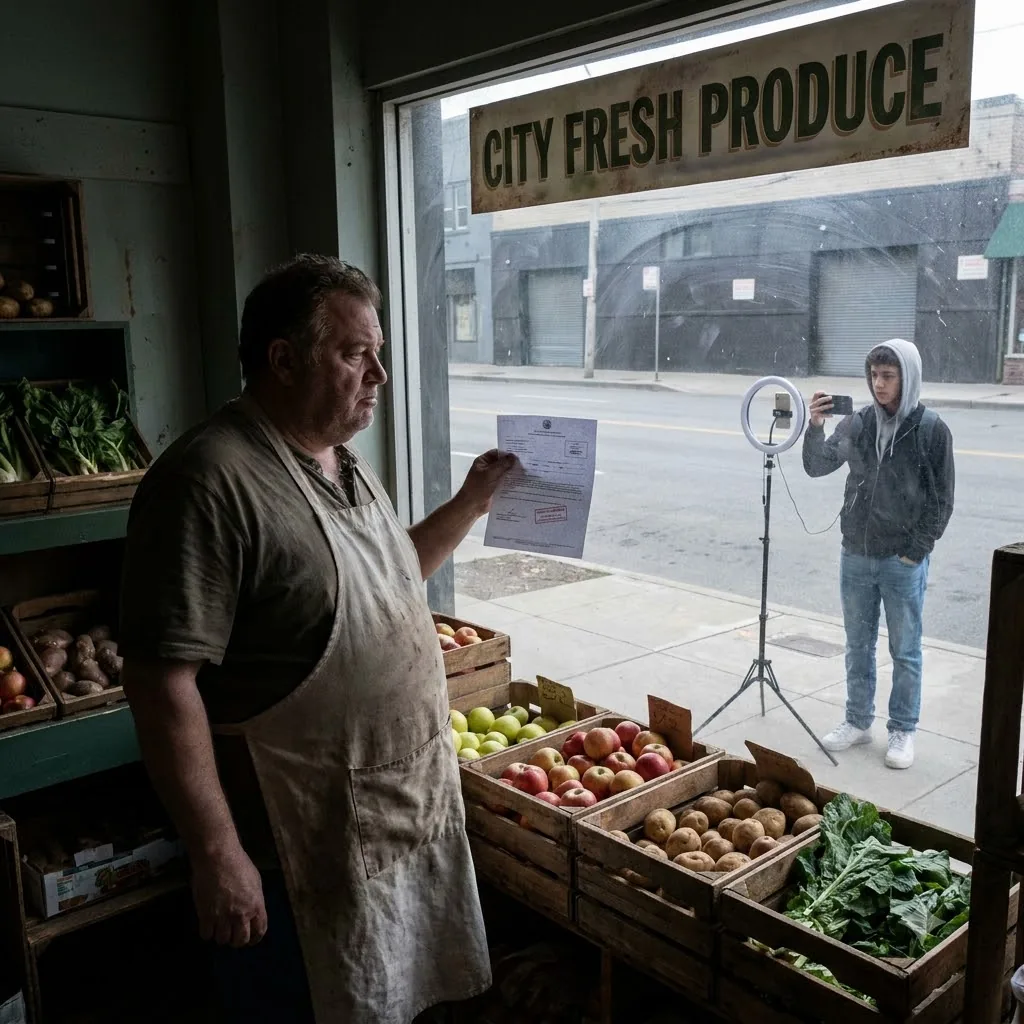
“This is a legally zoned food bank,” Marcus said, taking one slow, deliberate half-step forward. “I just got the paperwork approved today. If you shoot a gang video with a firearm on this property, the city takes my permit. If they take my permit, this neighborhood doesn’t eat.”
“I don’t give a damn about your vegetables!” the armed teen yelled, waving the gun rapidly to punctuate his words. He was putting on a show for his crew, desperately needing to maintain the lethal persona he had just been projecting to his digital audience. He stepped into Marcus’s personal space, jabbing the cold muzzle of the handgun hard against Marcus’s collarbone. “Get out of my frame, or I’ll drop you right here.”
The metal bruised Marcus’s skin, sending a cold, sharp shockwave through his nervous system. He could feel the thick, folded paper of the zoning permit burning in his back pocket. Eight months of attending hostile community board meetings, begging skeptical politicians, and emptying his meager retirement fund to pay legal fees and compliance officers. The city was waiting for any excuse to shut him down. The board had explicitly labeled his charity a potential “magnet for urban decay.” If Marcus backed down, the video would go online, the alley would be geolocated, and the zoning board would have their ultimate proof.
But if he pushed forward, he might die bleeding on his own loading dock.
“Move,” the boy demanded, his voice shaking with volatile, untested anger.
Marcus didn’t blink. “You’re going to have to shoot me, then.”
The boy’s eyes widened behind the dark fabric. The flanking teenagers shifted nervously, their earlier aggressive posturing fading as the grim reality of the standoff set in. This wasn’t supposed to be a murder; it was supposed to be a promotional stunt for social media.
“Bro, just pop him,” the kid who had kicked the potatoes muttered, but his voice lacked any real conviction. He was already slowly backing toward the alley’s rear chain-link exit.
Suddenly, the sharp squeak of a rusty window hinge echoed from above.
“I see you down there!” a shrill, elderly voice shouted from a third-story fire escape across the narrow gap. It was Mrs. Gable. She was leaning precariously over the wrought-iron railing, clutching a cordless landline phone to her ear. “I’m calling the precinct! Armed thugs! They’ve got guns at the pantry!”
“Shut up, you crazy old bat!” one of the teens screamed, pointing up at the fire escape.
“Police are already dialing!” Mrs. Gable yelled back, slamming her window shut with a terrifying finality.
The dynamic in the alley fractured instantly. The three sidekick teenagers scrambled like roaches in the light. One grabbed the portable speaker; the other two sprinted down the narrow passageway toward the back fence, scaling the chain-link with panicked desperation. They abandoned their star in a heartbeat.
The main teenager froze, his head snapping wildly between the escaping crew, the third-story window, and Marcus. The gun was still pressed to Marcus’s collarbone, but the boy’s hand was shaking violently now. He looked down at the glowing ring light, then back at Marcus. The ruthless drill rapper persona dissolved completely, leaving behind a terrified kid holding a massive felony charge.
“Let me pass,” the boy gasped, trying to violently shove past Marcus toward the open street.
Marcus held his ground, planting his feet and blocking the narrow exit. “If you run out there with that gun, they’ll shoot you on sight.”
“Get out of my way!” The boy raised the gun higher, aiming it directly at the bridge of Marcus’s nose, sheer desperation replacing the bravado. “I’m not going to jail!”
A faint, high-pitched wail drifted through the muggy morning air. It was distant, but Marcus knew the geography of the neighborhood intimately. The local precinct was only four blocks away. The sirens were already multiplying, echoing sharply off the concrete high-rises. In less than sixty seconds, cruisers would lock down both ends of the avenue.
If the police found an armed teenager on Marcus’s property, the food bank would be permanently shuttered by noon, declared an immediate public safety hazard by the city. But if Marcus let the terrified kid run into the street with a drawn weapon, the boy would almost certainly be gunned down by arriving officers. The neighborhood would lose its pantry, and it would lose another young life to the pavement.
The flashing reflection of red and blue lights began to bounce faintly off the bodega’s metal security gate across the street. The wail of the sirens sharpened into a deafening scream as the first cruiser turned onto the avenue.
Marcus stared down the shaking barrel of the gun, realizing the only way to save his hard-won legal victory was to hide the very threat that was about to destroy it.