Story code: ST-000030
Part 4: The Ghost Remains
The heavy black handgun hovered inches from Marcus’s eyes. The boy’s finger whitened against the trigger, trembling with the toxic, desperate need to reclaim his dignity in front of the thousands of viewers still watching through the glowing ring light.
The screech of police tires locking up on the avenue signaled the absolute end of their time. Cruiser doors were already violently slamming open. Heavy boots hit the pavement.
Marcus didn’t have time to negotiate with a bruised ego. He didn’t have time to be the smiling neighborhood organizer anymore.
He moved.
It was a muscle memory he had spent twenty years trying to bury, an instinct forged in the absolute brutality of his past. Marcus didn’t just swat the gun away; he stepped inside the boy’s guard with terrifying, practiced speed. His left hand clamped over the hot steel slide of the pistol, forcing the barrel violently toward the sky just as the trigger snapped. The deafening gunshot echoed off the brick walls, tearing a chunk of mortar from the third floor.
Simultaneously, Marcus drove his right forearm hard into the teenager’s throat. The boy’s eyes rolled back. Marcus stepped through his center of gravity, twisting the trapped wrist with a sickening, audible pop. The teenager collapsed completely, the gun slipping easily into Marcus’s grip.
Marcus didn’t stop there. The violence of his past demanded total, unquestionable control. He slammed the boy face-first into the concrete, driving his heavy knee squarely between the tactical vest’s shoulder blades, pinning him to the ground with a merciless, crushing weight.
It took less than two seconds. It was a perfectly executed, brutal dismantling of a human threat.
“Drop the weapon! Hands in the air! Right now!”
Marcus froze. The alley was suddenly bathed in the strobing red and blue lights of three police cruisers angled onto the sidewalk. Four officers had their service weapons drawn, aimed directly at Marcus’s chest.
Slowly, deliberately, Marcus tossed the captured handgun toward the storm drain. It clattered uselessly against the curb. He raised his hands high above his head, stepping carefully off the groaning teenager.
“He’s the victim! He’s the victim!” a voice shouted from above. Marcus didn’t look up, but he knew the shrill pitch of Mrs. Gable’s voice. “That boy tried to shoot him!”
The officers swarmed the alley, kicking the ring light over and wrenching the sobbing teenager to his feet, snapping heavy steel handcuffs over his broken wrist. A burly sergeant with graying temples approached Marcus, keeping a hand resting firmly on his holstered weapon.
“You the owner of this property?” the sergeant barked, looking at the spilled crates of oranges and the tactical vest on the crying kid.
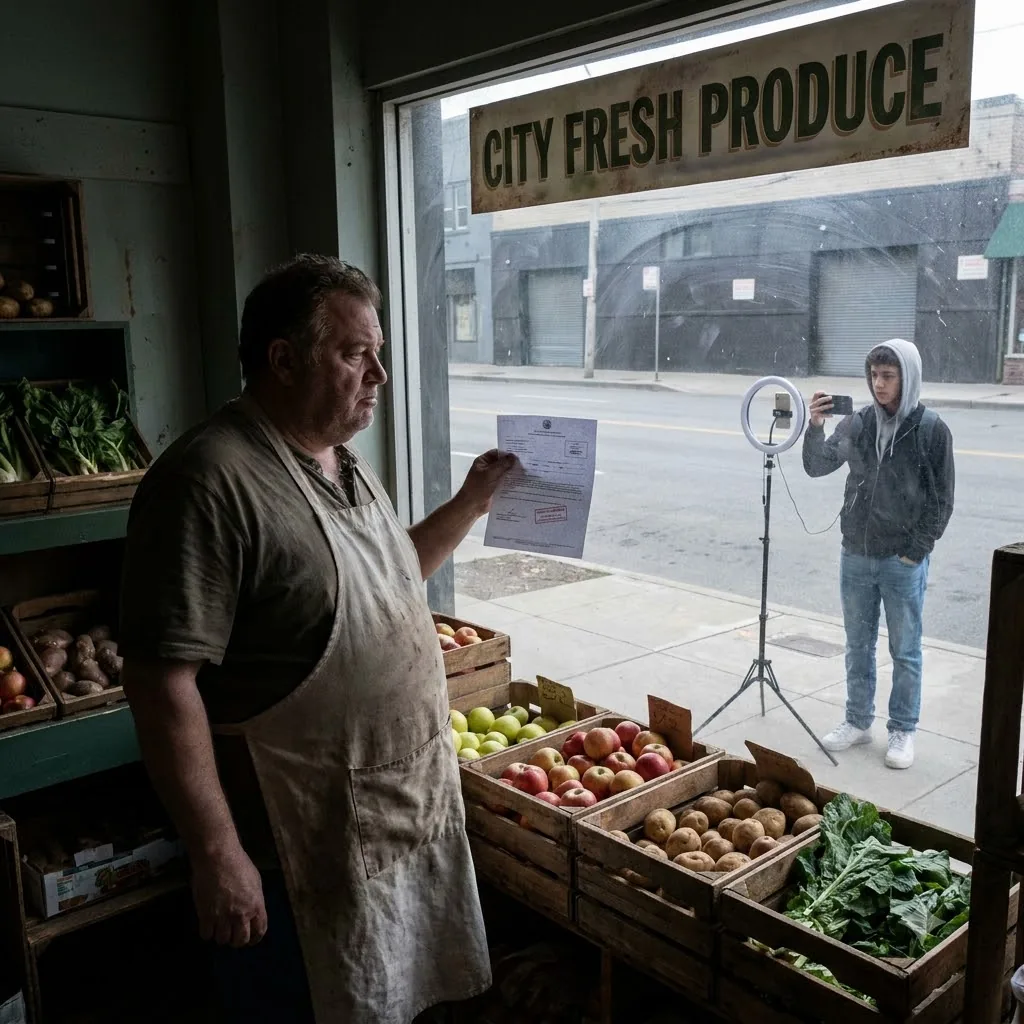
Marcus slowly lowered his hands and reached into his back pocket. He pulled out the folded, thick paper of his zoning permit, the raised seal still intact. “I manage the food bank. This is an active distribution day. That kid trespassed to shoot a video.”
The sergeant snatched the paper, reading over the city seal, the date, and the signature. He looked at the weeping, bloodied teenager being shoved into the back of a cruiser, and then looked back at Marcus’s hard, unblinking eyes.
“You got lucky, Mr. Hayes,” the sergeant said, handing the permit back. “If this paperwork wasn’t valid today, we’d be padlocking these doors and seizing the property as a nuisance site. As it stands, you’re the victim of an armed trespass. We’ll need a statement.”
Marcus folded the paper and slid it back into his pocket. His permit was safe. The pantry was legal. He had won the eight-month war against the city.
The cruisers eventually pulled away, their sirens cutting out as they turned the corner. The alley fell entirely silent, save for the low hum of the bodega’s refrigeration unit across the street.
Marcus turned toward the avenue, ready to reset the fallen crates and salvage the bruised fruit. Distribution Day could finally begin.
He stopped.
The metal barricades he had set up to manage the crowd were still perfectly empty. But the street was no longer deserted. A dozen people had stepped out onto the sidewalks. The bodega owner was standing by his rolling gate. Mrs. Gable was leaning over her third-story fire escape. Three young mothers from the daycare center were huddled on the corner.
None of them were looking at the fresh bell peppers or the sweet potatoes. They were all staring at Marcus.
There was no gratitude in their eyes. There was only raw, paralyzing terror. They had seen the speed of his strike. They had seen the merciless, cold way he had broken a teenager’s wrist and driven his face into the pavement. They hadn’t watched the smiling pantry manager defend his charity; they had watched the Ghost of Tenth Avenue casually dismantle a man.
Marcus took a step forward, raising a hand in greeting. “We’re open,” he called out, his voice echoing too loudly in the quiet street. “Fresh produce. It’s free.”
The bodega owner immediately turned around, walked inside, and pulled his glass door shut. The mothers on the corner hurried away, pulling their children tightly by the wrists. Up on the fire escape, Mrs. Gable slowly backed away from the wrought-iron railing and closed her window, drawing the floral curtains tight.
Within sixty seconds, the street was entirely deserted again.
Marcus stood alone in the muggy morning air. He reached into his pocket, his thumb brushing against the raised seal of his hard-won legal permit. He looked at the fifty crates of beautiful, expensive produce, glistening with condensation in the rising sun. They would sit there all day, rotting slowly on the pavement. The neighborhood finally had its food bank, but they would rather starve than take a meal from the monster who ran it.