Story code: ST-000068
Part 3: Urban Decay
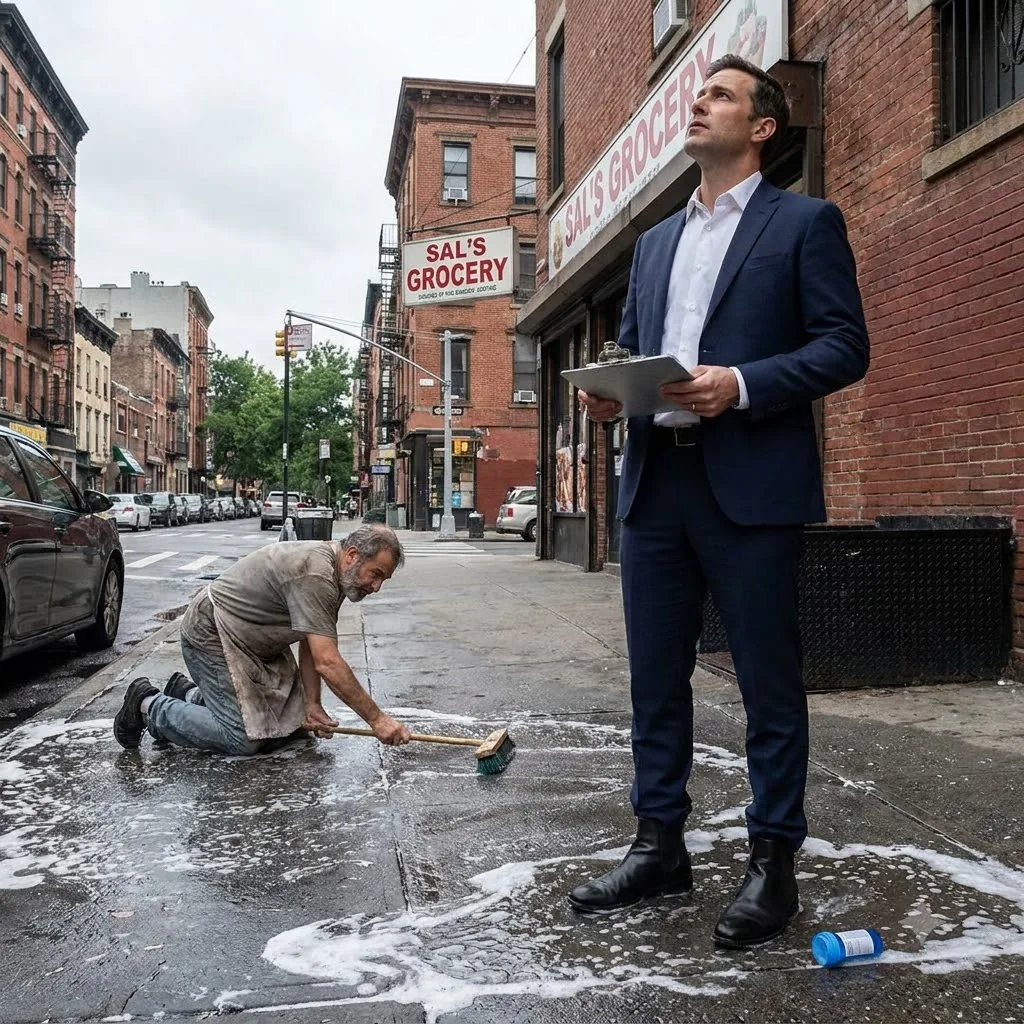
The heavy wood of the mop handle bit into my palms. I stared at the man’s thumb hovering over the bright screen of his phone. Fifteen years. Fifteen years of early mornings, of stocking heavy pallets until my back seized, of extending quiet credit to families who needed baby formula on a Tuesday before payday. If he made that call, the police would force my rolling gates down by noon. I would lose the bodega before the bleach water on the pavement even dried.
My chest tightened as I slowly lowered the mop. I extended my left hand, the heavy, blood-stained parchment trembling slightly in my grip.
“Smart man,” the landlord said.
He didn’t take the paper with his bare hand. Instead, he produced a monogrammed silk handkerchief from his overcoat pocket, using it to pinch the corner of the soiled document. He slipped it delicately into his leather portfolio, snapping the brass clasp shut. The PR nightmare was securely contained.
Almost instantly, the dead, shark-like emptiness in his eyes vanished. A warm, practiced smile spread across his face, so sudden and bright it made my stomach turn. He adjusted his camel-hair coat and took a step back, opening his arms as if we were old friends wrapping up a minor neighborhood misunderstanding.
“I’m glad we could be reasonable, Teo,” he said, seamlessly reading the embroidered name tag pinned to my work shirt. He extended his hand again, this time for a handshake. “I’m Declan. And I want you to know, my partners and I aren’t the bad guys here. We love the character of this neighborhood. We want to preserve its authentic soul.”
I stared at his outstretched hand. I didn’t move.
Declan lowered his arm, completely unbothered, his salesman smile never wavering. “In fact, adaptive reuse means keeping the community fabric intact. When we open the boutique coffee bar in your unit next month, we’re going to need local faces. People who know the block.”
He leaned in, lowering his voice as if offering me a gold mine.
“I could bring you on as our Neighborhood Liaison. You’d handle the sidewalk maintenance, sweeping up, keeping the storefront pristine. It’s minimum wage, but you get a branded uniform, and there’s a path to health benefits after twelve months. You wouldn’t have to stress about a commercial lease or paying for expired inventory ever again.”
My jaw locked. He was standing in the exact spot where a kid I’d watched grow up had just stopped breathing, holding the eviction notice that would destroy my life’s work, and he was offering me minimum wage to sweep the very same sidewalk for him.
“I’m not wearing your apron,” I said, my voice barely a rasp over the chilling wind. “And I’m not wiping down your espresso machines.”
Declan’s smile tightened, the edges of his mouth straining to keep up the friendly facade. “Pride is a luxury, Teo. You should think about the reality of your situation.”
I turned my back on him. I didn’t care if he was still talking. I walked over to the stack of blue plastic milk crates by my outdoor ice machine. I reached onto the bottom display shelf and grabbed a tall, glass *veladora*-a prayer candle with the faded, printed image of San Judas glued to the front. I pulled a cheap plastic lighter from my apron pocket.
Walking back to the storm drain, I knelt on the damp, freezing concrete. Nestled in the corner of the brickwork, tucked away from the wind, sat two other partially melted candles. I kept them there for Hector and Maya, ghosts this avenue had swallowed up last winter. I placed the new glass cylinder beside them, shielding the flame with my cupped hand as I lit the wick for the kid in the ambulance.
“What is this?” Declan’s voice snapped behind me.
The corporate warmth was entirely gone, replaced by a sharp, nasal disgust.
I stayed on my knees, watching the small flame flicker against the cold glass. “It’s a memorial.”
“Absolutely not,” Declan barked. I heard the sharp click of his leather shoes stepping closer. “No spontaneous memorials. No junkie shrines on our property line. It’s an eyesore. It signals urban decay to the investors.”
“They’re people,” I said, standing up to face him. “They’re the people of the neighborhood you just said you loved.”
“They are blight!” Declan shouted, his face suddenly flushed with a dark, ugly red.
The mask was completely shattered. He wasn’t a community builder. He wasn’t preserving any authentic fabric. He was a conqueror who despised the very dirt he was standing on and everyone who walked over it.
Before I could step between them, Declan lunged past me. He swung his polished leather shoe in a violent, sweeping arc, kicking directly into the cluster of glass candles.
The heavy glass shattered with a sharp, explosive crack. The noise rang out over the street, freezing a passing commuter in her tracks. Hot wax, shards of painted glass, and small pools of rainwater exploded across the brick wall and the concrete. The wicks hissed loudly as they died in the rusted pink bleach water.
Declan stood there, chest heaving beneath his expensive overcoat, his shoe covered in wet soot and melted wax. He looked up, his breath pluming in the cold air, realizing that the architect, the commuters, and I were all staring at him in dead silence.