Story code: ST-000068
Part 2: Adaptive Reuse
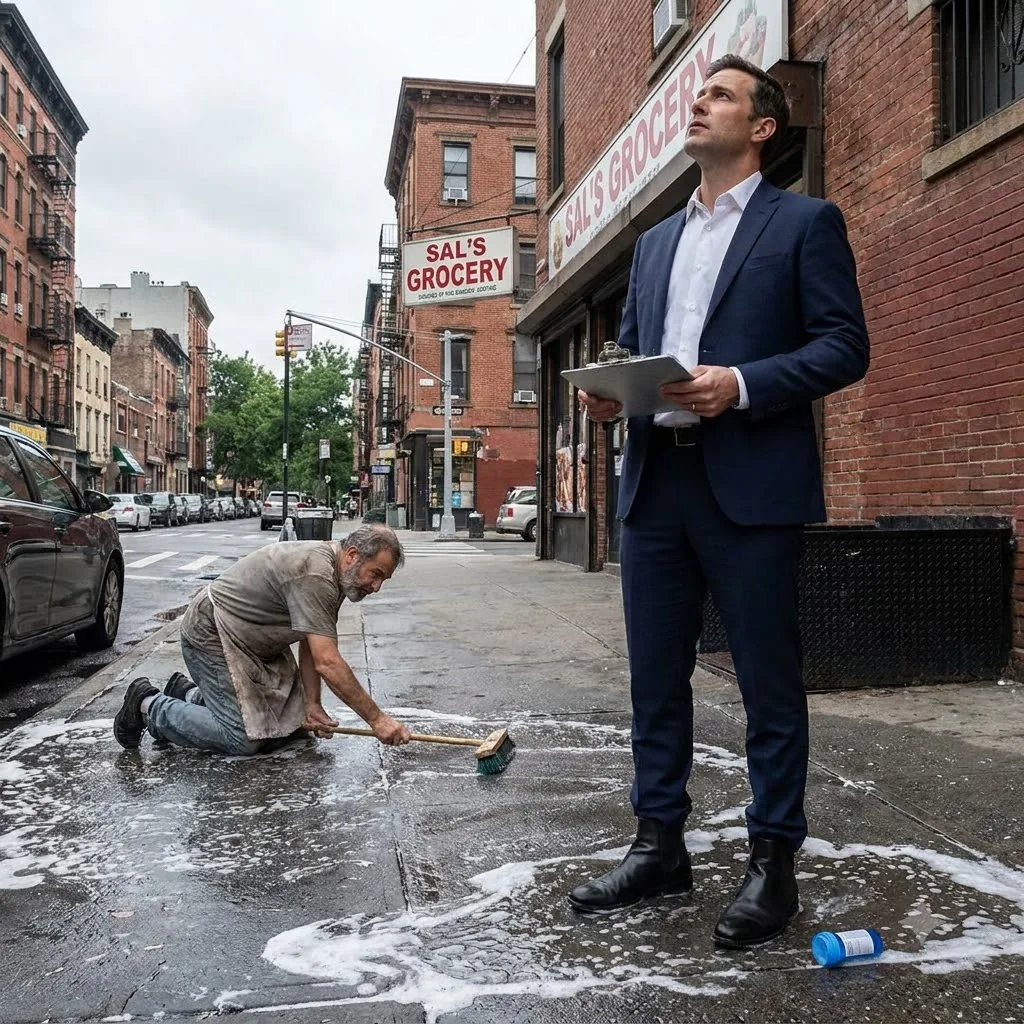
The morning wind caught the edge of the heavy parchment in my hand, threatening to tear the wet, stained fibers down the middle. The man in the camel-hair overcoat didn’t blink against the chill. He just stared at the document, his polished leather shoes planted squarely in the rusted pink puddle of bleach and the kid’s blood. The street around us was beginning to wake up-the screech of the M15 bus braking at the corner, the rhythmic clatter of metal security grates rolling up on the next block over-but right here, the silence felt suffocating.
He took a slow, deliberate step toward me. The thick leather portfolio tucked under his arm shifted as he extended a bare, manicured hand.
“That belongs to me,” he said. His voice was entirely flat, devoid of any adrenaline or basic human empathy you’d expect from a man standing in a fresh medical emergency zone. “The vagrant snatched it off the glass before the ambulance arrived. Hand it over.”
I didn’t move. My knuckles ached from how tightly I was gripping the wooden handle of the mop. I looked down at the parchment in my other hand. The gold-embossed seal of the property group gleamed under the streetlights, but my eyes caught something else entirely-a thick piece of torn blue painter’s tape stuck to the back flap. It was the exact same blue tape the man had just used to stick an envelope to the residential door.
Using my thumb, I peeled back the wet fold, ignoring the dark, copper-smelling stain that soaked into the canvas of my work gloves. The tight, mechanical typography spelled out my own address. *412 East 9th Street. Commercial Unit A. Teo’s Grocery.*
My breath caught roughly in my throat. The kid hadn’t just picked up a random piece of expensive trash off the concrete. He had peeled this notice off my metal security gate before I even arrived to open up this morning. Maybe he was trying to hide it from me. Maybe he was hoping to trade it for a hot coffee and a butter roll. He had been shivering against my ice machine, clutching my corporate death sentence to his chest while his heart stopped beating.
“I said, give it to me,” the man in the overcoat repeated, his tone dropping an octave, now carrying a sharp edge of irritation. He checked a heavy silver watch on his wrist. “I have twenty more doors to tag today, and I do not have time for a sanitation dispute with the outgoing tenants.”
“This has my store’s address on it,” I said, my voice sounding hollow over the low rumble of a passing garbage truck. “It’s a thirty-day notice to vacate.”
The architect in the gray suit stopped tapping his pen, his metal tape measure snapping back into its casing with a sharp *crack*. “Listen, buddy,” the architect said, leaning around the overcoat man to look at me. “The building sold. The grace period is officially over. We’re knocking down the load-bearing wall behind your deli coolers by the end of the month to open up the lobby flow. It’s nothing personal. It’s just adaptive reuse.”
Adaptive reuse. They were casually summarizing fifteen years of my life-sweeping this sidewalk, knowing the neighborhood kids, feeding them on credit. And this man was calling my eviction “adaptive reuse” while standing in the literal blood of a kid who had nowhere else to go.
“You served it,” I said, staring hard at the landlord. “He took it down. Now I have it. So we’re done here.”
I turned back toward my mop bucket, but the overcoat man stepped directly into my path. The scent of sandalwood cologne mixed sickeningly with the ammonia rising from the concrete.
“We are not done,” the landlord said quietly. “I need *that* specific copy back.”
“Why?” I asked, shifting my weight and gripping the mop handle like a baseball bat. “You have a whole stack of them right under your arm. Give me another one.”
“Because,” the architect interjected, his eyes darting nervously to the dark red smears soaking into the paper, “that one is a biohazard. And if some local stringer for a neighborhood blog takes a photo of an eviction notice covered in a junkie’s blood, it creates an enormous public relations headache for the development group. We are cultivating a high-end demographic. We can’t have viral poverty porn circulating online before we even break ground.”
My stomach turned violently. They didn’t care that the kid was on a ventilator. They didn’t care that they were wiping out my livelihood and the entire block’s history. They only cared about the optics. The bloody paper in my hand was a PR liability that could delay their boutique coffee bar.
Early commuters were navigating around us, keeping their heads down, their wireless earbuds firmly in place. Nobody wanted to look at the bodega owner holding a dirty mop, standing off against two men in tailored clothes. I was completely isolated. The neighborhood I had anchored for a decade and a half was dissolving around me, walking past me in broad daylight.
“I’m keeping it,” I said, my voice trembling with a sudden, hyper-focused rage. “It’s my notice. Addressed to me.”
The landlord’s eyes went completely dead. He reached into his coat pocket and pulled out a sleek smartphone.
“You are holding stolen property,” he said, his thumb hovering over the bright screen. “You are interfering with a legal eviction process, and you are wielding a wooden handle in a threatening manner. If you do not hand over that soiled document right now, I will call the police. You can spend the next forty-eight hours in a holding cell while my crew comes in and legally boards up your shop today under the abandonment clause in your lease.”
I froze, my boots heavy on the wet concrete. The cold reality of his words hit me harder than the freezing wind. If I got arrested, there would be no one to open the metal gates. No one to fight the lockout. I would lose the store before the sun even fully rose.
The landlord extended his bare, manicured hand again, stopping mere inches from my chest. “The paper. Right now. Or you lose the store today.”