Story code: ST-000463
Part 4: The Disconnect
The scrolling text on the glossy screen blurred into an illegible, frantic stream of white pixels as the shareholder chat erupted. Wayne felt the rigid aluminum of the stabilization rig hum in his grip, vibrating with the sheer volume of incoming notifications. Vance stood paralyzed, his mouth opening and closing soundlessly, the polished executive facade entirely stripped away by the realization of what had just been broadcast.
“Give it to me!” Julian screamed, his voice cracking with sheer panic.
Abandoning the gimbal controls, the young assistant lunged forward. Instead of grabbing the expensive equipment, Julian seized Wayne’s left arm with both hands, his manicured nails digging fiercely into Wayne’s bare wrist just above the biometric band. He yanked backward with his entire body weight, trying to physically tear Wayne away from the camera.
The sudden, aggressive contact triggered a localized fail-safe. Julian’s own smart-badge, clipped to his lapel, flashed a blinding strobe of blue light. An automated, synthetic voice boomed from the overhead speakers, cutting through the cavernous space.
*”UNAUTHORIZED PHYSICAL INTERVENTION. SECTOR LOCKDOWN INITIATED.”*
The pneumatic brakes hissed again, a deeper, structural venting that signaled a total hard-stop of the entire western quadrant. The remaining ambient hum of the facility died instantly. The automated sorting arms froze mid-swing. The yellow safety lights locked into a solid, unblinking glare. Julian had just violated the company’s most stringent zero-tolerance protocol against physical altercations on the floor, effectively paralyzing the very system Vance had been boasting about.
Heavy boots pounded against the concrete as three facility security guards sprinted around the corner of the cross-aisle. They didn’t bother assessing the trapped teenager or the frozen machinery. The lead guard bypassed Wayne entirely, rushing straight for the main network breaker on the structural pillar behind the line. He smashed a heavy fist into the manual override panel.
On the phone screen, the furious scroll of shareholder outrage vanished. The livestream died, plunging the display into a dead, reflective black. The corporate broadcast was severed.
Julian let go of Wayne’s arm, stumbling backward as if burned. He stared at his own flashing smart-badge, his chest heaving. Vance didn’t move. The regional director of operations stared blankly at the dark phone screen, his charcoal suit suddenly looking wrinkled and cheap in the harsh emergency lighting. The pristine narrative was gone, and Vance’s career was likely bleeding out right alongside it.
On Wayne’s left wrist, the biometric monitor emitted one final, flat tone. The digital countdown hit zero. The solid red screen updated one last time.
*TERMINATION FINALIZED. PLEASE ESCORT TO EXIT.*
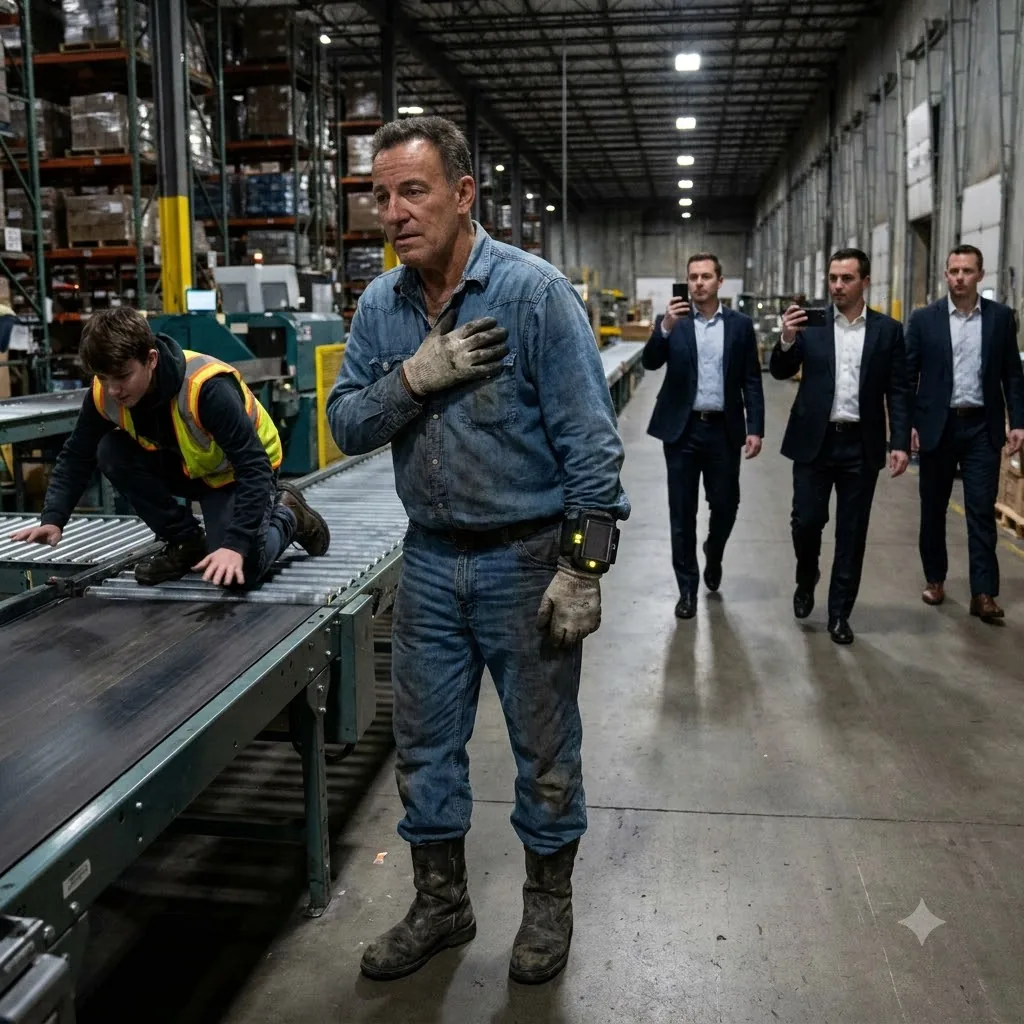
Wayne looked down at the band. For five years, that heavy plastic cuff had dictated his bladder, his sleep, his heart rate, and his worth. He reached over with his right hand and pressed the dual release clasps on the underside of the monitor. The thick band clicked loudly and unspooled from his wrist. Wayne rubbed the deep, red indentation left behind in his skin.
He reached out and set the dead monitor gently onto the stationary steel rollers of Conveyor Line Four, right next to the torn canvas he had cut away from Liam’s arm.
The lead security guard stepped up to Wayne, raising a hand to point toward the main aisle. There was no aggression in the guard’s eyes, only a quiet, tense instruction to leave. Wayne nodded. He knelt down beside Liam one last time. The teenager was pale, but he was breathing steadily, his uninjured hand clutching the fabric of his jacket.
“Medical’s coming, kid,” Wayne said softly. “You’re going to be alright.”
Wayne stood up and turned away from the machinery. Floor Manager Davis was standing by the yellow railing, his hands hanging limply at his sides. Davis wasn’t sweating anymore. He wasn’t begging. He just stared at Wayne, a strange, silent awe replacing the perpetual terror in his eyes.
As Wayne walked down the main cross-aisle, he noticed the silence wasn’t just coming from the halted machinery. The other associates on Lines Two and Three had stepped away from their stations. None of them were attempting to manually restart their zones. None of them were tapping their biometric monitors. Dozens of workers stood in the dim, red-lit aisles, watching Wayne walk past. A few of them met his gaze, their postures shifting from the usual slouched exhaustion to something rigid and awake. A newly defiant energy crackled in the stagnant warehouse air, a collective realization that the immaculate machine could, in fact, be broken.
Wayne didn’t look back. He kept walking, passing through the heavy metal turnstiles at the front entrance without scanning a badge. He pushed open the double emergency doors, ignoring the localized alarm that chirped in protest.
He stepped out onto the concrete loading dock. The massive bay doors were shut, but the pedestrian exit led straight to the employee parking lot. A cold, gray afternoon sky stretched out over the industrial park. It was the first time in half a decade Wayne had seen the daylight during a scheduled shift. The air smelled of diesel exhaust and damp asphalt, but as Wayne took a deep, unrestrained breath, he realized it was the cleanest air he had tasted in years. He had no job, and by tomorrow, he would have no housing. But as he walked out into the gray expanse, his shoulders felt lighter than they had since the day the old plant closed.