Story code: ST-001543
Part 2: Sanitization Zone
“Nine. Eight.” Elliot stared at the amber numbers blinking on his dashboard screen. If that countdown hit zero, the municipal system would lock the demolition sequence into the unalterable execution phase. There would be no reversing it. He couldn’t trigger the formal mayoral override-the resulting thirty-day municipal review board inquiry would instantly kill the foreign battery plant deal. The investors demanded a sanitized, blank slate today. If they pulled out, the town’s remaining pension funds would evaporate within the fiscal quarter, taking Elliot’s political career down with them.
He dragged his thumb across the tablet’s secondary menu, bypassing the formal veto and frantically selecting ‘On-Site Hazard Mitigation.’ It was a tactical, manual pause. A brief grace period designed for clearing stray dogs or sleeping vagrants from blast zones without resetting the entire bureaucratic cycle.
The tablet flashed green, accepting his fingerprint, then instantly snapped to a new, flashing red countdown: *05:00*. Five minutes.
Elliot shoved his car door open. The wall of July humidity hit him like a wet wool blanket, instantly stifling his breath. “Silas!” he shouted, sprinting up the cracked, weed-choked walkway toward the brass doors of the union hall.
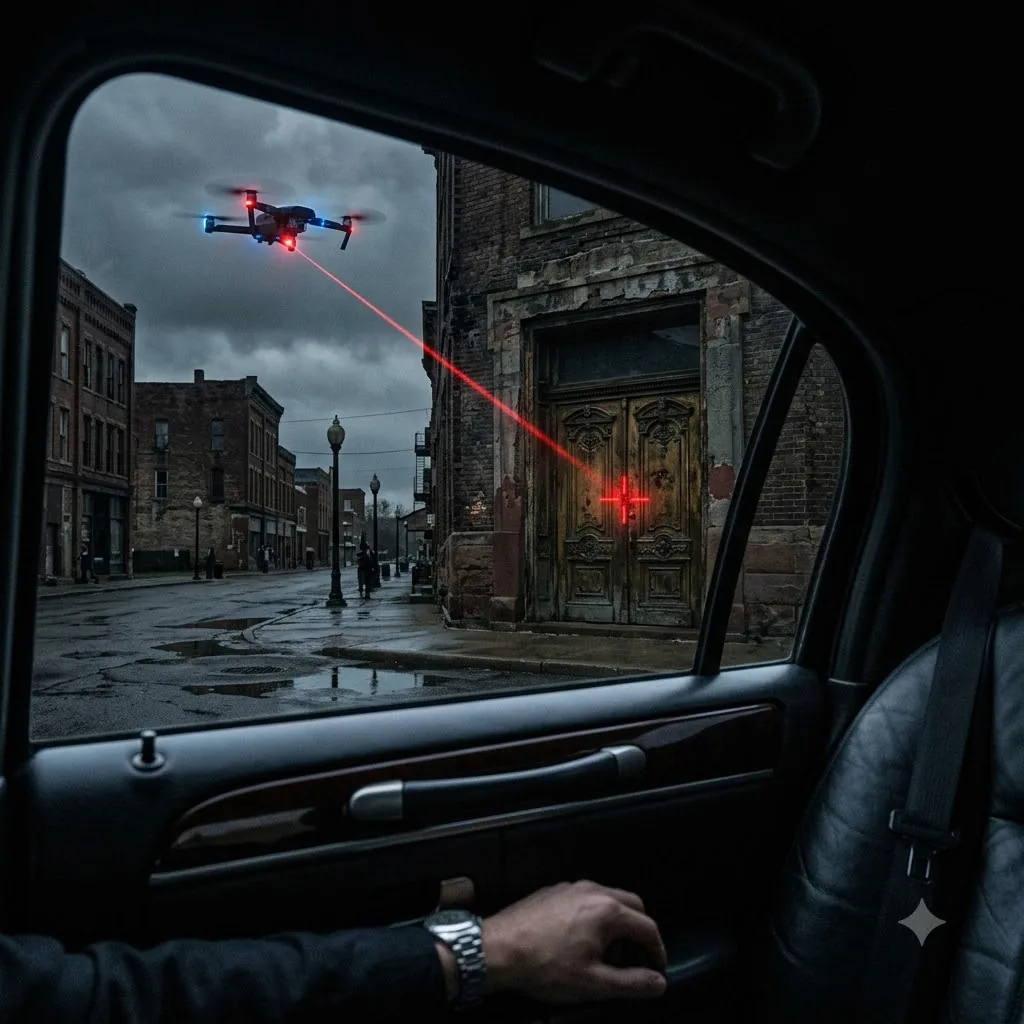
Above the landing, the drone swiveled. Its repulsor engines whined, shifting pitch as it trained its primary optical lens on Elliot’s approaching figure. A second ruby laser shot out from its underbelly, dotting the crisp white fabric of Elliot’s dress shirt.
“Warning,” the synthesized voice boomed, the sheer volume rattling the remaining unbroken glass in the union hall’s windows. “Unauthorized biological entity entering sanitization zone. 280 seconds to automated structural collapse.”
Vance stood his ground on the concrete landing. He hadn’t put the oxygen cannula back in his nose. His chest heaved with agonizing slowness, his face pale and slick with sweat, but his grip on the tall green cylinder’s cart was iron-clad.
“Get in the car, Silas!” Elliot gasped, reaching the top of the stairs. He lunged for the handle of the oxygen cart, intending to yank it down the concrete steps.
Vance didn’t let go. The old man’s knuckles were white, locking the cart’s wheels against the raised brass threshold of the doorway. “You’re early, Elliot,” Vance wheezed. His voice carried the wet, metallic rattle of failing lungs. “Thought you suit-and-tie boys didn’t like getting your hands dirty.”
“I am not letting a municipal drone execute you on my watch,” Elliot grunted, planting his Italian leather shoes on the cracked concrete and tugging the cart with all his weight. “Let go! You have a subsidized room at the county care facility!”
“I built this hall,” Vance said, his voice dropping to a harsh, strained whisper. “My union dues paid for these doors. My brothers’ blood paid for the steel in those rafters. You think I’m letting some foreign battery conglomerate turn our history into a parking lot?”
“They’re bringing three thousand jobs, Silas! They’re saving the town!” Elliot shouted over a sudden, deep mechanical roar echoing from the far end of the street.
Elliot snapped his head to the left. Two blocks down, the heat shimmer distorted the horizon. Bursting through the summer haze were the automated heavy crawlers. They were windowless, brutalist blocks of yellow steel mounted on massive tank treads, equipped with pneumatic battering rams and high-tensile sweepers. They didn’t have drivers. They possessed no steering wheels, no glass cabins, no manual brakes. They were directed solely by the algorithm’s coordinates.
“210 seconds,” the drone overhead announced, its dual lasers holding steady on both men’s chests.
Elliot’s suit jacket was already soaked through with sweat, clinging to his back. He abandoned the oxygen cart and grabbed Vance by the shoulders of his faded denim jacket. “I don’t have time to argue labor history with you! We have three minutes before those crawlers flatten this entire block!”
“Then you better run, Mr. Mayor,” Vance said. He coughed, a deep, rattling sound that shook his entire frame, and his knees finally buckled.
Elliot caught him, stumbling backward under the sudden dead weight. The old man was much heavier than he looked, dense with decades of mill work and sheer, unyielding stubbornness. Elliot dragged him a foot away from the door, but Vance suddenly twisted, throwing a bony elbow that caught Elliot hard in the ribs.
“Get off me!” Vance snarled, struggling back toward the oxygen cart. His breathing was reduced to rapid, shallow gasps. Without the supplemental oxygen, his lips were already taking on a terrifying, faint blue tint.
Elliot clutched his side, wincing in pain. Deep in his breast pocket, his phone began to vibrate violently. He didn’t need to look at the screen to know it was the investor advance team. They were tracking the demolition progress remotely from the regional airstrip. The five-minute hazard hold would be lighting up their interface as an unacceptable, unexplained delay.
The ground beneath them began to vibrate. The rhythmic, earth-shaking crunch of the crawlers’ treads chewing up the asphalt sent aggressive tremors up through the soles of Elliot’s shoes.
“120 seconds,” the drone chirped. The ruby laser on Elliot’s chest pulsed in time with an amber warning light on the machine’s chassis.
Elliot lunged for the oxygen cart again, bypassing the handle to lift the entire metal frame up and over the brass threshold. He slammed it down onto the concrete landing, the green tank clanging loudly. “I’m carrying you to my car if I have to,” Elliot said, blinking away the stinging sweat in his eyes.
Vance leaned heavily against the brass doorframe, his breathing now a desperate, reedy hiss. He reached his free hand deep into the pocket of his denim jacket. Elliot froze, his heart hammering against his ribs, half-expecting the labor leader to pull a weapon.
Instead, Vance pulled out a heavy, rusted iron chain and a thick brass padlock.
Before Elliot could process the movement, Vance looped the heavy chain through the massive brass door handle of the union hall, wrapped the other end tightly around his own left wrist, and snapped the padlock shut. With a flick of his wrist, he tossed the only small silver key through the gap in the doorway, sending it clattering into the dark, asbestos-filled belly of the condemned building.
“I’m staying right here,” Vance gasped. He slid down the doorframe until he was sitting on the vibrating concrete, permanently tethered to the brass handle. He looked up at Elliot, a grim, triumphant smile cracking his weathered, blue-tinged face. “Your move, Mayor.”
The vibration in Elliot’s pocket stopped, then immediately started again. The investors were calling back. If he answered, he would have to explain the delay, risking the entire contract. If he ignored it, they might assume incompetence and turn their plane around.
The roar of the heavy crawlers was deafening now. Elliot looked down the street in horror. They had crossed the final intersection. Fifty yards away. The lead crawler raised its primary pneumatic ram, a solid, ten-ton cylinder of polished steel designed to punch through load-bearing masonry like wet paper.
“60 seconds to structural collapse. Evacuate blast radius immediately,” the drone broadcasted. Its secondary laser remained painted squarely over Elliot’s rapidly beating heart.
Elliot stared at the rusted chain digging into Vance’s wrist. He looked back at his idling town car at the curb, the open passenger door offering a desperate sanctuary of air conditioning and absolute safety. He could make it. He could sprint down the walkway, get in, drive away, and let the algorithm do exactly what he had programmed it to do. The investors would never know the true cost. The town would get its salvation.
“Sixty seconds,” Elliot muttered, the words catching painfully in his dry throat. He dropped to his knees on the filthy concrete and grabbed the rusted chain with both hands, pulling with all his strength, but the thick iron links didn’t even bend.
The shadow of the lead crawler fell over the landing, entirely blocking out the July sun.