Story code: ST-001543
Part 4: Readiness Score
“Nine. Eight.” Elliot threw his arms over his head, curling his body over Silas as the automated countdown bled through the steel blast shield.
The primary ram struck.
The sound wasn’t just a noise; it was a localized earthquake. The heavy brass doors buckled inward, screeching as the hydraulic deadbolts tore through the concrete framing. The vestibule ceiling split open. A cascade of century-old lath, plaster, and shattered brick rained down on them. Dust filled the dark space instantly, thick and choking. Elliot couldn’t breathe, couldn’t see. He felt Silas go entirely limp beneath him, the old man’s chest stopping its frantic, shallow heaving.
The building groaned, shifting on its foundation. Through the choking white cloud, the deafening mechanical shriek of the crawler resetting its ram pierced Elliot’s ringing ears. The machine was pulling back for the killing blow. It would bring the entire facade down on their heads.
Elliot squeezed his eyes shut, waiting for the ceiling to collapse.
Instead, the shrill, oscillating wail of police sirens cut through the diesel roar.
Flashing blue and red lights strobed wildly through the gaping cracks in the destroyed masonry.
“Warning,” the municipal drone broadcasted outside, its voice glitching. “Unauthorized interference. Code violation.”
A series of sharp, percussive cracks echoed outside. Gunfire. Twelve-gauge shotguns discharging at close range.
“Take out the primary optics!” a voice roared-Chief Valetti, the head of the local precinct. “Smash the lenses! Cut those hydraulic lines!”
The robotic monotone of the drone was suddenly cut short by the sickening crunch of a heavy police baton shattering its chassis. Outside, the clash of metal on metal rang out as the precinct officers physically attacked the automated crawlers. Without an executive override code, the only way to stop the algorithmic demolition was brute force destruction. More shotgun blasts echoed, followed by the high-pressure hiss of severed hydraulic hoses.
The massive diesel engine of the lead crawler sputtered, choked, and finally whined down into a dead, heavy silence.
“Mayor!” Valetti’s voice barked through the dust. Flashlight beams sliced into the ruined vestibule through the splintered gaps around the jammed blast shield. “In here! Bring the breaching axes!”
It took ten minutes of frantic chopping and prying for the officers to widen a gap in the destroyed brickwork large enough to pull them through. Elliot was hauled out first, coughing violently, his bespoke suit torn and coated in a thick layer of gray dust.
He stumbled onto the sidewalk, gasping for the humid July air, and turned back to watch the paramedics pull Silas out. The labor leader’s face was a horrifying, ashen blue. A paramedic immediately clamped a bag-valve mask over Silas’s mouth, rhythmically squeezing pure oxygen into his failing lungs, while another used heavy bolt cutters to sever the rusted chain still biting into his wrist.
“No pulse, starting compressions!” a medic shouted. They heaved Silas onto a gurney, the metal legs snapping down, and rushed him toward the waiting ambulance. The doors slammed shut, and the rig tore down the street, sirens screaming toward the county hospital.
Elliot didn’t follow. He stood frozen on the sidewalk, numb.
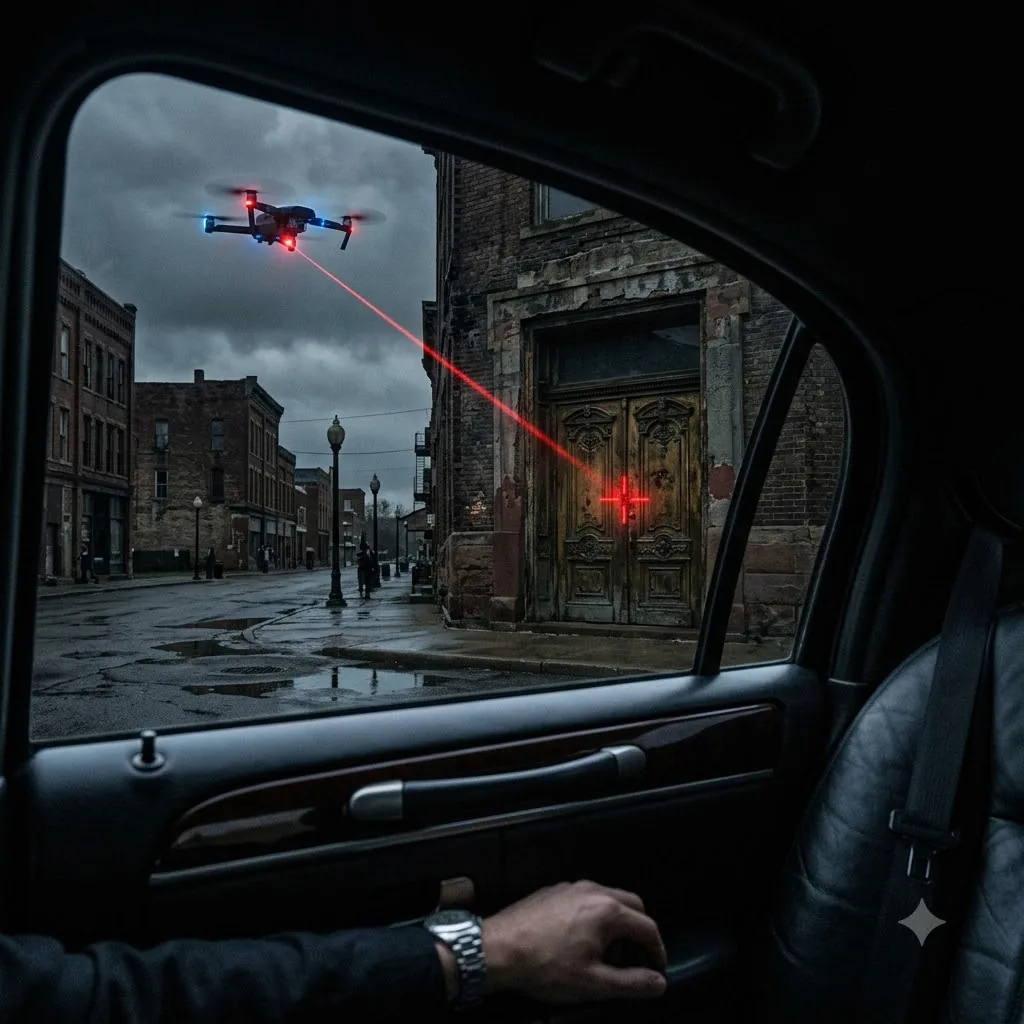
The street looked like a warzone. The municipal drone lay in pieces on the asphalt, its ruby targeting laser flickering weakly from a cracked lens. The two heavy crawlers sat dead, bleeding thick pools of dark hydraulic fluid into the gutters. Their camera housings had been beaten into jagged plastic shards by police nightsticks. The union hall was half-standing, its facade a crumbled, unstable mess of exposed rebar and shattered brick.
“You okay, Elliot?” Chief Valetti asked, his uniform covered in grease and drywall dust. He lowered his shotgun. “Dispatch got the drone’s automated hazard alert. Said there were non-compliant biologicals in the blast radius. What the hell happened here?”
“The investors,” Elliot rasped, his throat raw and bleeding. “They wouldn’t give me the override code. They wouldn’t stop the machines.”
Valetti stared at the ruined million-dollar municipal equipment, then at the half-demolished hall. “Well, with a police-involved discharge and an active structural failure, this site is locked down. State investigators are going to be crawling all over this block by morning. Nobody’s building a battery plant here anytime soon.”
Elliot nodded slowly. The town’s pension funds. His political career. All of it was buried in the rubble. Davis and the Vanguard team were likely already on their private jet, flying back to a city where the algorithms worked cleanly, leaving Elliot to deal with the wreckage of his own ambition.
He sat down heavily on a chunk of the union hall’s limestone cornice that had rolled into the street. The July heat pressed down on him.
Deep in his torn breast pocket, his phone vibrated.
Elliot pulled it out. The screen was cracked, spiderwebbed with fractures from the collapse. It wasn’t a call from Davis. It was an automated push notification from the city’s municipal dashboard, triggered by the permanent structural damage to the union hall. The algorithm didn’t care how the building was destroyed, only that it was no longer standing.
Through the cracked glass, the cold, green text blinked against the dust:
*Blight Structure 402 Neutralized. City Readiness Score Restored to 100%.*
Elliot sat alone on the broken stone, staring blindly at the perfect score, while the distant, fading wail of Silas’s ambulance disappeared into the stagnant summer air.