Story code: ST-000823
Part 3: The Proprietary Mold
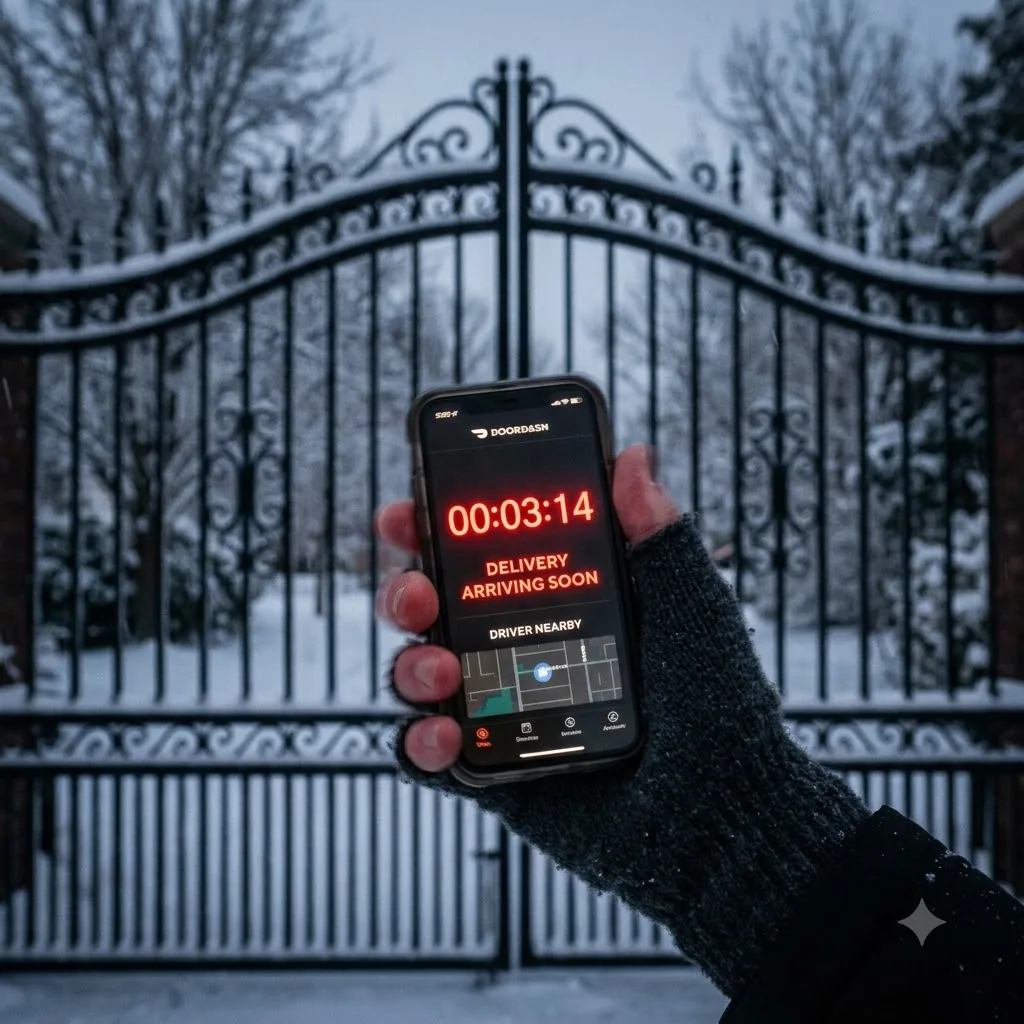
The mechanical groan of the massive iron hinges vibrated through the frozen pavement beneath Leo’s boots. The gap between the two iron gates was narrowing, the heavy metal jaws swinging inward to seal the estate. Twenty seconds. The slate-gray sky spun above him, a dizzying vortex of flat, featureless light.
He could not die on the driveway. He could not fade out here, fifty feet from a paved public road, while the sugar he needed swung in a canvas bag on the other side of an automated firewall.
Leo dragged his right arm forward. His hand slapped wetly onto the heated brick of the inner courtyard. The sudden, artificial warmth shocked his numb nerve endings. He pulled. His left knee dragged across the frost line, tearing the denim of his jeans, scraping raw skin against the concrete as he forced his dead weight over the threshold.
The gate sensors detected the obstruction. A shrill, electronic whine pierced the sterile silence of the estate. The heavy iron doors shuddered and locked in place, their gears grinding in protest, leaving a three-foot gap open to the street.
The homeowner stopped halfway to his massive oak front door. He turned around, the canvas grocery bags hanging heavily from his cashmere-gloved hands. The patronizing, benevolent smile had been entirely wiped from his face, replaced by a rigid mask of aristocratic fury.
“Are you out of your mind?” the man shouted, his rich baritone echoing harshly off the stone facade of the mansion. He dropped one of the bags. It hit the heated bricks with a heavy thud. The other bag, the one containing the imported Manuka honey, remained tightly clutched in his left hand. “Get off my property! I am calling the police right now!”
Leo tried to speak. He needed to say the word *medical*. He needed to explain the red alert flashing silently on his phone. But his jaw was locked in a rigid tremor. His teeth ground together involuntarily. He pushed himself up with his left arm, swaying wildly on his knees, desperately trying to reach his heavy jacket pocket. He needed his wallet. He had a laminated red diabetic alert card tucked right behind his driver’s license. If the man saw the card, he would understand. He wouldn’t call the police. He would open the jar.
Leo dug his trembling, unresponsive fingers into the deep nylon pocket. He couldn’t feel the leather of his wallet. His nerve endings were firing blank static. Instead, his knuckles hooked the thick canvas strap of his small, insulated medical cooler. It was a cheap, frayed neoprene pouch he carried on every shift, packed with a single gel ice pack to keep his medication stable while he drove.
He yanked his hand free, dragging the pouch out into the freezing air.
His legs finally gave out completely. The very last reserve of glucose in his muscles was spent. Leo collapsed forward, his shoulder slamming hard into the heated bricks with a sickening crack. The impact jarred the breath from his lungs. The frayed zipper of the neoprene cooler, already damaged from years of daily use, burst open upon hitting the ground.
A single glass vial slipped free.
It tumbled across the pristine, frost-free bricks with a delicate, crystalline clinking sound. It rolled directly toward the homeowner, crossing the distance between them until it bumped gently against the toe of the man’s cedar-scented leather loafer and stopped.
The homeowner took a quick step back, as if the small object were a live grenade. He glared down at it, his chest heaving with indignation.
“I knew it,” the man snarled, reaching into his tailored wool trousers for his phone. “I told you I knew the signs. You couldn’t just take the tip. You had to bring your paraphernalia onto my-”
The man’s voice hitched.
Leo lay on his side, his cheek pressed flat against the unnaturally warm bricks. His vision had tunneled down to a dark, narrow circle, but at the very center of that tunnel, he watched the homeowner’s hand freeze in the air over his phone.
The man stared at the small vial resting against his shoe.
Slowly, the righteous indignation melted entirely from his posture, replaced by a rigid, unnatural stillness. He didn’t pull his phone out. Instead, he crouched down, the fine wool of his trousers pulling tight against his knees. He reached out with his cashmere-clad hand and carefully picked up the glass cylinder.
Leo watched the man’s thumb rub against the bottom of the glass.
“The hexagonal base,” the man muttered. His voice was no longer booming. It was a hollow, breathless whisper, stripped of all its previous authority. He rotated the vial, staring at the thick, fluted glass neck designed to prevent shattering. “This is an Eterna-Pharm casing. It’s… it’s our proprietary mold.”
The man looked closer, holding the vial up to the flat, gray light of the winter sky.
“But this is…” The man’s brow furrowed, his eyes widening in a mixture of confusion and growing horror. He stared at the milky, degraded liquid sloshing sluggishly inside the pristine glass casing. “We don’t manufacture NPH in this casing. This is our rapid-acting analog. Why is it cloudy? This is completely denatured. Where did you get this?”
Leo’s lungs burned. He forced a breath, his lips moving clumsily against the brick.
“Expired,” Leo rasped, the word tasting like copper in his dry mouth. “Stretched it. Four days.”
The homeowner stared at him. The gray cashmere fingers trembled slightly around the small piece of glass.
“You’re stretching it?” the man asked, the syllables catching in his throat. “But the list price… the copay assistance program…”
“Couldn’t… qualify,” Leo whispered. The darkness was closing in, creeping over the edges of the man’s tailored suit, swallowing the background of the sprawling, multi-million-dollar mansion. “Need… sugar.”
The homeowner looked from the cloudy, useless insulin in his right hand to the canvas bag dangling from his left hand-the bag holding the eighty-dollar jar of imported honey.
The man who sat on the board of three homeless shelters, who praised the gig economy as the truest form of the free market, who told himself his mere presence was a charitable act, stopped moving altogether. He stood frozen on his heated driveway. He held the physical, terrifying proof of his own pharmaceutical company’s pricing model in one hand, and the immediate salvation for its victim in the other.
He looked at the honey. He looked at the vial. He looked at the dying man bleeding onto his bricks.
“This is our casing,” the man whispered again, the words empty and broken.