Story code: ST-000823
Part 4: Uncashed Absolution
The violently sweet taste of the pulp-free orange juice coated the back of Leo’s throat. He held the heavy crystal tumbler with both hands, using the chilled glass to anchor his trembling fingers. He sat on a backless leather stool at the edge of a kitchen island that was larger than his entire apartment. The surface was a seamless slab of white marble, gray veins running through the stone like frozen rivers.
The continuous glucose monitor strapped to his tricep buzzed softly against his skin. Leo didn’t need to look at his cracked phone screen to know what the alert meant. The double-down arrows had vanished. A single, diagonal arrow pointing upward had taken their place. His blood sugar was climbing. The critical danger had passed, leaving behind a profound, hollow exhaustion that made his bones feel like they were filled with wet sand.
On the other side of the massive marble island, the homeowner paced in a tight, erratic circle. The man had discarded his cashmere gloves and his tailored wool jacket. His crisp white dress shirt was unbuttoned at the collar, and a thin sheen of sweat shone on his forehead. He looked entirely different from the benevolent, commanding figure who had lectured Leo about the gig economy on the driveway just ten minutes ago.
“You have to understand the macro-economics of it,” the man said, his rich baritone now carrying a thin, reedy edge of panic. He wasn’t looking directly at Leo. He was staring at the commercial-grade appliances, at the floor, at the vaulted ceiling. “The research and development costs for that specific rapid-acting analog were astronomical. We spent billions before it ever hit clinical trials. If we don’t price it at a premium, the board revolts. The shareholders divest. We stop innovating. It’s a systemic issue. It’s the insurance tiers, the pharmacy benefit managers. It’s not just me.”
Leo took another slow sip of the orange juice. The sugar hit his bloodstream, chasing the cold fog from the corners of his vision. He watched the man pace. He didn’t interrupt. He didn’t have the energy, nor did he see the point.
The man stopped pacing and leaned heavily against the marble counter, running a hand through his perfectly styled hair. He looked down at the frayed neoprene medical cooler resting on the pristine stone. Right next to it sat the thick, fluted glass vial with the hexagonal base. The proprietary mold. The cloudy, denatured liquid inside seemed to mock the sterile perfection of the kitchen.
“I run a foundation,” the man whispered, almost to himself. “I build shelters. I put my name on wings of hospitals.”
Leo set the crystal tumbler down. The glass clinked softly against the marble. The sound made the homeowner flinch.
The man suddenly pushed off the counter. He walked over to a bank of custom cabinetry, pulling open a drawer with unnecessary force. He rummaged inside, retrieved a heavy, leather-bound checkbook, and slapped it onto the island. He pulled a silver fountain pen from his pocket and began to write furiously. His hand shook. The aristocratic composure was completely gone, replaced by a desperate, frantic need to fix the jagged crack that had just split his worldview wide open.
He tore the check from the binding with a loud rip and slid it across the smooth marble. It stopped inches from Leo’s resting hand.
Leo looked down. The handwriting was sharp and aggressive. The amount was written in thick black ink: *Ten Thousand and 00/100 Dollars*. In the memo line, the man had scrawled a single word: *Assistance*.
“Take it,” the man pleaded, his voice dropping to a harsh whisper. He finally looked Leo in the eye. The patronizing smile was dead. In its place was a naked, desperate begging. “Please. That covers the insulin. Years of it. It covers a new car. It covers whatever you need. Just… take it. Deposit it today.”
Leo stared at the check. He understood exactly what it was. It was not a lifeline. It was a receipt for absolution. It was the price of silence, the exact dollar amount required to let the man sleep in his multi-million-dollar estate without seeing a dying delivery driver bleeding on his heated driveway. If Leo put that piece of paper in his pocket, the man would be instantly transformed from an architect of suffering back into a generous philanthropist. The transaction would be complete. The illusion would hold.
Leo slowly pulled his hands off the counter. He reached out, bypassing the check entirely, and picked up his frayed neoprene pouch. He picked up the proprietary glass vial and slipped it safely into his heavy jacket pocket.
“Wait,” the man said, his eyes widening as Leo slid off the leather stool. “What are you doing? It’s ten thousand dollars. It’s yours.”
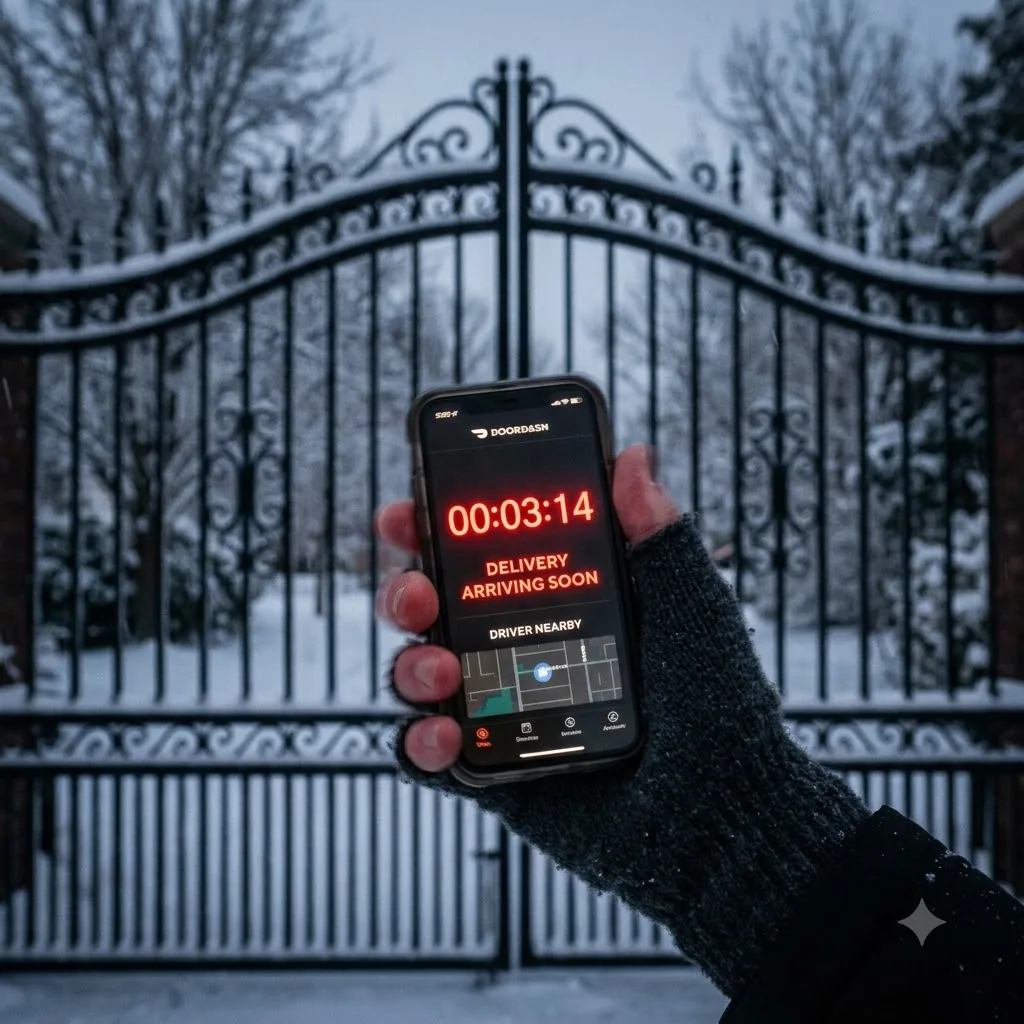
Leo checked his phone. The screen flickered to life. The delivery app displayed a final confirmation page, thanking him for his service. His payout of twenty-two dollars had cleared. He slid the phone into his other pocket. His scraped knee throbbed sharply as he put weight on it, and his bruised hip burned, but his legs held. The muscles belonged to him again.
“I completed the delivery,” Leo said, his voice flat, devoid of anger or gratitude. It was simply a statement of fact.
“You can’t just leave that there!” the homeowner shouted, his voice cracking as Leo turned toward the mudroom hallway that led back to the courtyard. “I’m trying to help you!”
Leo didn’t look back. He walked down the hall, his boots leaving faint, damp scuff marks on the pristine hardwood. He pressed the heavy brass handle of the front door and stepped out into the freezing, slate-gray afternoon. The automated iron gates remained locked open in their emergency position, completely paralyzed.
Leo limped slowly down the long, winding driveway toward his sedan, leaving the homeowner alone in the vast, silent house with his foundation, his proprietary molds, and ten thousand dollars of uncashed guilt resting on the cold marble island.