Story code: ST-000774
Part 2: He Would Not Let Go
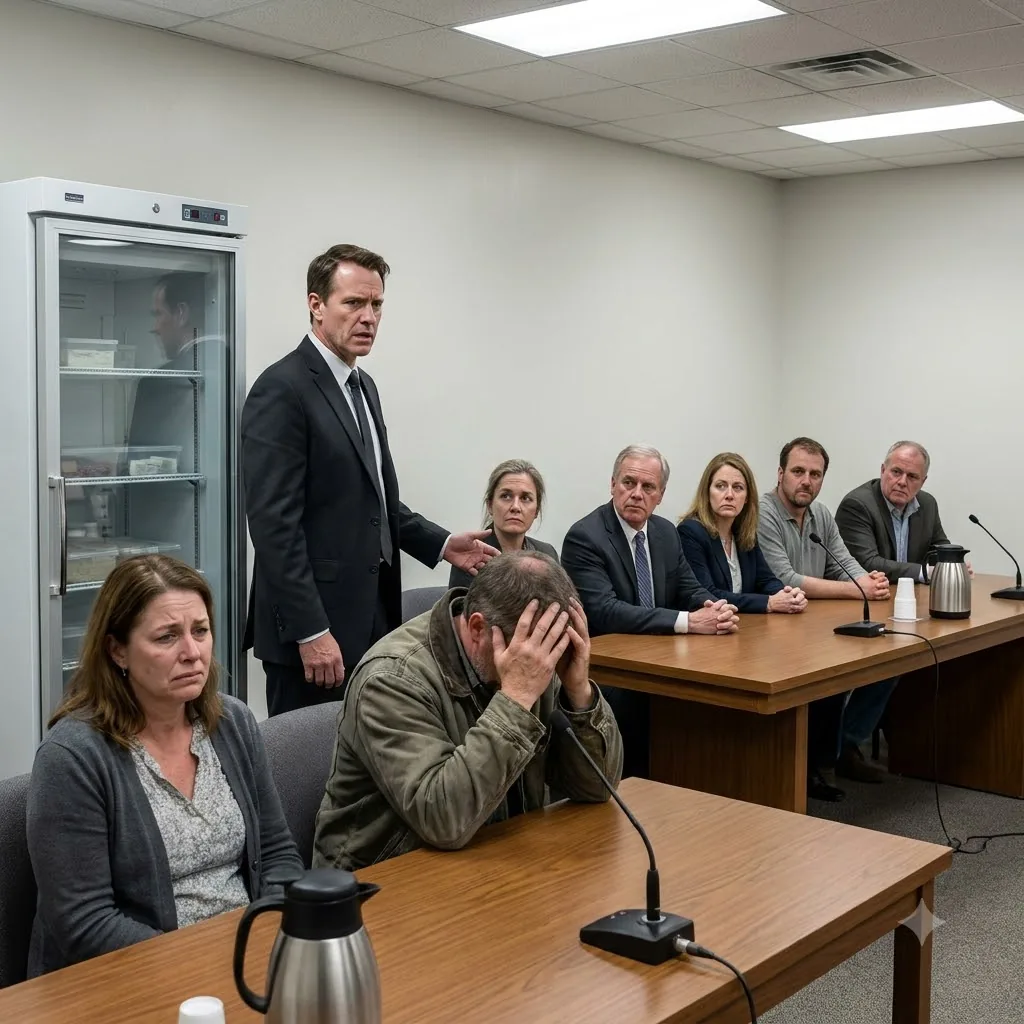
Once Martin said he could step back, the whole room changed around that sentence. The hearing had been running on his version of events up to that point, with him standing there in his polished voice talking about what he had borne for us. But a person who really wants out does not keep checking whether everyone is afraid to let him go. Dr. Nandakumar caught it too. She folded her hands on the table and said, “Let’s stay with that. Mr. Vale, are you formally offering to remove yourself from sponsor control over the sample pathway if the family requests a different structure?” Martin’s chair legs gave a short squeal as he shifted. “I said I could step back if they understood the consequences.” “That is not the same answer,” she said. The clerk stopped typing for a second, then resumed. The freezer compressor kicked on again behind Martin’s shoulder, a steady mechanical hum that made the pause feel longer. Evan sat up straighter. “What consequences?” Martin turned toward him with that same careful voice. “Disruption. Delay. Exposure to people who do not have your best interests in mind. I have spent years shielding this process. You know that.” Evan looked at him, then at me, then back to the freezer. “You keep saying shielding. From what?” Martin smiled without showing teeth. “From the kind of chaos that happens when people treat a medical pathway like a family argument.” I said, “This became a family argument when you started using my agreement as proof of whether Evan deserved access.” “That is not what I said.” “You said my disagreement could jeopardize his options.” He lifted one shoulder. “Because public attacks have effects. That’s reality.” Dr. Nandakumar wrote another note. “Mr. Vale, who currently controls authorization for movement, testing, or transfer regarding the sample in the freezer?” “The program structure does,” Martin said. “Name the person authorized to initiate requests.” He paused just long enough for everyone to hear it. “I am the active sponsor contact.” Nobody spoke for a second. There it was, not hidden, not dramatic, just sitting in the middle of the room in a direct answer. The burden he kept describing like a wound was also the hand on the gate. Evan rubbed both palms on his pants and said, “So if Nora doesn’t play along, you can say the family is a risk and slow things down.” Martin looked at him sharply. “I did not say that.” “You didn’t have to,” I said. He leaned forward. “This is exactly the problem. I make a sacrifice, and suddenly it gets recast as control because nobody here wants to admit what it took to preserve a viable line.” The word line hung there. Not Evan. Not my brother. A line. Dr. Nandakumar said, “This hearing is not about applauding sacrifice narratives. It is about whether consent and oversight remain valid under pressure. So I will ask again. If the family seeks a revised arrangement, will you cooperate with transfer review without attaching personal conditions?” Martin pressed his lips together and tapped one finger against the table. “I will not be railroaded into a decision that destroys continuity.” That was the closest thing to an answer he had given all morning. A man in the public row crossed his arms. The clerk looked up this time and did not bother hiding it. Even Evan let out one short laugh, not because anything was funny, but because the shape of it had finally become simple enough to hear. Martin swung toward him. “You think this is amusing?” Evan held his gaze. “I think you keep saying nobody can force you to keep carrying this, and then every time somebody offers to take weight off you, you call it destruction.” Martin’s hand went still on the tabletop. I watched his eyes go to the freezer again, then back to the panel. That quick glance told me more than his speeches had. Every time the burden started moving away from him, he pulled it back by renaming it duty, risk, protection, continuity, sacrifice. The words changed. The grip did not. Dr. Nandakumar said, “Ms. Hale, based on what has been stated here, what is your position?” I chose each word before I said it. “My position is that gratitude is being used as a condition. My brother’s sample is being used as leverage in front of us. And when Mr. Vale says he wants release from responsibility, he only means it if he can keep authority while being thanked for it.” Martin gave a small disbelieving shake of his head. “That is insulting.” “It is direct,” Dr. Nandakumar said. He turned to her. “You are allowing this to become personal.” “No,” she said. “I am noting coercive framing when I hear it.” Martin sat back and laughed once under his breath. Then he said, “Fine. If everyone is so eager to tear me out of the process, say it plainly. Say on the record that you are prepared to lose what I built.” That was the moment I stopped hearing him as a man defending a role and started hearing the trap itself. He wanted the room to beg him to stay. He wanted me, especially, to be the one who softened first so later he could call it consent. I did not give him that. I only asked, “If this was really sacrifice, why won’t you let anyone relieve you of it?” He looked at me and did not answer. The freezer hummed behind him. The digital numbers stayed steady. Dr. Nandakumar lowered her pen and said she wanted the sponsor-control question clarified before the hearing moved on. Martin reached for his water, missed it the first time, and caught the cup on the second. That was all he did. But it was enough for me to see that the story he had been selling depended on one thing more than the sample itself. It depended on us being too.