Story code: ST-000774
Part 4: I Left Without Giving Him a Stage
The next thing Dr. Nandakumar did was not dramatic. She simply picked up the hearing packet, turned one page, and said, “For clarity, the panel records that sponsor control is being conditioned on family compliance. That is noted.”
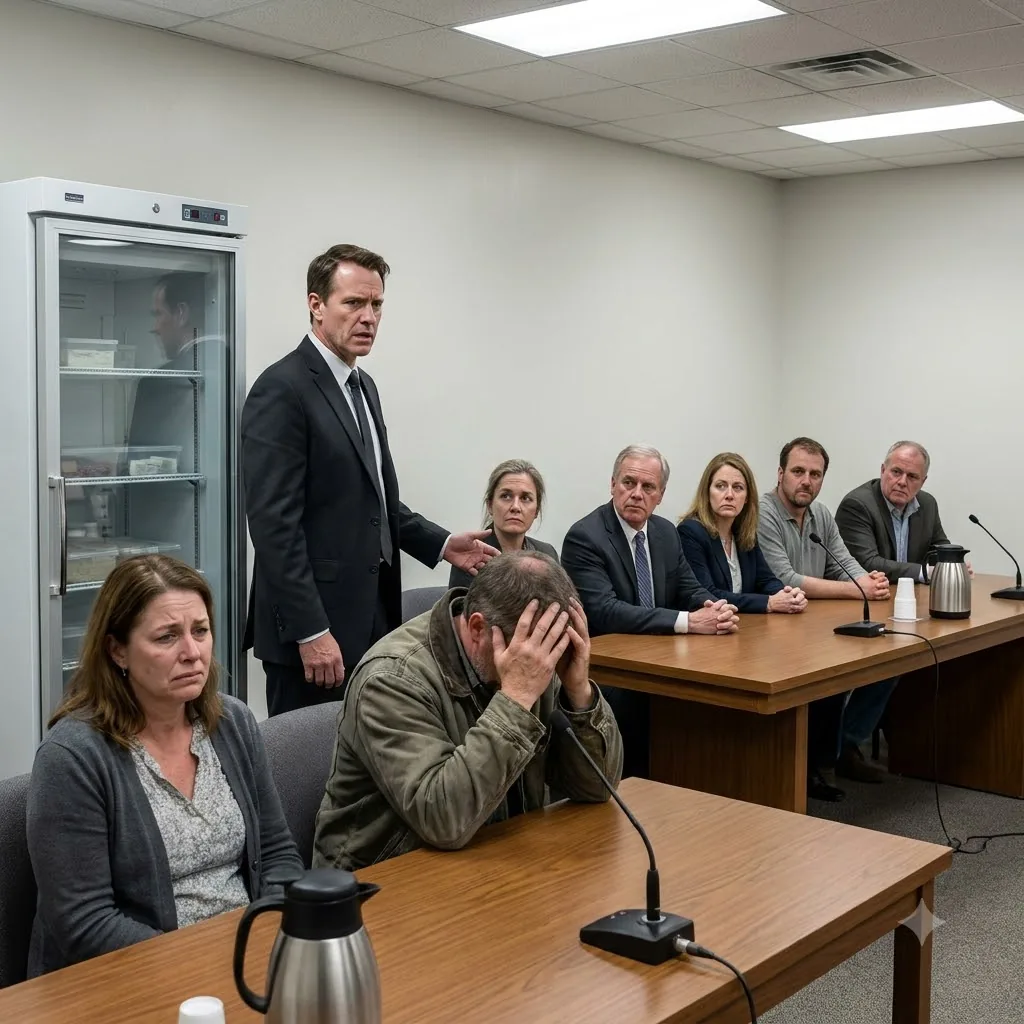
Martin’s head came up. “That is not-”
“It is what you said,” she replied. “We are done translating it.”
The words sat on the table between us like a locked drawer. Nobody moved for a beat. The clerk typed the note into the record, the keys clicking in a steady line that sounded too ordinary for the room we were in.
Martin shifted in his chair and looked at me. “Nora, don’t do this here.”
I kept my eyes on the freezer. The red restricted label was still bright against the white panel. The little blue numbers on the display held steady.
“I am not doing anything to you here,” I said. “That is the point.”
His throat worked once. “If you walk away from this without talking it through, you are cutting off the family path.”
I said, “No. I am cutting off your leverage.”
He stood so quickly that the chair legs scraped hard across the floor. Dr. Nandakumar lifted one hand. “Sit down, Mr. Vale.”
He did not sit. He stared at me over the table, then at Evan, then back at the freezer. His voice came out controlled, but the polish had gone thin. “You do not understand what you are throwing away.”
“I understand what you keep calling sacrifice,” I said.
Evan stood too, slower, like he was not sure whether to follow me or stay. His eyes went to the chair, then the freezer, then Martin’s hands. Martin’s fingers were flexing once and then stilling, flexing again, the kind of motion that means a person is trying not to grab something.
Dr. Nandakumar said, “Ms. Hale, if you are withdrawing from the hearing, say so plainly.”
I looked at her. She was not pleading, not warning me, just asking for the line to be clear. That was enough.
“I am withdrawing from this frame,” I said. “I am not accepting his version, and I am not giving him one more argument to feed on.”
Martin barked out a short laugh that held no humor at all. “You think leaving makes you right?”
“No,” I said. “It makes you stop talking over me.”
That hit harder than anything else I had said. He took one step toward the end of the table and stopped because Dr. Nandakumar was already on her feet.
“Mr. Vale,” she said, “you will remain in your seat while the panel notes the withdrawal.”
He looked at her, then at the clerk, then at the freezer. The room did not give him the reaction he wanted. Nobody rushed to soothe him. Nobody begged me back. The chair wrote the note. The clerk slid the paper forward. The hearing kept its shape without him controlling the pace.
I picked up my bag.
Martin said, “If you leave now, you are making this worse for everyone.”
I paused with my hand on the strap. “You already did that when you made gratitude into a lock.”
Then I turned and walked toward the door.
Nobody stopped me. That was the strangest part. There was no applause, no apology, no last-minute rescue. Just the sound of my shoes on the floor, the click of the freezer motor, and Martin’s voice behind me trying one more time to drag the room back into his story.
At the doorway, I saw the small wall control mounted beside the frame. The hearing coordinator had to use it to keep the inner room access limited. A red indicator was lit under a label that said RESTRICTED ACCESS ACTIVE. The button sat above it, plain and square.
The clerk stepped over, looked at Dr. Nandakumar, and waited. She nodded once.
He pressed the button.
The indicator changed from red to amber, then to a steady locked glow. A soft chime sounded from the freezer side of the room, and the access light by the sample case went dark.
That was the concrete thing I carried out with me: he no longer had the same access, and the room had put it in writing before I reached the hall.
Martin said my name once, but I did not turn back.
By the time I got to the corridor, the hearing room door had closed behind me. I could still hear the low machinery hum through the wall, but the shape of it had changed. It was no longer his stage.
I stood there with my bag in my hand and let the air hit my face. My chest still felt tight, but the room had lost its grip on me. No one followed. No one explained. The record had been marked, the access light had gone dark, and the story he wanted to sell had been cut off at the source.
That was the relief. Hard-edged. Not warm. Not neat. Just mine.