Story code: ST-000774
Part 3: He Tried to Reclaim the Weight
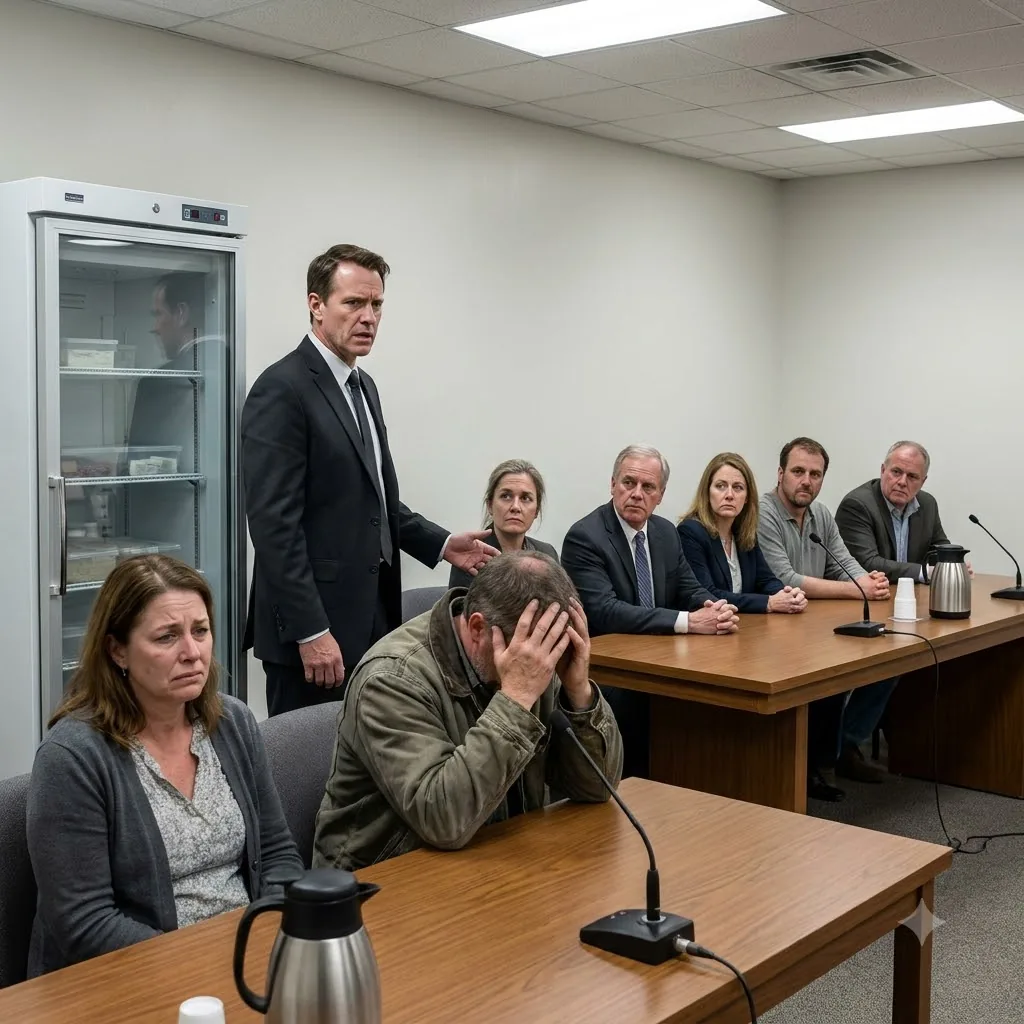
Dr. Nandakumar did not let the room drift after that. She put her pen down, looked at Martin, and said, “We are not moving on until you answer the authorization question directly.” Her voice stayed even, but the words landed harder than his had. Martin straightened in his chair and folded his hands together so tightly the knuckles showed pale. “I already answered,” he said. “No,” she said. “You offered condition after condition. Answer the question. If Ms. Hale requests a revised structure, will you cooperate without tying it to public gratitude or family compliance?” Martin glanced at the sample freezer again. It was still there, the same small box of steel and glass with the same red label staring out through the room. The compressor clicked once, and then the motor settled into a low hum. He drew a breath through his nose and let it out slowly. “You keep framing me as if I am obstructing care,” he said. “I am trying to prevent chaos.” Evan said, “Then answer her.” He had not raised his voice, but the room went still anyway. Martin turned toward him. “You think this is simple because you have not had to carry any of it.” I looked at Evan’s hands. They were flat on his knees now, no longer locked together. He had started doing that since Martin kept talking about burden, like his body had finally decided it was tired of the speech. Dr. Nandakumar tapped the table once. “Mr. Vale. Direct answer.” Martin’s jaw moved. He looked from her to me, then to the freezer, and back again. “If the family insists on a revision, I will need assurances that the line remains stable.” “That is not cooperation,” I said. He gave me a tight smile. “It is realism.” That was when I saw it shift. Not in his face, not in anything dramatic, but in the way he leaned his chair a fraction closer to the freezer instead of away from it. The burden he had been begging us to respect was only acceptable to him when it stayed attached to his terms. The minute it might move, he started narrowing the exits. Dr. Nandakumar said, “Then let the record reflect that you are tying consent to conditions outside the hearing question.” Martin turned both palms up, a gesture that tried to look reasonable. “I am tying responsibility to outcomes. That is what adults do.” “Adults do not call a demand for obedience a sacrifice,” I said. His face changed then, just for a second. Not enough to name what it meant, but enough that the room saw him lose his polish. He leaned forward and said, “You do not get to talk to me like I have done nothing. I built the bridge that kept this from being shut down. I made calls. I took the heat. I put my name on the line when nobody else would.” “And you keep asking for payment in the form of obedience,” I said. A woman in the back row lowered her eyes to her lap. The clerk stopped typing and did not start again right away. Martin laughed once, short and sharp. “You all want the comfort of pretending this was clean. It was never clean. Someone had to absorb the damage.” Dr. Nandakumar said, “No one asked you to turn absorbed damage into a right to control the family.” He looked at her, and then he did something small that made the whole room readjust. He reached for the hearing packet in front of him, flipped to a tab, and slid one sheet forward without being asked. I could not see the whole page from where I sat, only the top lines and the word transfer stamped in the corner. He kept his finger on it as if pinning the page to the table mattered more than the words on it. “If you want to talk about leverage,” he said, “then talk about what happens when people stop being reasonable. There are procedures. There are delays. There are notifications. There are people who will decide the family is unstable.” The room did not need translation. The threat was wrapped in administrative language, but it still landed like a hand closing around the freezer handle. Evan looked at the page. “Is that what this has been?” he asked. “You keep a file and a freezer and call it protection?” Martin did not answer him. That silence was louder than the rest of it. I leaned forward and kept my voice low. “You wanted us grateful enough to stay quiet. You wanted us nervous enough to agree. And when we start pulling the weight back, you reach for paperwork and consequences.” He stared at me for a long second. Then he said, almost lightly, “You keep making it sound dirty because that is easier than admitting what was at stake.” Dr. Nandakumar gathered the page he had slid forward, read the header, and set it aside without comment. Then she looked at me. “Ms. Hale, do you want a short recess?” I looked at the freezer, then at Evan, then at Martin with his hands spread too neatly on the table. A recess would let him recover his face. It would let the room smooth itself back over the crack he had just opened. “No,” I said. “I want the chair to hear this while he is still trying to call it care.” Martin’s mouth pressed into a thin line. “Then hear it,” I said. “If the only way you can keep the story alive is by threatening delay, then the story is already the control.” He started to answer, but the freezer motor behind him gave a louder kick, and the sound cut straight through the room. He turned toward it too fast. For one second his hand hovered over the table edge as if he wanted to check the latch through the glass. That was the first time I.