Story code: ST-000275
Part 2: The Tag Stayed on the Stud
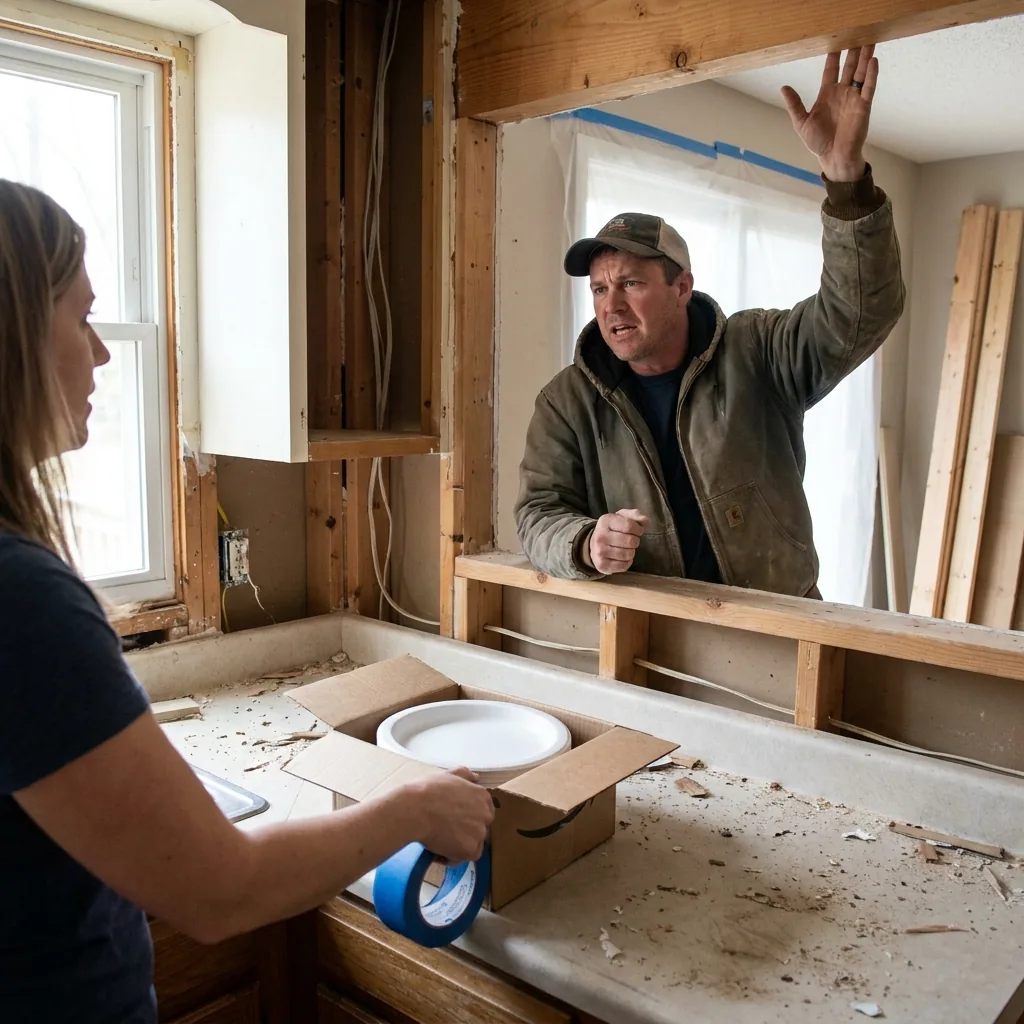
By the time I ended the call, nobody in the kitchen had picked up a tool again. Eli stood between the island frame and the sink wall with his jaw working like he was chewing something he couldn’t swallow, and the permit tag was still clipped to the stud by the doorway where anybody could read it. Five minutes earlier he had been pushing my crew, my house, my decision. Now he was telling me not to let the inspector come.
“You just said this was active,” I said.
“I said it needed to be handled today,” he snapped.
“You said emergency.”
He looked past me at his guys instead of answering. One of them bent down and started zipping a tool bag closed without being told. The other stayed by the hallway, one hand on the breaker panel door, waiting to see which version of the morning was going to win.
Eli ran a hand over the back of his neck and started over in a calmer voice, the one he used when he wanted a room to forget what he had said thirty seconds earlier.
“What I’m saying is, if an inspector shows up before we open the wall, she’s going to slow everything down with extra notes. This is a simple field adjustment. That’s all.”
I pointed to the wall. “It’s already open.”
He looked at it, then at the permit tag, then at the floor. “Not fully open.”
That was new too.
The plastic at the pantry opening lifted and slapped back against the trim. Outside, a truck backed up with the beeper sounding from the street. Inside, the whole kitchen had that waiting silence job sites get when the loudest person has run out of clean words.
“If it’s simple,” I said, “then she looks at it and says it’s simple.”
He gave a short laugh that didn’t pull anybody else in with it. “You don’t understand how these people work.”
“Then explain it in front of her.”
He didn’t answer that one either. He walked over to the sink wall, tapped a section of pipe, and said, “The issue is right here. We found it this morning.”
“Found what?”
“A conflict.”
“With what?”
“With the layout.”
I looked at the run he was tapping. The sink opening had been measured three times last week in front of me, once by Eli, once by the cabinet installer, once by the countertop template guy. The pipe hadn’t moved. The studs hadn’t moved. The marks were still on the floor where they had snapped lines.
“Yesterday you said the layout was locked,” I said.
“Yesterday was before we opened enough to confirm,” he said.
“You just said you found it this morning.”
His mouth stayed open a second before he shut it. Then he crouched and pulled a level off the floor like the tool itself might carry him out of the sentence.
His phone buzzed. He looked at the screen and turned it face down on the window ledge without answering. One of the crewmen finally spoke.
“Do you want us cutting or not?”
Eli stood up too fast. “No one cuts anything until I say so.”
That made all three of us look at him, because cutting had been the entire emergency five minutes ago.
I stepped back to the permit tag and read the printed line out loud again, including the inspection status and the work categories listed on it. I didn’t add anything. I just read what was there in the room.
Eli interrupted before I reached the end. “That tag doesn’t tell the whole story.”
“Then what does?”
He spread his arms at the kitchen, at the taped-off cabinets, the bare plywood under the fridge gap, the sink wall still missing half its drywall. “This. The real-world conditions.”
The crewman by the hall shifted his drill from one hand to the other. “If inspector’s coming, I should probably unload the permit packet from the van,” he said.
“No,” Eli said at once.
The man stopped moving.
I looked from Eli to the doorway. “Why not?”
“Because we’re not at that stage,” Eli said.
I touched the corner of the permit tag. “Then why is this posted?”
He started talking again, quick and overlapping now. First it was a scheduling issue. Then it was a materials issue. Then it was access. Then he said the city liked to complicate small corrections. Every explanation pushed the last one aside before it could settle. He never went back to house danger, active risk, immediate threat. Those words were gone.
My phone buzzed with a text from an unknown number: On my way. Ten minutes. – Dana Mercer.
I didn’t have to say the name out loud. Eli saw the screen from where he stood. His face didn’t change much, but he moved fast. He crossed the kitchen, reached past me, and unhooked the orange extension cord feeding the work lights by the sink wall. Half the room dropped into a dim gray wash from the back door and one hanging bulb over the breakfast nook.
“That’s enough for today,” he said to his crew. “Pack it.”
“You said we had to do it now,” I said.
“Not with an audience,” he said.
Nobody spoke for a second after that. The permit tag stayed on the stud. The open wall stayed open. His guys started closing cases instead of opening them, and all I could think about was that the person he needed most, according to him, was ten minutes away, and he had just shut down the entire kitchen rather than let her look at one wall.