Story code: ST-000143
Part 2: Nobody Could Explain the Script
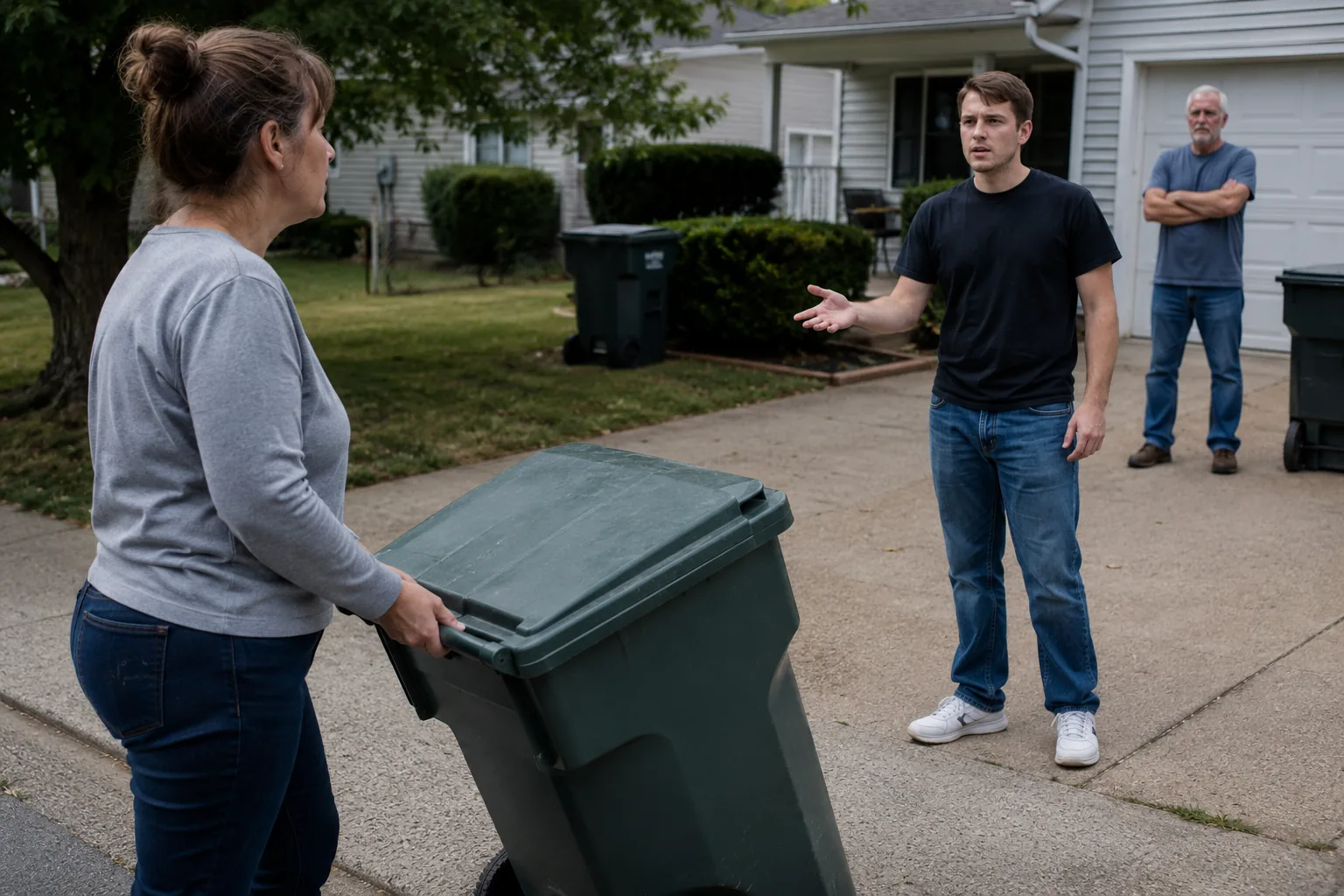
By the time I came back from the curb, the bins were lined up, the kids had drifted a little closer, and Tina was still wearing that brisk, neighborly expression like the issue had already been settled. Evan stayed near the center of the driveway with his recycling bin beside him, and Denise remained on her top step, not close enough to join us, not far enough to pretend she wasn’t part of it. I still had the same problem I started with: two people had used the same strange accusation, and neither one had shown me what it actually meant. So I stopped in the middle of the apron and asked the simplest question I could. “Evan, who told you to say that?” He rubbed one sneaker against the concrete and looked toward the house again. “I just said it.” “No,” I said. “You said the same sentence twice. Who told you to say ‘obstruct the easement’ exactly like that?” Tina cut in fast. “Does it matter? The point is the bins shouldn’t be in the way.” “Then explain how they’re in the way,” I said. She pointed at the space between our two houses, but not at anything specific. Her hand made a small circle in the air, more like a placeholder than a direction. “People drive through here.” “Yes,” I said. “And they still can. My bin is at the curb, off the wheel path. Same place it always goes.” I turned back to Evan. “What is an easement?” He shifted his weight. “It’s the part you’re not supposed to block.” “What part?” He shrugged one shoulder without looking at me. “The easement part.” There it was. Not an explanation. Just the same word folded inside itself. One of the kids near the sidewalk laughed under his breath, then stopped when Tina shot a glance over. Denise still had not moved from the step. She called out, “Mara, nobody wants an argument. We just need the driveway to stay open.” “It is open,” I said. “You can show me if it isn’t.” She did not come down to show me. That mattered more than anything she said. Because if my bin had truly been blocking some obvious route, anybody standing there could have pointed to the exact line: tire marks, turning angle, the narrow swing by the garage side, whatever they believed the problem was. Instead, they kept reaching for language that sounded settled without supplying any details underneath it. Tina dropped her arms and tried a softer tone. “I think he just means the shared access.” “Then why didn’t he say shared access?” I asked. She had no answer ready. She looked toward Denise, then back at me. “That’s just the word he used.” “And you used it too.” Her mouth tightened. “Because that’s what he said.” That was the second clean piece I could actually use. Tina was not correcting him, not describing something she had seen with her own eyes. She was borrowing his line and treating it like proof. I walked back toward where my bin had been before I rolled it out and looked at the marks on the driveway. There were the usual things: damp streak from a leaking lid, black arcs from tires, the rough strip along the edge where gravel always spilled out. Nothing new. No chalk line. No cone. No note. No sudden obstacle except the people insisting there was one. Noah came out our side door then, carrying a smaller kitchen bag and our second bin lid tucked under one arm. He looked from me to Evan to Denise on the steps. “What’s going on?” I said, “Apparently my trash can is obstructing an easement.” Noah paused, glanced at the curb, then at the driveway, and asked the practical question immediately. “Where?” Tina spoke before anyone else could. “In the center area.” Noah looked down the middle strip where both households leave room for tires and said, “The can isn’t there.” “It was,” Evan said quickly. “For ten seconds while I rolled it out,” I said. Noah nodded once. He has lived the same routine I have. He knows the movement of trash night the way you know stairs in your own house. “Everybody’s bins cross the middle for ten seconds,” he said. “That’s how wheels work.” Denise’s hand tightened on the door frame. Even from below I could see the small movement. Then she said, sharper this time, “The issue is where things are being staged.” Staged. Another different word. I looked at Noah. He looked at me. Neither of us said anything for a second, because now we had heard three versions from the same side of the driveway. Evan had his polished line about an easement. Tina had repeated it because he said it. Denise had shifted from center path to staged. Not one of them would hold still on a concrete description. I asked Evan one more time, carefully, so nobody could pretend I was confusing him. “If your mom wanted me to move the bin, why didn’t she just say where she wanted it?” He opened his mouth, then stopped. His eyes went to Denise. Not casually. Directly. Denise answered for him from the steps. “Because I shouldn’t have to come out every single time to manage this driveway.” That was the first sentence all evening that actually fit the scene. Not a blocked path. Not some mysterious easement. Management. I looked at the bins, the tire marks, the narrow strip both houses used, and then at Denise still refusing to come down and point to one actual problem with her own hand. The wording had not slipped by accident. It had been built, repeated, and handed around until somebody asked one plain question too many. And once Denise finally stopped hiding behind the script, the driveway fight looked a lot less like confusion over trash cans and a lot more like she was trying to train the rest of us to.