Story code: ST-000675
Part 2: Then She Started Revising It
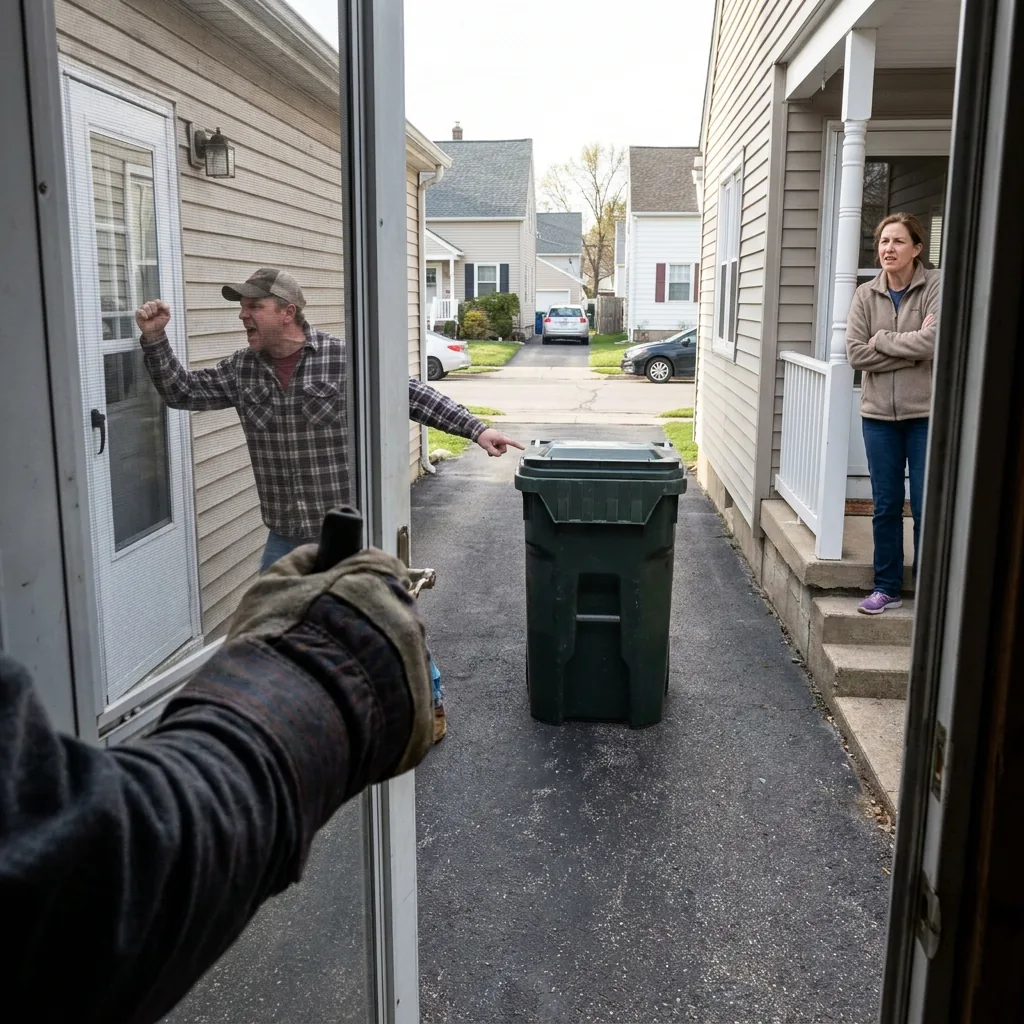
The second Dana said, “Just move it before they get here,” the whole scene shifted from loud to strange. She was no longer talking about danger like something arriving any second. She was talking about witnesses.
I did not move the bin.
Neither did Marisol. She stayed beside it with one hand on the lid, not protective, just steady, like she did not want anyone saying later that it had been somewhere else.
Dana looked from the bin to the street and back again. Her phone was still in her hand. She had been pacing before; now she kept stopping mid-step, then starting again.
“This is ridiculous,” she said. “I was trying to keep this from becoming a problem.”
Marisol answered with the same flat voice she had been using the whole time. “You said it was already an emergency.”
Dana snapped her head toward her. “I said access had to stay clear. Don’t twist my words.”
I said, “You said emergency access. Twice.”
She pointed at me without looking at me fully. “And you are not even the homeowner, so I don’t know why you think this is your argument.”
That part was for the audience she wanted, not the facts in front of us. A man walking a dog slowed on the sidewalk. A woman across the street looked up from loading groceries into her trunk. The driveway sat open to everybody’s line of sight. The trash bin was still the only object Dana had named, and it was still standing in the same place.
I kept my voice even. “You came to me because I was standing here.”
She ignored that and aimed at Marisol again. “If a vehicle needed to come through, this setup would be impossible.”
Marisol said, “What vehicle?”
Dana spread her hands, then brought them back in fast. “Any vehicle. Service. Emergency. Whoever had to get through. That is the point.”
Now the timeline had changed. First it had to be moved right now for an emergency. Then it was to prevent one. Now it was any vehicle that might maybe need the space. Every version still came back to the bin, but each version landed a little farther from the first thing she had shouted.
I walked to the mouth of the shared driveway and turned so I could see the line from the street. “There is room to enter,” I said.
Dana followed two steps behind me. “Don’t do that. Don’t stand there acting like you measure these things.”
“I’m looking at it,” I said.
Marisol joined us but stayed by her side of the concrete seam. “The delivery van got in this morning,” she said. “So did the recycling truck yesterday.”
Dana cut in at once. “Those are not emergency vehicles.”
Marisol answered, “You still haven’t named one that is coming.”
That stopped Dana for half a beat. She filled it by pointing at the curb. “That is not the issue. The issue is that I should not have to explain common sense on my own property line.”
“Shared driveway,” Marisol said.
“You know what I mean.”
No one raised their voice except Dana. That made her voice sound sharper every time she restarted it. She went from claiming an emergency to talking about safety in general, then to respect, then back to blocked access. Each time she reset, she aimed her finger at the same bin like the plastic itself could lock the story back in place.
I asked, “Do you want me to roll it straight so the wheel isn’t cocked?”
She answered too quickly. “No. Leave it.”
There was a short silence after that. She had been demanding movement for ten straight minutes. Now she was refusing the smallest adjustment.
The woman across the street shut her trunk and kept watching. The man with the dog had stopped completely. Dana saw both of them. She took in a breath through her nose and shifted again.
“Actually,” she said, “what I want is for this not to become a whole official thing over one bin.”
Marisol looked at her. “You made it official when you called.”
Dana’s chin jerked toward the phone in her hand. “I called to ask a question.”
“You were saying blocked emergency access loud enough for the block to hear,” I said.
She swung toward me again. “Because nobody was listening.”
A sedan turned into the street and passed our houses slowly. Dana stared at it until it moved on. Then she stepped closer to Marisol and lowered her voice, but not enough that I couldn’t hear.
“Move it now and I’ll tell them not to come.”
Marisol did not touch the bin. “Tell who?”
Dana did not answer that directly. She looked at the street again, then at the driveway opening, then at the bin wheel. Her thumb moved over her phone screen without actually placing a call.
I said, “If there is a real access problem, let them come look at it.”
Dana’s reply came out thin and quick. “No, because they’ll make this into something bigger than it is.”
That was the clearest thing she had said all afternoon, and it still did not match the emergency she had started with. Before either of us could answer, a dark patrol SUV turned onto the block and slowed in front of the Pike and Trent houses, and Dana took one hard step toward the street like she meant to intercept it before anybody could test what she had been claiming.