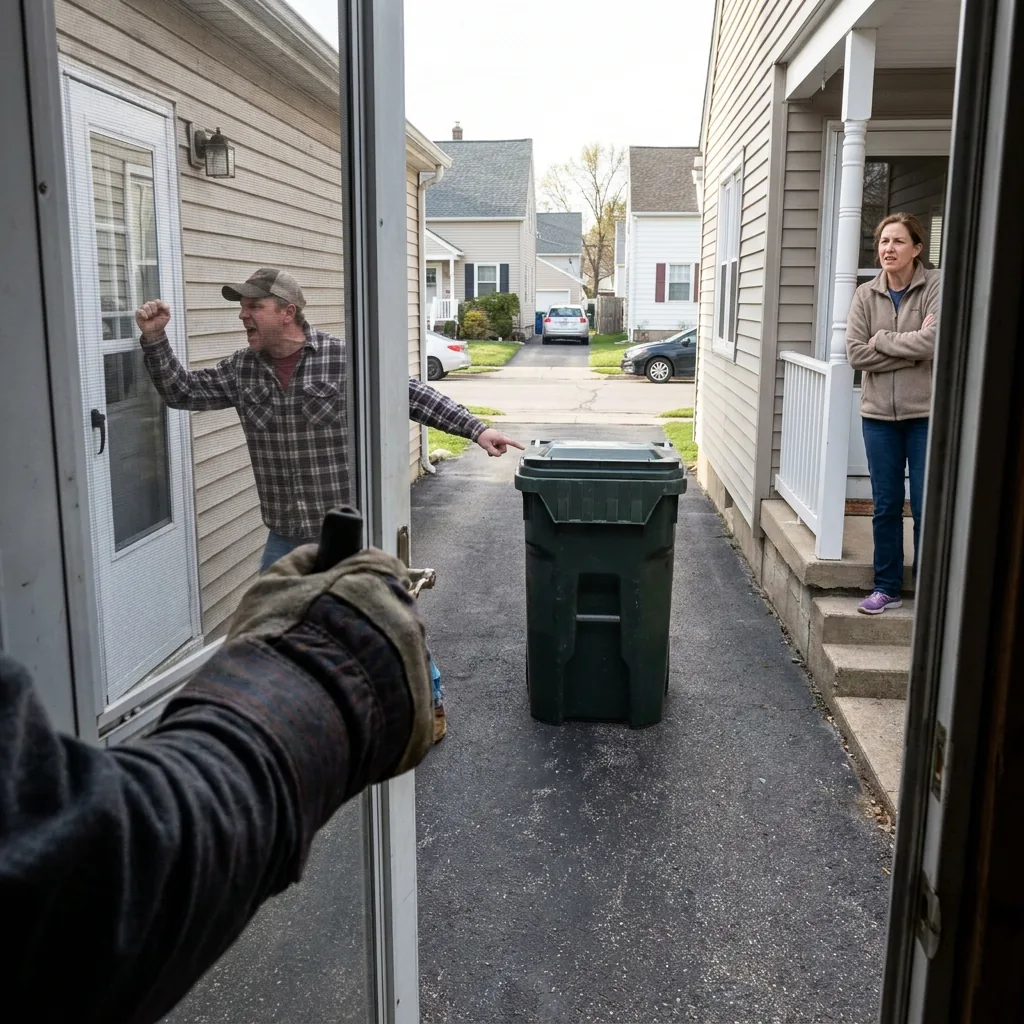
Story code: ST-000675
Part 4: The Record Stayed
Once Keller said, “It’s already logged,” nobody talked for a second.
Not dramatic silence. Just that flat break that happens when a thing cannot be pulled back by talking faster.
Dana recovered first. She shifted from the driveway toward the street, then back again, phone still in her hand, thumb moving over a dark screen.
“So what, now I’m getting punished for trying to keep a shared area safe?” she said.
Keller kept his notepad open. “No one is being punished. I’m closing a false urgency complaint based on what is visible on scene.”
He said it the same way somebody might say a package was delivered to the wrong porch. No heat, no lecture.
Dana gave a short laugh that did not go anywhere. “False urgency? That is not what this was.”
Keller pointed with the tip of his pen, not at her face, but at the driveway. “You reported blocked emergency access. The driveway mouth is open. The bin is off center on one side. No active emergency vehicle was trying to enter. You then tried to stop the on-scene check before arrival. Those are the facts I can document.”
Every piece of it came from the driveway itself. Not rumors. Not history. Just placement, timing, and what had been said out loud.
Marisol finally moved her hand off the bin lid. “Can I roll it back a little now that you’ve seen it?”
Keller nodded. “You can place your bin where it doesn’t narrow the shared approach more than necessary. Same goes for vehicles on either side.”
That last line mattered because he said it while looking at both the bin and Dana’s crossover. He was not giving Dana the version where she stayed the only person doing common-sense policing in the driveway. He was reducing the whole thing to a shared-space rule in front of witnesses.
Dana heard that too. “So you’re blaming my car now?”
“I’m describing the layout,” he said.
He tore a small sheet from his pad and wrote for another few seconds, braced against the side of his SUV. Then he walked it back up the driveway and handed it to Dana.
“Incident number,” he said. “If you call again for an access emergency here, use that reference. If the same kind of complaint comes in and the scene is again non-emergent, that pattern gets noted.”
That was the consequence.
Not handcuffs. Not some speech. A number on a page and a pattern note attached to her address for this exact complaint lane. Cold, ordinary, and impossible to argue out of once it existed.
Dana looked at the paper without taking her eyes all the way down to it. “You’re putting something on my address over a misunderstanding?”
Keller answered, “I’m documenting the response I made today.”
She folded the slip once, then unfolded it immediately. “I want your supervisor.”
“You can request one through non-emergency,” he said. “The incident number is on the page.”
Same tone. Same pace. No opening for a neighborhood performance.
The woman across the street went back to her trunk. The dog walker started moving again. That was almost the worst part for Dana, I think, if a person only looked at surfaces. The crowd she had pulled by shouting did not stay for a second act. Once the test was done, people returned to groceries and dogs and engines.
Marisol gripped the handle and rolled the bin back maybe eighteen inches, then straightened the wheel. The difference was minor. Anyone standing there could see that it had never been the catastrophe Dana had sold at my side door.
Keller watched the bin settle, glanced once at the parked crossover, and closed his notebook. “Keep the center approach reasonably clear between both properties,” he said. “That’s it.”
He went back to his SUV and drove off without another word.
Dana stayed where she was, incident slip in one hand, phone in the other. She did not apologize. She did not restart the emergency line either. She looked at the driveway, then at the paper, then at the street where the patrol SUV had turned the corner and disappeared.
Marisol picked up the box of tile samples she had set down at the beginning and carried it back into the garage. I followed her in and pulled my glove back on. Through the open side door I could still see the edge of the bin outside, square to the concrete now, ordinary again.
Neither of us said much for a minute. The whole thing had burned hot and then ended in a notation.
Marisol finally said, “Leave the door open. If she starts over, I want the driveway in full view.”
“Fair,” I said.
I went back to the paint cans. My hands were steady again, but slower than before. Outside, Dana’s car door opened, then shut. A little later her crossover backed up and was repositioned farther in on her side, giving the shared approach a wider turn without anyone asking her to narrate it.
That was all the relief there was.
No victory lap. No porch huddle. Just the bin where everyone had seen it, the call logged the way Keller said it, and one thin piece of paper that would still exist after the driveway looked normal again.