Story code: ST-000675
Part 3: He Measured What She Kept Changing
The patrol SUV stopped at the curb with its lights off.
Dana moved first. She got to the sidewalk before the driver even opened his door, one arm up, talking before Officer Ben Keller had both feet on the ground. From where I stood at the mouth of the driveway, I could hear her words hitting in bursts.
“It was almost blocked,” she said. “I told them to fix it, and now it’s turning into a scene for no reason.”
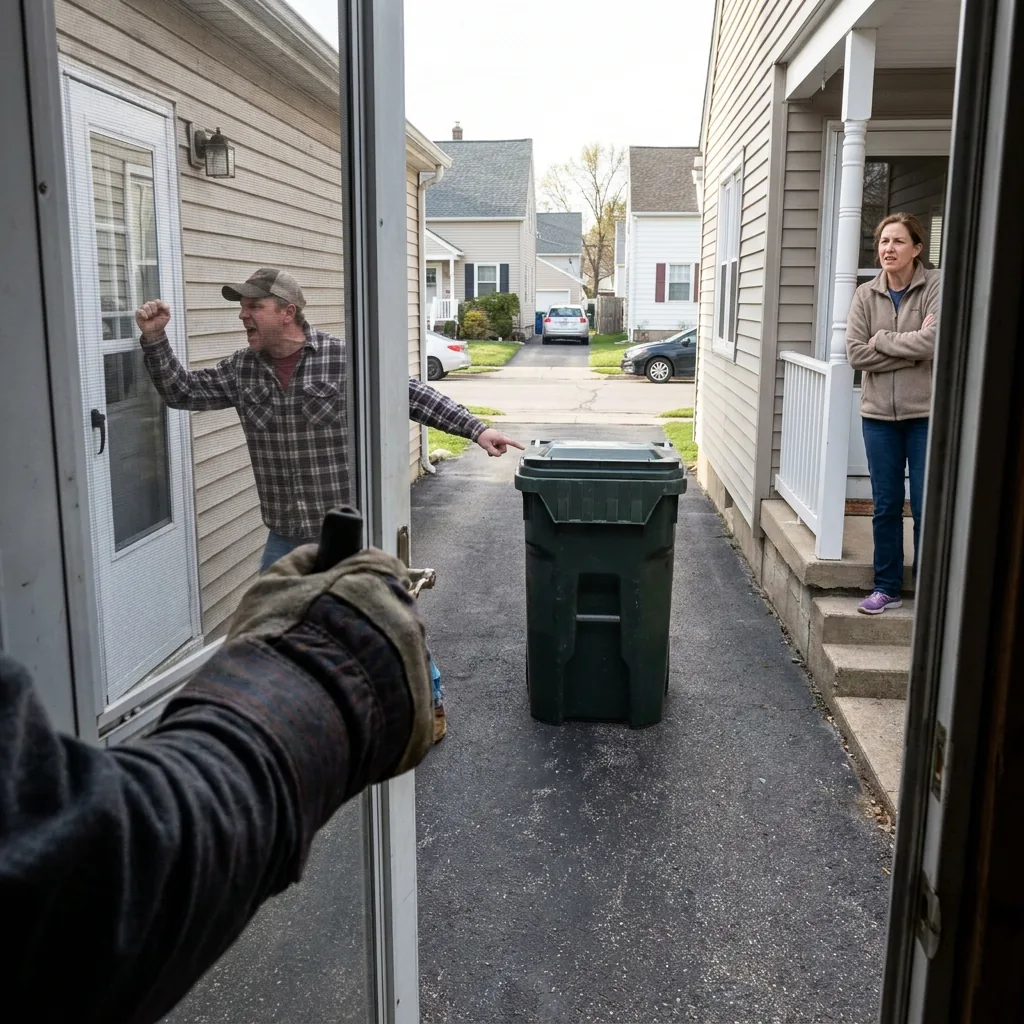
That was not what she had yelled through the side door ten minutes earlier.
Officer Keller did not answer right away. He looked past her, across the shared driveway, at the trash bin, then at Marisol standing beside it, then at me in one work glove with the other tucked into my back pocket. He shut the SUV door and walked up the driveway at a normal pace, not hurried, not casual either.
“Who called in blocked emergency access?” he asked.
Dana lifted her phone a little. “I did, but I was trying to prevent a problem before it got worse.”
Marisol said, “She came over saying it was an emergency and the bin had to be moved right then.”
I added, “Then when we said let help come look, she asked us to move it before you got here.”
Dana turned toward us sharply. “Because this is stupid over one trash bin.”
Officer Keller held up one hand without looking at her. “Nobody talk over each other.”
He walked to the bin and stopped beside it. Up close, it looked exactly like it had from the garage: one wheel turned sideways, lid shut, body angled slightly toward the narrowing point but still on Marisol’s side of the seam. Keller looked at the wheel, then at the space between the bin and Dana’s parked crossover on her side.
“Whose bin?” he asked.
“Mine,” Marisol said.
“Who placed it here today?”
“I rolled it out before six for pickup.”
Dana cut in. “That isn’t the point. The point is that if an emergency vehicle had needed in, this would have blocked the route.”
Keller looked at her for the first time since coming up the driveway. “Had needed in, or needed in?”
There was a short pause.
Dana said, “Needed clear access.”
“That’s not the same answer,” he said.
He stepped backward toward the street and sighted down the driveway opening. Then he walked the line a vehicle would take, from the curb cut inward, not touching anything, just watching the angle. He stopped near the seam where the two halves tightened together.
“Move nowhere,” he said. “I want it as-called.”
Dana made a small sound in her throat and came forward one step. “Officer, this really doesn’t need all that. She can just pull it back two feet and we’re done.”
“You reported immediate access obstruction,” he said. “I’m looking at immediate access obstruction.”
The dog walker was still at the sidewalk. The woman across the street had crossed her arms and stayed by her trunk. A landscaper’s trailer slowed at the stop sign, then rolled on. Dana’s voice got tighter with every extra set of eyes.
Keller took a small tape measure from a pocket on his duty belt. He did not make a show of it. That almost made it colder. He hooked the end at the edge of the bin, stretched it toward the parked crossover, looked once, and let it retract.
Then he pointed at Dana’s vehicle. “Is that yours?”
“Yes, but that has nothing to do with this.”
He said, “It is on your side of the shared approach and reduces swing room more than the bin does.”
Dana’s mouth opened, then shut. “Because I parked at my own house.”
Marisol did not move. “And I put my bin at mine.”
Keller nodded once, still looking at the layout. “Exactly.”
Dana turned toward him fully. “You are missing the bigger issue. If somebody had to come through fast-”
He cut her off. “Somebody did not. That is why we’re on the access complaint side, not an active emergency response side.”
That landed harder than if he had raised his voice.
He asked me, “When I arrived, had anyone moved the bin from the position it was in when she first complained?”
“No,” I said. “I offered to straighten the wheel. She told me not to touch it.”
Marisol said, “I heard that too.”
Dana swung toward us. “Because by then there was no point.”
Keller wrote something in a small notepad. “So first the bin had to be moved immediately, then it was not to be touched.”
Dana stepped closer to him. “That is not what I said.”
He looked up. “I heard what you said at the curb. They heard what you said before I got here. The layout is here in front of me.”
Then he did the one thing that changed the scene from argument to test. He spoke into his shoulder mic, gave his location, and asked dispatch to note that the reported emergency access obstruction was unfounded on arrival, with complainant on scene and access visible from the street.
Dana put her hand out like she could stop the words in the air.
“No,” she said fast. “Don’t put it through like that. I wasn’t reporting it like that. I was asking a question.”
Officer Keller finished the transmission anyway, clicked the mic off, and said, “It’s already logged.”