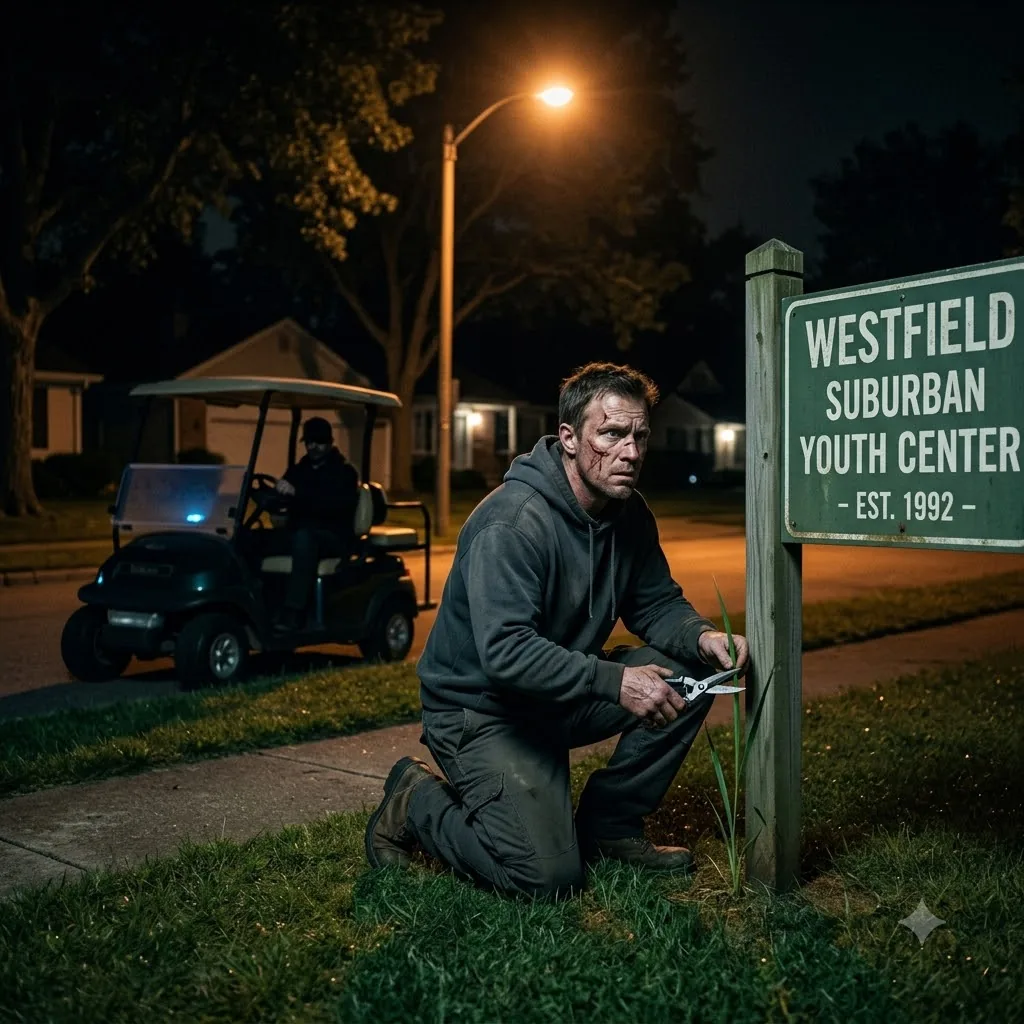
Story code: ST-000690
Part 3: The Civil Matter
Mateo stared at the heavy, matte-black pneumatic stunner resting on the pristine plastic table. The silence in the cavernous, frost-bitten warehouse was total, broken only by the rhythmic, electrical hum of the single halogen work light overhead. The threat hung in the freezing air, sharp and physical. *The collections committee.* He knew exactly what that meant. *The kids.*
Mateo’s massive hands, hanging loose at his sides, slowly curled into tight, trembling fists. He had spent five grueling years trying to bury the man he used to be. The man who collected debts in dimly lit basements, who solved complicated problems with broken glass and fractured orbital bones. But if Hector sent someone in the dark to lay a hand on Julian or any of the other twenty-nine children sleeping under that roof, that buried man was coming back.
Mateo shifted his weight to the ball of his back foot. He calculated the geometry of the room. Exactly ten feet to the folding table. He could clear it in one point five seconds. He could shatter the older man’s jaw with a cross, flip the heavy table over to pin the woman, and have his thumbs buried in Hector’s windpipe before the board president’s manicured fingers could even brush the cold steel of the bolt stunner.
“You send anyone near my center,” Mateo said. His voice was a low, gravelly rasp that echoed off the corrugated steel walls. “And I won’t just kill you. I’ll make it last for days. I know how.”
He stepped forward, his heavy boots crunching loudly on the gravel-dusted concrete, crossing the invisible boundary into their space.
Hector did not flinch. He did not lunge for the weapon. The woman in the peach tennis skirt merely adjusted her posture, looking mildly bored, like she was waiting in line at a high-end coffee shop. The older man in the navy blue sweater vest sighed softly and took a slow sip from a stainless steel travel mug.
“Violence,” Hector said smoothly, resting his hands flat on the meticulously aligned stack of yellow citations, “is exactly the kind of uncultured, low-yield behavior we left behind, Mateo.”
Mateo stopped. His muscles remained coiled, but his mind scrambled, confused by their utter lack of adrenaline. People facing death always reacted. They fought, they fled, or they froze. These three were doing none of the above. They were doing paperwork.
“You think a slaughterhouse toy is going to stop me?” Mateo asked, nodding toward the pneumatic bolt gun.
“This?” Hector reached out and casually tapped the metallic cylinder. “This is just for wild dogs that wander onto the subdivision properties. Or stray coyotes rummaging in the recycling bins. County animal control is terribly slow, and we demand pristine streets.” Hector smiled. It was the exact same polite, dead-eyed expression he had worn on the sidewalk at four in the morning. “I don’t need weapons to destroy you, Mateo. And I certainly don’t need to break the law.”
Hector reached up and slowly unzipped his crisp, charcoal-gray tracksuit jacket just a few inches.
Beneath the expensive fabric, resting high on his collarbone, Mateo saw the ink. It was faded, jagged, and unmistakable. A black skeletal saint clutching a blood-red scythe. La Santa Muerte. But it was the three gothic block letters surrounding the skull that made Mateo’s blood run instantly cold. *C.D.R.* The Cartel de los Reyes. The syndicate that had swallowed the southern drug corridors whole, leaving a trail of hanging corpses from highway overpasses across three states.
The frantic warning from his old associate flooded back into his mind. *Nobody crosses the Oak Creek HOA. They aren’t just enforcing grass lengths.*
Mateo’s eyes darted between the three of them, the tactical geometry of the room suddenly feeling like a mouse trap. “Reyes,” he breathed, the realization clicking into place. “You’re cartel. All of you.”
“I am the Vice President of Neighborhood Compliance,” Hector corrected softly, though his dark eyes gleamed with a cold, predatory intelligence. “And Mr. Vance here,” he gestured politely to the older man in the sweater vest, “ran the largest trafficking plaza in Sonora for a decade. Now, he chairs the beautification committee.”
Mr. Vance raised his travel mug in a silent, polite toast.
“What is this?” Mateo demanded. His fists remained tight, but the tactical advantage had completely evaporated. You couldn’t punch a multinational syndicate out of existence. “You’re running a safe house out of a suburban subdivision? Using an HOA as a front to launder money?”
“A front?” The woman in the tennis skirt scoffed, rolling her eyes. “Please. Give us some credit. Think bigger.”
Hector leaned forward, folding his hands deliberately over the deed transfer. “Do you know what happens when you run a traditional protection racket, Mateo? When you smash windows and break kneecaps to collect your neighborhood tax?”
Mateo didn’t answer. He kept his eyes locked on Hector’s hands, waiting for a trick.
“The police get involved,” Hector answered for him. “The FBI builds a massive RICO case. The ATF raids your safe houses. Your own lieutenants wear wires. The overhead of violence is astronomical, and the legal risk is entirely unacceptable for a modern enterprise. We are businessmen. We wanted to extract regular, substantial capital from a community, and acquire vast amounts of real estate, without ever committing a single prosecutable felony.”
Hector tapped the yellow carbon-copy slip resting on the top of his pristine stack.
“Enter the Homeowners Association,” Hector said, his voice dropping into a tone of genuine, chilling reverence. “It is a masterpiece of American jurisprudence. When you buy a home in Oak Creek, you sign a restrictive covenant. You legally surrender your property rights to a private corporate entity. Us.”
Mateo stared at the paperwork on the table. The noise citations. The aesthetic blight fines. The fractional measurements of grass.
“Extortion is a major crime,” Hector continued, his flat eyes locking onto Mateo’s. “But levying a three-thousand-dollar fine because a trash can was left at the curb for four hours? That is a legally binding civil penalty. If you don’t pay it, we automatically attach a lien to your deed. If you still don’t pay it, we foreclose. We take your home, completely legally, with the full armed backing of the county sheriff, who will gladly evict you on our behalf.”
The sheer, bureaucratic evil of the mechanism washed over Mateo, suffocating him. The cartel wasn’t hiding from the law. They had weaponized it.
“We don’t sell drugs in Oak Creek,” Hector said softly. “We don’t shoot people in the streets. We just enforce the bylaws. Strictly. We generate six million dollars a year in penalty revenue, completely clean, completely taxable. And when someone can’t pay their fines, we seize the asset, flip it to a shell company, and gentrify the neighborhood.”
Mateo looked at the printed deed of transfer waiting on the plastic table. The trap was flawless. If they were just street thugs, he could fight them. If they came with guns, he could barricade the doors. But they were coming with clipboards, calipers, and the supreme power of the county civil courts.
“Your youth center,” the woman in the tennis skirt said, her voice dripping with artificial, saccharine sympathy, “is sitting on three acres of prime residential zoning. The board has voted to redevelop the parcel into luxury townhomes.”
“So you engineered the fines,” Mateo said, his voice hollow, the fight draining out of his massive shoulders. “The grass. The peeling paint. The AC unit. You’re just bleeding me out to steal the land.”
“We are simply enforcing the established community standards,” Hector replied, tapping the deed transfer with a perfectly manicured fingernail. “You owe us eight thousand dollars, payable immediately. You don’t have it. Which means we begin foreclosure tomorrow morning. Or, you sign the deed tonight, walk away free and clear, and we won’t have to send a property inspector to visit those sleeping children to evaluate the structural integrity of their cots.”
Hector slid a heavy silver pen across the table. It rolled smoothly and came to a stop exactly one inch from Mateo’s scarred hands.
“It’s entirely your choice, Mateo,” Hector smiled. “A purely civil matter.”