Story code: ST-001783
Part 4: The Arithmetic
“Would you like to provide a debit card today to make a supplementary payment…” Marcus’s tinny voice repeated from the tiny speaker, oblivious to the crater he had just blown into our lives.
I finally moved. I stepped forward, my hand shaking violently, and stabbed the red button on the screen. The call disconnected. The sudden silence in the garage was suffocating, broken only by the rhythmic, wet sounds of my mother quietly weeping on the bottom step of the stairs.
My dad didn’t move. His grease-stained hands hung uselessly at his sides. He stared at the blank screen of the phone resting on the workbench, the realization of what had just happened settling over him like a suffocating blanket of lead. Brenda in HR knew. By lunchtime tomorrow, every guy on the shop floor would know. The financial discipline he had worn like a badge of honor for three decades was gone, exposed as a massive, humiliating fraud.
“Dad,” I croaked, the word tearing at my throat. “I’m so sorry. I didn’t want this.”
He finally lifted his eyes to mine. There was no rage left in them. Just an endless, hollow devastation.
“You let me brag,” he whispered, his voice trembling under the weight of the betrayal. “You stood right there by the tire, listening to me tell Frank Henderson that you paid your own way. You let me look like an absolute fool.”
The guilt was unbearable, but beneath it, a sudden, jagged spike of defensive adrenaline flared in my chest. I had spent four years suffocating under the weight of his impossible expectations, and something inside me finally snapped.
“Because you wanted to look like a fool!” I screamed, the volume tearing out of me so violently that my mother flinched. The tears were pouring down my face now, hot and shameful. “You wanted the illusion, Dad! You demanded it!”
He blinked, stunned by my outburst, taking a half-step back against his truck.
“Did you ever once sit down and do the math?” I yelled, gesturing wildly at the workbench. “Did you ever actually calculate what it costs to live in this century? Tuition at Emerson was twenty-two thousand dollars a semester! The dorm was ten thousand a year! Meal plan, textbooks, fees-it was sixty grand a year! I was making seven dollars and twenty-five cents an hour at the diner! Seven dollars!”
“People work their way through!” my dad shouted back, a weak, desperate attempt to defend a worldview that was rapidly disintegrating. “I paid for my degree working at the lumber yard!”
“That was 1985!” I shrieked, my voice cracking, echoing brutally off the concrete walls. “You paid four hundred dollars a semester! You cannot pay sixty thousand dollars a year bussing tables on the weekends! It is mathematically impossible! If I didn’t eat a single meal, if I didn’t buy a single textbook, if I didn’t sleep, I couldn’t even pay the interest on the loans! But you wouldn’t listen!”
I took a step toward him, pointing a trembling finger at his chest. “I begged you to let me go to community college. I begged you! But you said no. You said the Miller name belonged at a prestige school. You told me debt was for lazy people. You refused to co-sign the federal loans. So I had to go to the shadow lenders! I had to steal your tax returns in the middle of the night just to give you the son you wanted! I committed a federal crime so you could brag to the neighbors about how hard your boy works!”
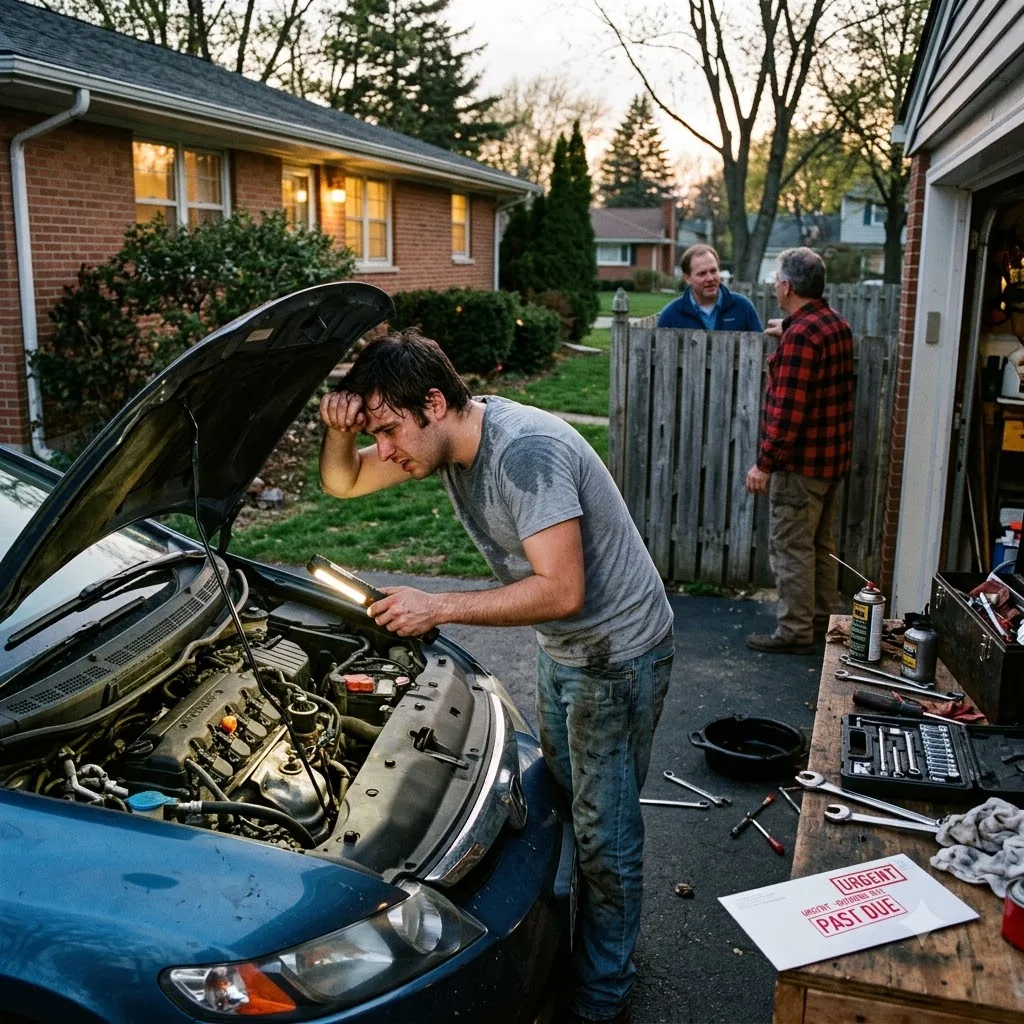
My dad stared at me. The color drained entirely from his face, leaving a sickly, ashen gray beneath the streaks of engine grease. He looked at the red-stamped envelope on the floor. He looked at the 1998 Ford Ranger he kept running just to save a few bucks. He looked at my mother, who was staring at me with abject horror.
The math. It had always been right there, staring him in the face, but he had chosen not to see it because the lie felt better.
His chest heaved. He looked down at his cell phone sitting next to the socket wrench. The device that had just delivered his death sentence to his employer. The device that proved his entire philosophy was obsolete.
With a sudden, terrifying roar that sounded more like a wounded animal than a man, my dad snatched the heavy cell phone off the workbench. He didn’t throw it at me. He raised it high above his head and brought it down with catastrophic force against the concrete floor.
The sharp crack of breaking glass and snapping plastic echoed like a gunshot. The phone shattered into a dozen pieces, the battery skittering under the truck, the spider-webbed screen settling in a puddle of old motor oil.
He stood over the wreckage, his chest heaving, his fists clenched so tight his knuckles were stark white. For ten agonizing seconds, nobody breathed.
Then, my dad slowly unclenched his hands. He reached over, grabbed a blue shop towel, and methodically wiped the grease from his fingers. He dropped the towel on the workbench. He didn’t look at the shattered phone. He didn’t look at my crying mother. And he didn’t look at me.
He turned around and walked slowly to the stairs. He climbed them with heavy, defeated steps, opened the door to the kitchen, and stepped inside. The door clicked shut behind him, sealing him in the house.
It was a quiet, final sound. The sound of a man retreating into a permanent, unbroken silence.
I stood alone in the center of the garage, the red-stamped envelope lying crumpled at my feet. The eighty-eight thousand dollar debt was still there. The wage garnishment was still coming. But worst of all was the sickening, absolute certainty that I had just destroyed my father, and no amount of hard work would ever buy him back.