Story code: ST-000846
Part 4: The Judge
The heavy sliding door of the passenger side didn’t just open; it was violently wrenched backward on its tracks. Two of Hector’s enforcers reached into the sweltering cab of the transit van before Leo could even process the movement. One massive hand clamped down on the teenager’s wrist, snapping it back to secure the useless pistol, while another fist twisted into the nylon fabric of the puffer jacket.
They dragged Leo out onto the sun-baked concrete of the loading dock. He hit the ground hard, his knees scraping audibly against the asphalt. The heavy, tape-wrapped brick of narcotics tumbled out of his lap, bouncing once before Marcus stopped it calmly with the toe of his polished boot.
Mateo kept his hands on the steering wheel, his breathing shallow. Through the dirty windshield, he watched Hector step forward. The scarred Eastside leader didn’t look at the drugs, and he didn’t look at the hyperventilating teenager bleeding onto the concrete. He looked directly at Mateo.
Hector offered a single, microscopic nod. An acknowledgment of the transaction. A confirmation that the summer truce remained intact, paid for in full by the delivery of this rogue variable.
Mateo didn’t nod back. He shifted the van into reverse. As he backed out of the crumbling lot, his side mirror caught a brief, fragmented glimpse of the circle tightening. Marcus picked up the brick. Hector knelt beside Leo. Mateo cranked the steering wheel hard, forcing his eyes forward, and drove out of the industrial sector. He rolled the windows down, letting the hot, rushing air scour the scent of the teenager’s panic from the cab, but the silence in the passenger seat felt heavier than the gun had.
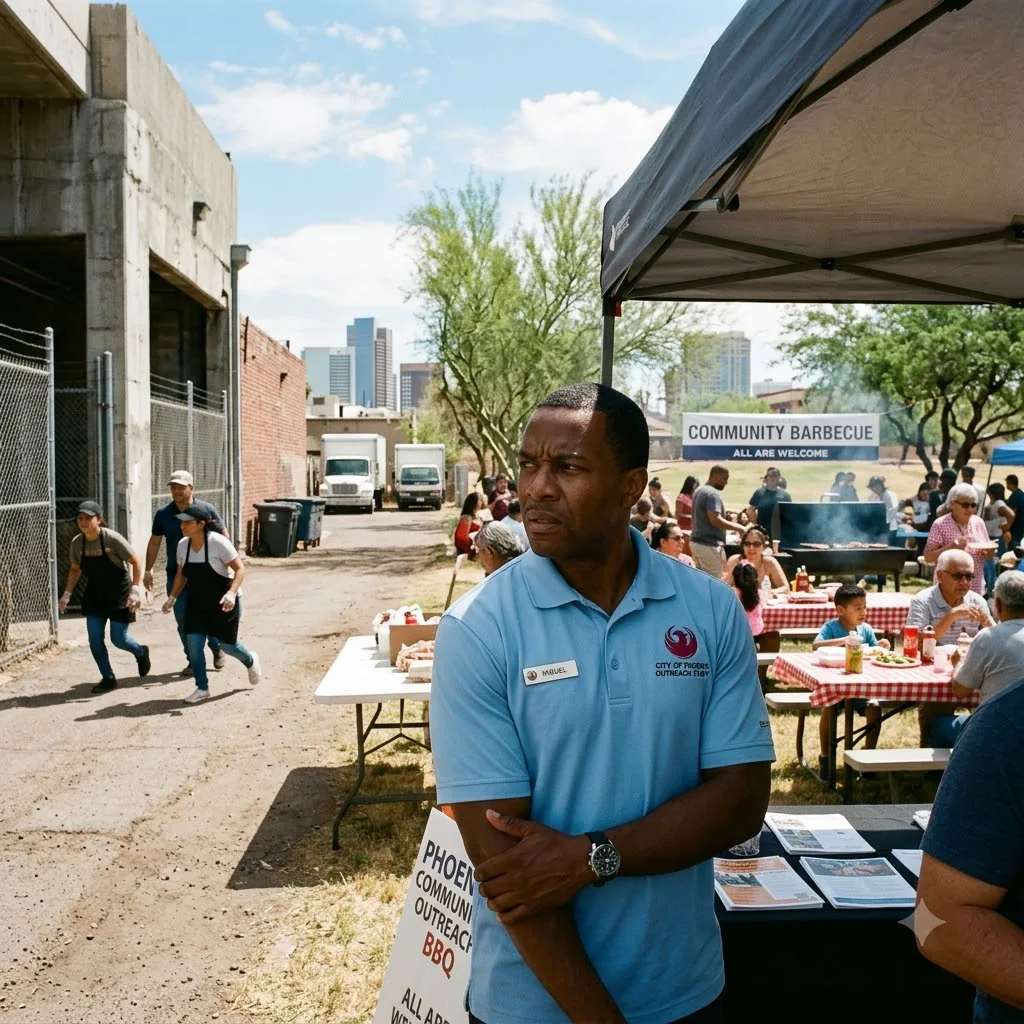
He didn’t drive back to the community center. The BBQ would be wrapping up soon, the elders packing up the folding tables, completely oblivious to how close the afternoon had come to a bloodbath. Instead, Mateo steered the municipal van toward the cramped, high-density residential blocks on the northern edge of the district.
He parked illegally in front of a fading brick tenement and took the stairs two at a time to the fourth floor. The hallway smelled of boiling cabbage and industrial floor wax. When he knocked on apartment 4B, the sequence was specific: two heavy knocks, a pause, one light tap.
The deadbolt threw instantly. Graciela stood in the narrow doorway, clutching a stuffed canvas backpack. Her eyes were red-rimmed, her face pale beneath the harsh fluorescent hall light. Behind her, in the tiny living room, her two young children sat perfectly still on a worn floral sofa, wearing their jackets despite the eighty-degree heat, their eyes wide with silent alarm.
“Did he talk?” Graciela whispered, her voice cracking. “Did he tell them my name?”
“He isn’t going to tell anyone anything,” Mateo said. The absolute certainty in his voice made Graciela flinch. She understood exactly what that meant. “But you can’t be here tonight. If he had friends, if his supplier gets paranoid and comes looking for the missing product, they might trace his last steps to the kitchen. You need to go to your sister’s place in the Heights.”
Graciela looked back at her children. The brutal reality of her situation settled heavily on her shoulders. She had done absolutely nothing wrong, yet she was the one fleeing her home, abandoning her weekend shifts, and uprooting her kids.
Mateo reached into his canvas apron. He pulled out his battered leather wallet, emptied every crumpled bill he had, and pressed the cash into her trembling hand. “This covers your shifts at the diner. Take the bus. Stay inside for four days. I’ll call you when the street is clean.”
She didn’t argue. She nodded numbly, shoved the money into her pocket, and ushered the children out the door. Mateo stood in the hallway and watched them hurry down the stairwell, three innocent ghosts slipping out the back door of a war zone.
When Mateo finally returned to the transit van, the sun had begun to dip below the jagged neighborhood skyline, casting long, bruised purple shadows across the concrete. He climbed into the driver’s seat but didn’t put the key in the ignition.
His phone buzzed on the dashboard. The screen lit up, illuminating the cracked glass.
A single text message from the unlisted number: *Pest control finished. Truce holds. Good looking out.*
Mateo stared at the glowing letters until the screen timed out, plunging the cab back into shadows. The silence in the van felt suffocating. He reached out and touched the cracked plastic tray between the front seats, where the taped brick of narcotics had rested just an hour ago. He had spent six months negotiating, pleading, and compromising to build a new role for himself-a neutral mediator, a man of peace, a city outreach worker who served the community instead of ruling it.
But as he sat alone in the fading light, the heavy canvas apron suddenly felt exactly like the armored vests he used to wear. He had protected Graciela. He had saved the community BBQ. He had kept the fragile peace alive. But he had paid for it by driving a seventeen-year-old boy directly to his execution.
Mateo leaned his head against the steering wheel and closed his eyes, burdened by the grim, inescapable realization that he hadn’t escaped his past at all. To save the neighborhood, he had simply become its judge once again.