Story code: ST-000029
Part 4: The Collateral Damage
Leo watched the silence stretch through the frigid, air-conditioned dining room. Arthur stood rigid, his hands resting on the stack of fake pink citations. The older man didn’t look like a neighborhood tyrant anymore; he looked like a tired, aging actuary who had run out of numbers to shuffle.
Arthur slowly pulled away from the oak table. He picked up the heavy FedEx box bound for Zurich-Apex and tucked it under his arm. Without a word, he turned and walked out the front door, leaving it wide open behind him.
Leo followed. The moment he crossed the threshold, the oppressive evening heat hit him like a physical blow. The sun had finally vanished behind the rooflines of Oakridge Estates, but the triple-digit temperature hadn’t broken. The stagnant air smelled heavily of baked dirt and dying fescue.
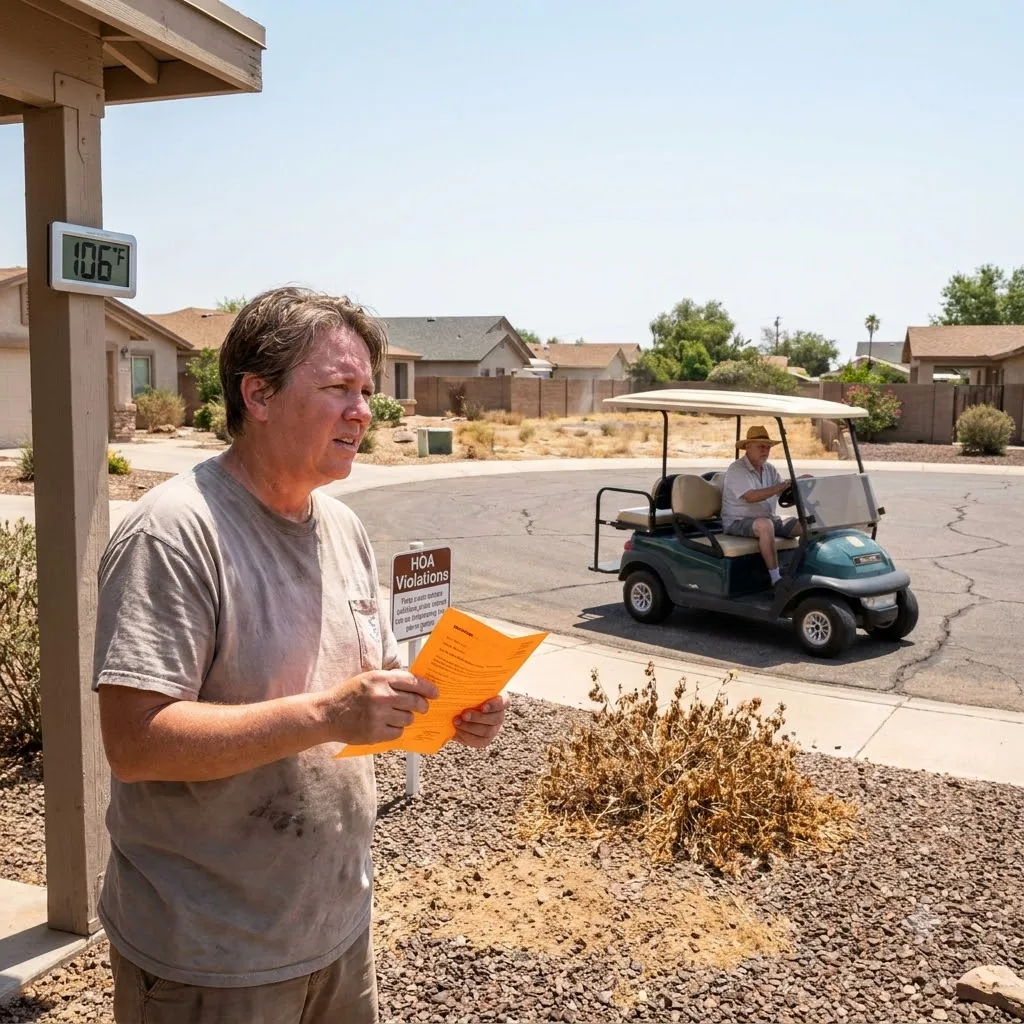
Arthur walked down the brick path to the street. His silver golf cart sat exactly where he had left it, parked against the curb. Arthur didn’t put the box on the seat. He dropped it onto the floorboard. Then, as if the last remnants of his adrenaline had completely evaporated, the HOA president sank down. He didn’t sit in the cart. He slid down the plastic fender and sat directly on the dark, heat-soaked asphalt of the street.
Leo walked down the driveway. His heavy work boots scuffed against the dead grass. He stopped in the street, looking down at Arthur. The older man had his elbows on his knees, staring blankly at the cracked pavement between his shoes.
Leo hesitated, then lowered himself down. He sat on the hot asphalt next to Arthur, leaning his back against the front tire of the golf cart. The heat radiating upward from the road surface seeped instantly through Leo’s jeans, an uncomfortable reminder of the scorched earth beneath them.
“It won’t work, Arthur,” Leo said quietly.
Arthur didn’t look up. “I have three hundred pages of documented compliance efforts. The extension clause is boilerplate. They have to give us thirty days.”
“And then what?” Leo asked, wiping a bead of sweat from his forehead. “In thirty days, the county water ban will still be in effect. The drought isn’t going anywhere. Our lawns will still be dead. What happens on day thirty-one?”
Arthur took a slow, rattling breath. “I don’t know.”
Leo looked down the street. A few houses away, the Miller residence stood in the fading dusk. The front lawn was soaked, dark mud pooling around the brittle brown hydrangeas.
“Mrs. Miller actually turned her sprinklers on,” Leo said, his voice tightening. “Because she was terrified of losing her house to your fake default auction, she broke a real municipal law. That county water inspector handed her a genuine one-thousand-dollar citation. She’s on a fixed income, Arthur. That fine is real.”
Arthur pulled his wire-rimmed glasses off, rubbing the bridge of his nose. “I know.”
“She appeased the HOA to save her house, and the county crushed her,” Leo continued, the bitter reality of the trap settling heavily in his chest. “If she hadn’t watered, the insurance company would have crushed us all on Monday. There’s no way out. We’re just caught in the gears.”
Arthur looked over at Leo, his eyes bloodshot and hollow. “I just wanted to buy us a month. I thought maybe the county would lift the ban. Or maybe it would rain. I didn’t know what else to do. If I tell the neighborhood the truth, panic sets in. People stop paying their HOA dues entirely. The association goes bankrupt before Zurich-Apex even drops the policy.”
They sat in silence on the baking street. The bureaucratic machinery that governed their lives had perfectly boxed them in. The local government demanded dead lawns to save water. The corporate underwriters demanded green lawns to mitigate risk. There was no appeals process for the drought, and no human being on the other end of the insurance master policy to negotiate with. It was just a collision of rigid, indifferent systems, and Oakridge Estates was the collateral damage.
Leo reached into his back pocket. He pulled out the neon-orange lien warning and the pink obstruction ticket Arthur had written him just hours ago. He stared at the bold red text threatening to seize his home. He thought about the eighty-two dollars sitting in his checking account.
He leaned forward and held the papers out.
Arthur looked at the neon-orange and pink slips. He didn’t recite bylaws. He didn’t threaten private security. His shoulders slumped further as he reached out and took the papers from Leo’s hand.
Arthur folded the citations carefully in half and slipped them into his shirt pocket, alongside his digital camera. It was a quiet surrender. He accepted the returned fines, knowing they were completely useless against the massive, looming machinery of the banks.
Leo leaned his head back against the golf cart tire, closing his eyes as the residual heat of the asphalt baked into his spine. They had thirty days of borrowed time, but the sky remained cloudless, and Monday was still coming.