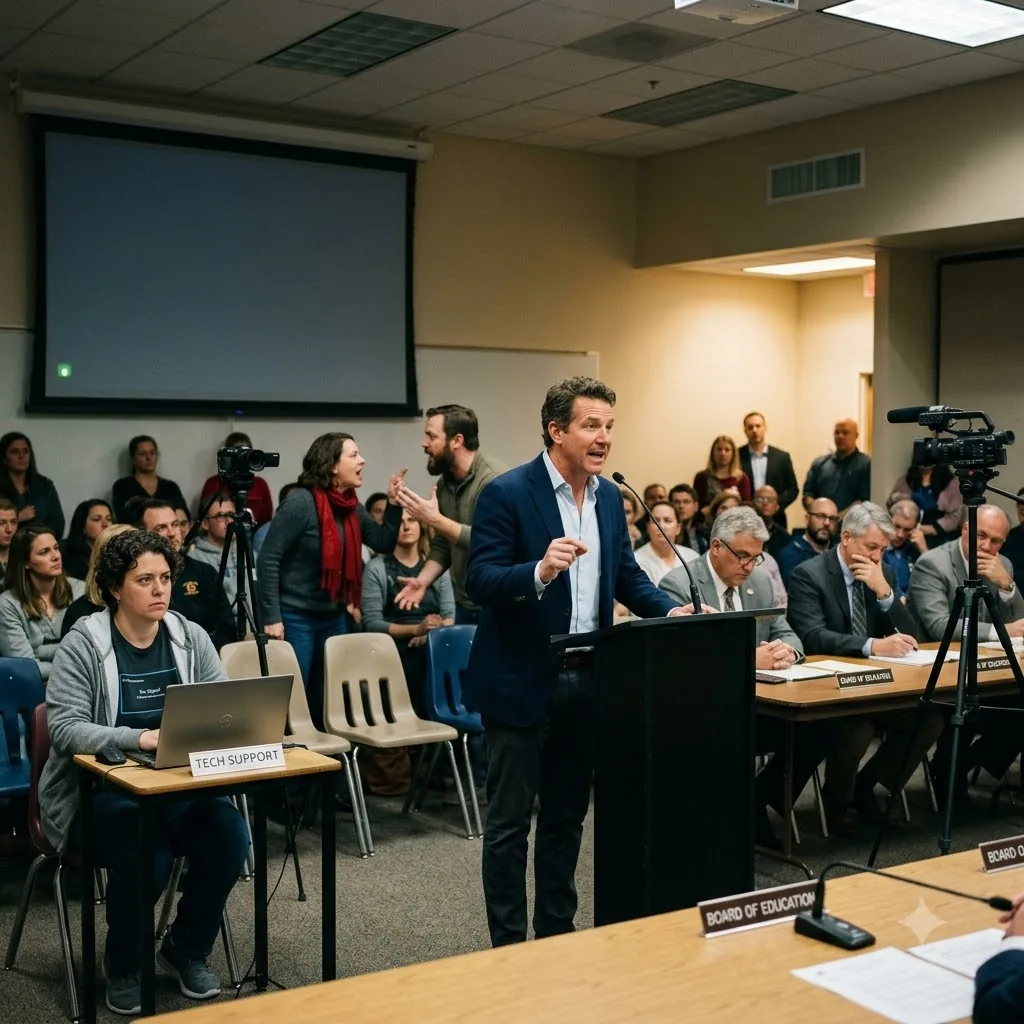
Story code: ST-001578
Part 2: The Sidebar on the Wall
The sidebar did not just open. It spilled.
A pale column spread across the projector image where the archive should have been, crisp enough now for the first row to read. Folder names stacked one under another. Date stamps. Colored collaborator dots. A highlighted item near the top with a title cut off after the first few words: Community Response – Franklin Ri.
Mara reached the clerk’s station just as the clerk lifted her hand from the mouse, eyes wide, as if the machine had moved by itself.
“Hands off,” Mara said, sharper than she meant to, and leaned between the desk and the projector cart. She caught the mouse, dragged the cursor hard toward the top corner, and clicked to close the panel.
Nothing happened.
The cursor lagged, jumped, and then a preview pane flickered open over the folder list.
There were lines of text now. Bullet points. Not enough for her to read top to bottom, but enough to catch fragments before the room did what rooms always did with half-seen words and a screen bigger than any person in it.
talking points.
board concerns.
press if asked.
A murmur broke across the gym in a wave. It started in the front rows, where people could read fastest, then widened into sound: questions, accusations, the low thrilled noise of a crowd spotting shape before fact. Phones went up all at once.
Behind her, Beck’s amplified voice cut in, no longer warm.
“Let’s not jump to conclusions about a partial display.”
That would have helped if he had said it ten seconds earlier. Now it landed as ownership. Mara felt that before she thought it. She hit Escape. She right-clicked by instinct, cursed herself for it, then grabbed the keyboard and used Alt-F4. The preview vanished. The folder remained.
The board president was half-standing. “Can we turn that off?”
“I’m trying,” Mara said.
She could hear her own voice through no microphone at all and hated that it sounded small.
Someone near the center aisle called, “What is Community Response?”
Another voice: “Whose talking points?”
The clerk, pressed back in her chair, said to no one and everyone, “I didn’t open that.”
Mara believed her. It did not matter.
She reached behind the monitor for the projector cable, fingers finding dust, plastic housing, a hot vent, then the thick HDMI line. If she killed the feed, the room would at least lose the text. But the cable had been zip-tied into the portable setup by district facilities, neat and stubborn, and Beck was suddenly at her shoulder, one hand over the microphone head as if muting himself for privacy while still standing where every camera could see him.
“If you disconnect now,” he said, low, “it will look worse.”
Mara turned on him. Up close, his expression was composed in the infuriating way of a man already adjusting his public version of events.
“It already looks worse.”
“Then don’t make it look intentional.”
The clerk made a sound somewhere between a gasp and a laugh as the screen changed again.
A file opened full frame.
This time there was no mistaking the formatting. A district crest sat at the top left. Below it, in clean bold type, was a meeting date matching tonight’s. Beneath that, lines of prepared language arranged in sections with headers.
Opening remarks.
Likely objections.
Redirects.
Mara could not see the whole page from where she stood, only the top third reflected in the clerk’s monitor and magnified behind them, but the gym saw enough. A man in the back shouted, “Scripted.” Someone else shouted, “Read the names.” A woman near the TV camera said, loudly and with satisfaction, “I told you.”
The board president pounded once on the dais with the flat of her hand. “Order. Please.”
No one obeyed. The room had crossed into that ugly, self-propelling stage where every attempt to contain it proved there was something to contain.
Mara yanked the laptop dock free from the monitor instead. The projector image flashed blue.
For a single blessed second there was only the projector’s input screen floating over the dais.
Then Beck lifted the mic again.
“No one in this room should confuse a broken display with evidence of wrongdoing,” he said, turning just enough to share himself with the cameras and the crowd at once. “And no one should be comfortable with the timing of this failure.”
There it was. Not a denial. Not a claim. A lane through the middle that let everyone carry their own worst assumption forward.
Mara still had the loose cable in one hand. The clerk’s monitor had gone dark. On the table beside it, the district laptop remained open, fan whining. If the sidebar had come from a sync notification or an already-open background window, it might still be there locally. If she shut it now, she might lose the only clean trace of what had flashed up. If she left it live, someone else could touch it again.
Her phone buzzed in her back pocket. Then again.
She shoved the cable down, fished the phone out, and saw three messages at once.
ON CALL: No platform-wide outage showing. Investigating your tenant.
UNKNOWN NUMBER: Do not open shared folders from board machine.
Lena Ops: Who else has clerk access tonight?
Mara stared at the second message long enough to feel the blood shift in her face.
Unknown number. No signature. No context. Just a warning that arrived about forty seconds too late.
“Mara.” The superintendent had come down from the dais and was standing on the other side of the station, jacket unbuttoned, voice pitched for urgency without panic. “Tell me exactly what that was.”
She looked from him to Beck to the board president trying and failing to reclaim the room. The local TV reporter had moved closer. Her camera light was on. Two parents were arguing in the aisle now, not about the screen but about what the screen proved. The veteran teacher on the livestream monitor was gone; his square had been replaced by a buffering wheel.
Exactly was impossible. Anything shorter would be used.
“A synced folder or document surfaced through the presentation machine,” Mara said. “I don’t know yet whether it was pushed, cached, or opened by accident. I need the device isolated before anyone touches it again.”
That got him only halfway to understanding, and she could see the moment he decided halfway was enough for public use.
He nodded once, already turning. “You heard her. The device may have been pushed.”
Beck’s head came up at that word. So did half the room’s.
Mara felt the mistake leave her mouth and become everyone else’s property.
“May have,” she said, too late and too quiet.
The superintendent was already speaking to the board president. The reporter was already repeating pushed into her phone. Beck did not smile. He did something worse: he looked grave, as if events had validated a concern he had carried with reluctance into the room.
Her laptop at the tech table chimed across the gym.
A new notification glowed on the unattended screen she had left by the wall. Even from here she could read the sender line because the projector glare no longer washed it out.
Board_Materials – Access changed.
Then the second line appeared beneath it.
You were removed from this folder.
A teenager in the front row read it aloud before Mara could move.