Story code: ST-001578
Part 4: Bruised Relief
Beck did not recover the room.
He tried.
Mara watched him reach for the old tools anyway: a lowered voice, an open hand, the look of a man saddened by confusion instead of cornered by it. But the rhythm was gone. Every sentence snagged on something already visible-the blue-ink note on the run sheet, the cached subject lines on Mara’s laptop, the district name sitting in that file title like a thumbprint left in wet paint.
“We’re not doing this by fragments,” Beck said at last. “Not in a public meeting with partial internal materials and no authentication of what was pushed to that screen.”
The board president stood fully now. “No,” she said, and her microphone carried cleanly for the first time in twenty minutes. “We are done doing your event.”
That landed harder than shouting would have.
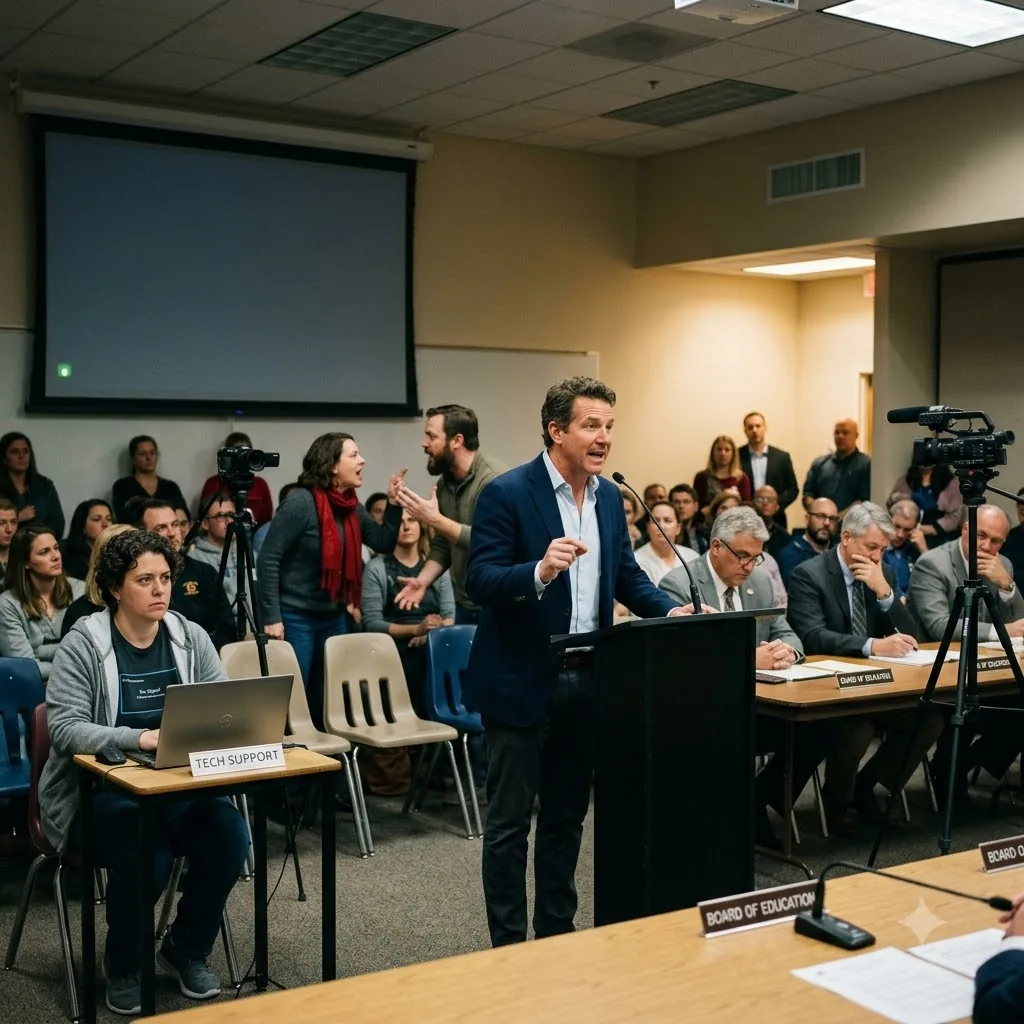
The superintendent stepped between Beck and Mara, not dramatic about it, just decisive. “I want copies of anything you have on that machine,” he told Mara. Then, to the district clerk: “Take a photo of that page.” To the AV volunteer by the wall: “Kill the projector and keep the recording from the board feed isolated.”
Beck started to object. The superintendent held up one finger without looking at him.
“Not another word until I finish.”
The gym obeyed that voice in a way it had not obeyed the gavel. People were still filming, still whispering, but the shape of the night had changed. This was no longer a spectacle looking for a villain big enough to hold everyone’s anger. It had narrowed into administrative decisions, which Mara knew from experience were slower, colder, and much harder to talk over.
The projector went dark. A few people booed at that, reflex more than conviction. Others began standing, collecting bags and jackets, talking in fast low bursts to whoever had come with them. The local reporter stayed exactly where she was.
Mara copied the screenshots, the browser history, and the cached inbox images onto a clean flash drive from the district tech kit. Her hands were steady now. That steadiness scared her more than panic had. It felt like stepping onto ground after a car wreck and discovering she could still walk.
“AirDrop it too,” the reporter said from too near her shoulder.
“No,” Mara said.
The reporter, to her credit, only nodded and backed up half a step.
Beck’s assistant appeared from the side aisle with the face of someone arriving late to a fire. She went straight to him. They spoke in whispers sharp enough to cut each other. Mara could not hear the words. She did not need to. The assistant looked once toward the run sheet in the reporter’s camera, once toward Mara’s laptop, and then at her own phone with the stunned focus of someone watching permissions disappear in real time.
That part spread fast.
Messages began coming in the moment Mara put her machine back on the hotspot long enough to send the files. Slack first, stuttering as if nothing unusual had happened: Can someone confirm founder calendar for tomorrow. Is the district event still on the homepage. Then direct messages from people who had clearly seen a clip already.
What is happening?
Did you send that file?
Why was my Drive access revoked?
Lena from ops sent no greeting at all: They just locked three shared folders and removed half the implementations team from admin groups.
Mara stared at that one.
There it was, the cost beginning to choose bodies.
Not Beck, not yet. People below him. The ones with rent, options, mortgages, childcare pickups. The ones who would wake up tomorrow and find the company had solved its narrative problem by shrinking the number of people allowed to see it.
She typed back: Save local copies of anything you already have permission to keep. Screenshot any access changes. Do not delete messages.
Then she stopped. She was not in charge of anyone. She might not even have a job by morning.
The district clerk came over while Mara was ejecting the flash drive. Up close, she looked exhausted and embarrassed, as if the machine had betrayed her personally.
“I didn’t open it,” she said quietly.
“I know,” Mara said.
The clerk let out a breath that trembled on the way down. In a room full of larger harms, that small absolution still mattered.
At the dais, the board president announced a recess that was really an ending. The veteran teacher from the livestream never came back on. Parents drifted into the parking lot carrying opposite versions of what had happened, but Mara could already tell which details would survive the night: the file named for the district, the note about instability, the sale emails. The rest would blur around them.
The superintendent returned and took the flash drive from her without ceremony. “I’ll need your contact information separate from the company list,” he said.
She wrote her personal email and number on the back of a meeting agenda.
He folded it once and put it in his inside pocket. “For what it’s worth,” he said, looking not at her but at the dead projector, “you stopped this before it turned into whatever they meant it to be.”
Whatever they meant it to be.
Not a compliment. Not forgiveness either. Just the size of the thing she had interrupted.
By the time Mara packed her laptop, Beck was gone.
Not vanished in disgrace. Just gone in the practical, infuriating way men like him often managed: escorted out a side door by their own staff before anyone could make them stand in the aftermath they had arranged for others. His assistant was gone too. So were two of the district partnership managers who had arrived with branded tote bags and smiles. In their place remained extension cords, folding chairs, crushed paper cups, and a yellow legal pad with Mara’s neat order-of-night notes crossed by everything that had actually happened.
Outside, the Indiana air had gone cold enough to sting her teeth. The parking lot lights made every windshield look blank and metallic. A small knot of teachers stood near the curb speaking to the reporter. Across the lot, a parent was replaying a video for three others, all of them leaning in at once. News traveled best when it could be held in the palm.
Mara sat in her car without starting it.
Her phone lit again.
A companywide email this time.
Effective immediately, all external statements must be routed through executive communications. Certain employee permissions have been temporarily adjusted during a security review.
No mention of the meeting. No mention of the district. No mention of sale language, founder payouts, or whose access had been cut to buy an extra hour of control.
Below it, a separate message from payroll automation had arrived out of sequence, one of those scheduled notices no crisis ever bothered to cancel.
Your equity portal documents will be updated this quarter.
Mara laughed once, short and airless, and pressed the heel of her hand against her eyes until the sting passed.
She had done the useful thing. She knew that. The district had the files. The board had seen enough. Beck had lost the easy version of the night.
But useful was not the same as clean.
Tomorrow people in her office would find themselves locked out of folders they had built, meetings they had staffed, plans they had been told were shared. Some of them would decide she had forced the break. Some would be right. Some would never forgive her for choosing the moment she did, even if there had been no other one left.
In the windshield, the school doors reflected as pale rectangles under the parking lot lights, already ordinary again from a distance.
Mara started the car and sat listening to the engine idle, feeling the relief come in bruised, uneven waves that never quite reached victory.