Story code: ST-001578
Part 3: The Price of Principle
The teenager who had read the notification aloud was still holding his phone up like proof.
“Removed,” he said again, louder this time, because the room rewarded repetition.
Mara was already moving.
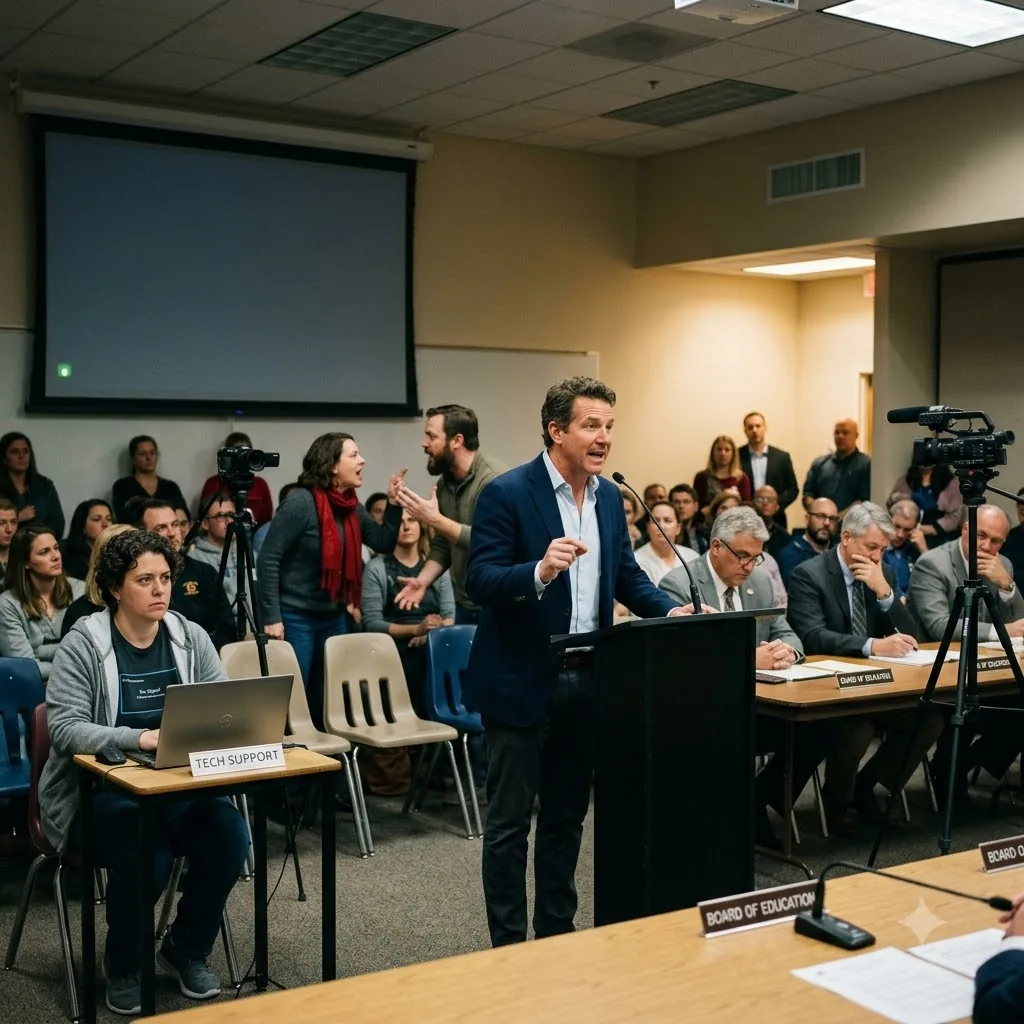
She crossed back to the tech table with the feeling of every eye attaching itself to her shoulders. The gym had become all angles and heat: the projector fan, the camera light, the clipped feedback whine from a microphone someone had set down carelessly. Her laptop sat where she had left it, screen bright with the banner notification and the half-frozen admin console beneath. She touched the trackpad once.
The folder was gone from her sidebar.
Not hidden. Gone.
She clicked the recent notifications panel, then the browser tab where she had tried to open it before. Access denied. She took a screenshot on reflex, then another of the browser history, then pulled the machine off Wi‑Fi before anyone could tell her not to. Around her, people kept talking over one another, but the shape of the sound had changed. Less outrage now than appetite.
“Mara.” Beck had come up behind her again. Not too close. Close enough for the cameras to place him with her. “Step away from the machine for a second.”
She did not turn. “No.”
“This isn’t the place to freelance incident response.”
That made her look at him.
He had his public face on still: jaw set, concern arranged carefully between his eyebrows, microphone lowered but not off. The same look he used in donor videos when he wanted to seem bruised by other people’s bad behavior. Under it, though, she saw the small impatience of a man whose schedule had been disrupted.
“You asked me to confirm an attack before I knew there was one,” she said.
His expression did not move. “Because the platform was down in a hostile room.”
“Ops says it wasn’t platform-wide.”
A flicker there. Tiny. Real.
The superintendent had reached them now, with the board president just behind him and the local reporter hovering in the lane beyond. The reporter’s camera operator had given up on distance entirely. Mara could see the red tally light reflected in the black edge of her own screen.
The superintendent said, “Can either of you tell me whether my district was used in some kind of demonstration tonight?”
Beck answered first. “Absolutely not.”
Too fast.
Mara heard it because she had spent two years in meetings where Beck waited half a beat before every denial, letting seriousness gather around him like a coat. Too fast meant he had prepared this answer somewhere before the question existed.
She looked back at her laptop. Access denied. Removed from folder. Unknown warning text. No platform-wide outage. Her pulse settled instead of rising. That was always how it happened for her, right at the point where panic became sequence.
“What was the folder called exactly?” the board president asked.
Mara enlarged the screenshot she had just taken. The notification was clipped, but enough remained.
“Board Materials,” she said. “And a file titled Community Response – Franklin Ridge.”
The board president went still in a way that was almost harder to read than anger. “Franklin Ridge is this district.”
“Yes.”
The superintendent turned to Beck. “Why would your staff have a file named for my district before this meeting started?”
“Because we prepare support materials for partner districts all the time,” Beck said. Smooth again. “Communications guidance, moderation language, de-escalation planning. Given the climate around these meetings, that’s basic duty of care.”
The answer was plausible enough that Mara felt the room hesitate.
Then she remembered the preview pane.
Not because of the title. Because of the headers.
Opening remarks.
Likely objections.
Redirects.
Not district language. Event language.
Her gaze dropped to the yellow legal pad beside her laptop, the one with her handwritten order of the night. Under it, half tucked away, was the printed run sheet Beck’s assistant had handed out in the parking lot before they came in. Mara had barely looked at it then. Arrival. Demo window. Press avail if needed. She pulled it free now.
There, in the margin beside the board’s public-comment block, Beck’s assistant had written in narrow blue ink: if archive unstable, hold on transparency frame.
Mara stared at the words for one second, then held the page up.
“This was in our run sheet before the meeting.” Her voice carried better now because she had stopped trying to make it gentle. “‘If archive unstable, hold on transparency frame.'”
Beck’s hand moved, quick and useless, as if he could take the paper back across open air.
The reporter said, “Can I see that?”
“No,” Beck said, at the exact same moment Mara said, “Yes.”
The reporter only needed the camera. She leaned in, zoomed, and the operator caught the line cleanly.
The superintendent looked from the paper to Beck. “You came in expecting your own system to fail?”
“No. We prepare contingencies.” Beck’s tone sharpened by a degree. “Anyone competent does.”
Mara could have stopped there if all she wanted was tonight. But the thing breaking open in front of her was larger than a planted line in a run sheet, and once she saw it she could not unsee the old pieces sliding into place.
The quarterly all-hands where Beck had bragged that conflict-heavy districts converted three times better than “low-friction civics markets.” The contract map with red circles around school boards that had gone viral on local Facebook pages. The way comms always clipped the ugliest meeting footage into fundraising ads by the next morning. The finance call she had accidentally joined for thirty seconds last week, long enough to hear someone say exposure spikes make the multiple easier to defend. The shared folder tonight. The acquisition rumor she had dismissed because no one announced a sale while employee equity paperwork was still pending.
She opened her email offline, searched Beck’s name, then acquisitions, then term sheet. Cached results populated slowly. Most would not open without network, but subject lines did.
One sat near the top from three days ago.
Re: retention carve-out / option treatment after close.
Another from CFO Melissa Dane.
Need founder payouts isolated from employee pool messaging.
Mara did not feel shocked. Shock was for surprises. This was recognition arriving late and all at once.
She turned the screen outward.
“You told staff last month there was no active sale process,” she said.
Beck’s face changed then. Not much. Enough.
“This is not an appropriate venue for internal speculation,” he said.
“It’s not speculation.” She pointed at the cached subject lines. “It’s a carve-out after close. And option treatment. While you have people here selling this as principle.”
The board president frowned. “After close of what?”
Nobody in LanternPath’s side of the room answered.
The superintendent looked at Beck as if seeing him for the first time without the conference lighting. “Are you telling me this company is being sold while using my district’s meeting as content?”
“That is a gross mischaracterization,” Beck said, and now the strain showed, a hard brightness under the practiced calm. “LanternPath serves communities under intense political pressure. We model for disruption. We protect enterprise value. We have obligations to employees, partners, and investors-”
“Employees?” The word came out of Mara before she could sand it down. “You mean the ones whose equity you were separating from founder payouts?”
He snapped his eyes to her. “You do not know what you’re reading.”
“Then explain it.”
The gym had gone quiet enough for the projector fan to sound loud again.
Mara held up the run sheet in one hand and turned the laptop screen farther with the other, giving him both things at once: the prepared outage frame, the sale language, the timing he could not smooth back into coincidence.
“Explain why there was a district-specific response file before the outage,” she said. “Explain why the outage was in your contingency notes. Explain why staff were told there was no sale while executives were discussing payouts after close.”
Beck opened his mouth.
Nothing clean came out.