Story code: ST-001588
Part 3: The Master Track
Arthur watched the glowing red digits on the mixing console’s clock click to 10:43 AM. He stared at Marcus, who was still hyperventilating in the mesh chair, babbling about the fifth-floor server room and executive keycards. For a brief, frantic second, Arthur had genuinely entertained the idea of a corporate heist. He had imagined himself sneaking up the stairwell, dodging security cameras, and hacking a mainframe to steal back his own stolen voice.
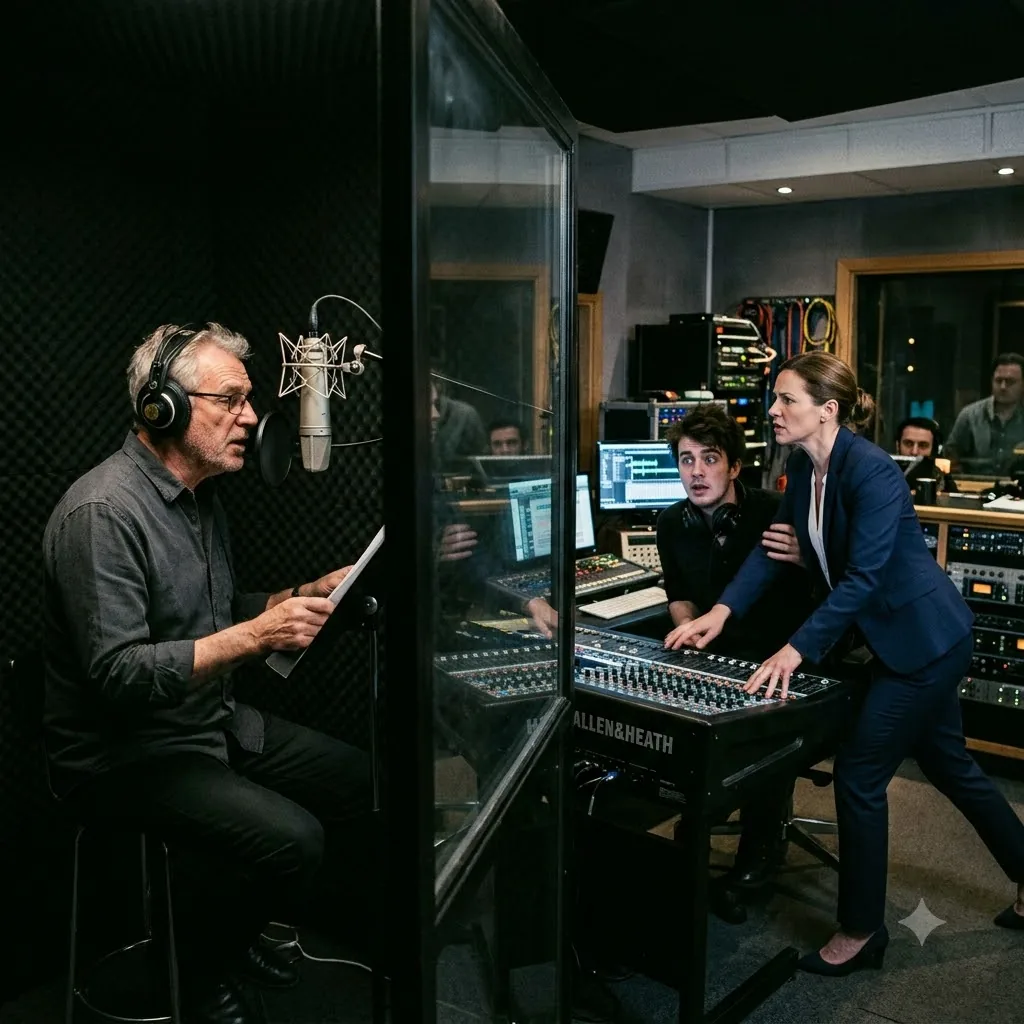
Then Arthur caught his reflection in the heavy, double-paned acoustic glass of the isolation booth.
He saw a sixty-two-year-old man in a faded flannel shirt, his shoulders rounded from decades of sitting on wooden stools. He had a bad left knee that popped when it rained and a mild tremor in his hands when his blood sugar dropped. He was an audiobook narrator, not a covert operative. If he stepped into that stairwell to attempt a break-in, he would be arrested before he even reached the third floor, terminating his contract and his wife’s insurance by noon.
Arthur forced himself to breathe. He drew a deep, diaphragmatic breath, holding the air in his lungs to steady his racing heart, exactly as he did before reading a complex, multi-page battle sequence.
He looked away from his reflection and scanned the massive mixing console. His eyes moved past the locked computer terminals and the wiped digital audio workstation. He looked at the secondary outboard gear mounted in the steel rack to the right of the desk. There, sitting quietly beneath a row of dusty equalizers, was the studio’s fail-safe system: a continuous solid-state analog master recorder.
Years ago, the voice actors’ guild had mandated physical backup loops in all corporate studios after a hard drive crash deleted forty hours of union work. The system was hardwired directly into the control room’s ambient microphones and the desk output. It bypassed the corporate network entirely, writing straight to an encrypted physical drive.
Arthur reached across the console. He flipped the heavy analog switch.
Then, he turned to Marcus. He instructed the young engineer to sit perfectly still and say absolutely nothing.
Arthur walked out of the control room, the heavy acoustic door hissing shut behind him. He jogged down the carpeted hallway, his bad knee throbbing with every heavy footfall. He reached the elevator bank just as the brushed steel doors began to slide open.
Chelsea was standing inside the car, scrolling through her tablet.
Arthur called her name, keeping his tone pitched in a higher, breathless register to project utter defeat. He sagged his shoulders, leaning heavily against the wall. He told her that he was not going to fight her, but he needed her to explain the exact scope of the addendum before he signed away his livelihood. He asked for five minutes of professional courtesy in the control room.
Chelsea let out a long, exasperated sigh. She checked her gold smartwatch, her manicured fingers tapping impatiently against the screen. Muttering about the sheer inefficiency of legacy talent, she stepped out of the elevator and marched back down the hall toward the studio.
Arthur followed her in, letting the heavy soundproof door click firmly into its locked position, sealing them inside the sterile environment.
Chelsea stepped right back to the mixing console. She crossed her arms over her crimson blazer, staring at Arthur with a mixture of pity and contempt. She demanded he hurry up, reminding him that the human resources deadline was immovable.
Arthur sat down heavily on the edge of the producer’s desk. He looked at the floor, playing the part of the broken man. He kept his voice low, forcing her to speak up over the ambient hum of the industrial air conditioning.
“The phrasing in the contract,” Arthur began, his voice trembling slightly. “It’s retroactive. That means you’ve already cloned my voice. You didn’t just run a local test on Marcus’s machine.”
Chelsea smiled. It was a cold, deeply satisfied expression. She didn’t just want to win; she wanted to be recognized for her genius. “Of course we did, Arthur. We fed your entire thirty-year catalog into our proprietary neural network. Three thousand hours of pristine, isolated audio. You have the most consistent cadence in the industry. The model mapped your vocal fry, your breath control, even the slight wheeze you’ve developed over the last few years.”
Arthur looked up, adjusting his wire-rimmed glasses. “But my current exclusive contract explicitly forbids uncompensated digital reproduction. If you’ve already trained a model and produced a fifty-book thriller series, you are in massive breach of contract. That’s why you need this retroactive signature.”
“It’s only a breach if anyone finds out before eleven-fifteen,” Chelsea replied, her tone dripping with corporate arrogance. “We synthesized the first five audiobooks last weekend. Do you know what it cost us? Twelve dollars in computing power. Compared to your hourly rate, it’s a revelation. The publisher has already paid the advance directly to the studio.”
“You circumvented the legal department,” Arthur stated, ensuring his diction was crisp and clear. “You committed large-scale copyright theft, wiped the local drive just now to destroy the evidence of premature synthesis, and you’re holding my wife’s cancer treatments hostage to cover your tracks.”
Chelsea let out a sharp, dismissive laugh. She uncrossed her arms and picked up the heavy silver pen from the console, holding it out to him.
“It’s called innovation, Arthur. The legal department didn’t know about the pilot program, but they drafted the addendum the second I showed them the profit margins. I saved this division millions. I proved that human narrators are an obsolete overhead expense. By the time this paper is filed, it will look like standard procedure. You get to keep Elaine’s insurance for one more quarter, and the studio owns your digital ghost forever. Now, sign the paper. I have a lunch meeting.”
Arthur looked at the silver pen. He listened to the steady hum of the air conditioning. The silence in the room stretched out, heavy and absolute.
He did not reach for the pen. His shoulders slowly straightened, the calculated posture of defeat vanishing in an instant. He drew in a long, silent breath.
“I don’t think I will,” Arthur said, his voice dropping back into his signature, commanding baritone.
Chelsea’s eyes narrowed, her jaw tightening. She told him that his wife’s insurance would be canceled in exactly twenty minutes.
Arthur didn’t argue. He didn’t raise his voice. He simply raised his hand and pointed a single, steady finger past her shoulder, directly at the control room window.
Chelsea frowned. She turned around.
Mounted on the wall just above the heavy acoustic glass, hardwired directly into the studio’s ambient microphones and the analog fail-safe deck, the massive plastic master recording indicator was illuminated.
The bright red light had been glowing the entire time.