Story code: ST-001516
Part 4: The Highway Stop
The brass doorknob was cold against Leah’s palm. She watched her father’s chest heave, the erratic rise and fall of his Sunday suit betraying the frantic recalibration happening behind his eyes. The echo of his confession-*I killed the housing so you would have nowhere to sleep!*-hung in the stifling air, mingling with the scent of cinnamon potpourri and sweat.
For three generations, her family had maintained absolute moral authority in this house. In ten seconds, her father had shattered it.
Mrs. Gable took a single, scraping step backward. The sound of her sensible heel against the hardwood was deafening. She wasn’t looking at Leah; she was staring at the man who had just admitted to manipulating their faith, their time, and their resources to build a domestic prison.
“My friends,” her father started, his voice cracking. He wiped a trembling hand across his slick forehead, forcing a grotesque, twitching smile onto his face. “The Lord tests us with rebellious spirits. I… my concern for my daughter’s soul spoke louder than my…”
No one murmured in agreement. The elderly man in the back didn’t stoop to wipe up his spilled sparkling cider. The congregation, usually so eager to follow his lead, stood frozen in a horrified tableau.
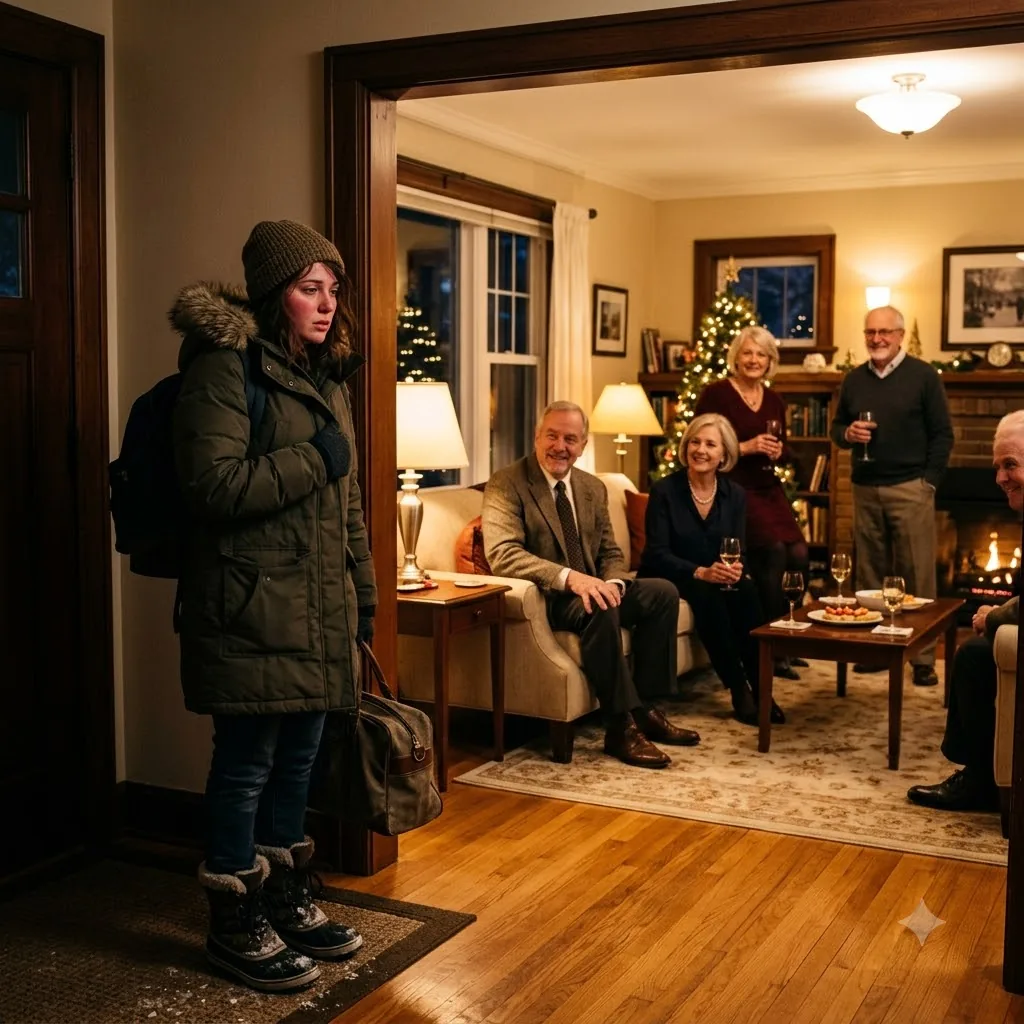
Leah turned the doorknob. She didn’t open the door to the hallway and the back stairs. Instead, she pivoted, crossing the three feet to the heavy oak front door.
Her father’s head snapped toward her. The false pastoral smile evaporated, leaving only a desperate panic. “Leah. Step away from the door.”
“No,” she said.
“If you open that door, you do not come back,” he warned. The booming volume was gone, replaced by a venomous, hissing whisper. “You have no car. You have no money for a deposit. If you walk out into that storm, you are choosing the gutter over your family.”
Leah looked at the thirty people crammed into the living room. None of them met her eyes. They wouldn’t help her, but they wouldn’t help him, either. The spell was broken.
She gripped the handle of the front door, pulled it open, and stepped backward over the threshold.
The shock of the outside air hit her like a physical blow. It was thirty-four degrees and raining, a vicious, driving sleet that immediately began to sting her cheeks. Behind her, the warmth of the house radiated outward, a cloying, suffocating heat trying to pull her back in.
“Close the door!” her father shouted, taking a step forward but stopping at the edge of the entryway rug. He wouldn’t step into the weather. He wouldn’t risk ruining his polished shoes or his perfect suit in front of his fractured audience.
Leah pulled the heavy oak door shut. The click of the deadbolt sliding into place from the inside echoed through the wood, a final, metallic punctuation mark on her twenty-two years in the house.
She stood on the cracked concrete of the driveway, the freezing rain instantly soaking through the knees of her denim jeans. The sprawling brick colonial blazed with light behind her, but for the first time in her life, she felt no gravitational pull toward it.
She turned and began to walk.
The two miles to the highway were a masterclass in suburban hostility. There were no sidewalks here, only manicured lawns that bled into the asphalt, designed exclusively for cars. Leah walked on the narrow shoulder, hugging the deep shadows cast by the dormant oak trees. The heavy winter coat, the very garment her father had tried to strip from her, was now her only shelter. The thick fleece lining absorbed the biting wind, though the sleet quickly matted her hair to her skull and sent icy rivulets running down the back of her neck.
Every time a car’s headlights swept over the crest of the hill, she stepped off the asphalt and into the muddy drainage ditches, her boots sinking into the icy slush. She wouldn’t put it past her father to send someone after her, not to rescue her, but to drag her back and restore his authority. But no cars slowed down. The suburban streets remained dead and empty.
It took her an hour to reach the commercial boundary. The ambient glow of the streetlights turned the falling sleet into sheets of yellow static. At the edge of the four-lane highway, the 42-B bus stop stood like a forgotten outpost. The plexiglass shelter was heavily scratched and covered in faded graffiti. The wind howled across the open expanse of the empty highway, rattling the metal frame.
Leah stepped under the narrow awning and sat on the freezing steel bench. Her teeth chattered, a rapid, uncontrollable rhythm that vibrated up into her jaw. Her toes were completely numb inside her wet boots. She was exhausted, shivering, and entirely alone in the middle of a winter storm.
She had never felt better.
With a shaking hand, she reached into her back pocket and pulled out her phone. The screen illuminated her wet face in a pale, blue glow. The notification from the northern district housing authority was still sitting on the lock screen.
She swiped it open. The alternate roommate matching portal loaded, displaying a small, cramped apartment miles away from the transit line, deep in a neighborhood her father would consider a war zone. It wasn’t the beautiful complex by the wetlands. It was going to require two buses and a subway train just to get to her job.
It didn’t matter. It was out of his jurisdiction.
Her shivering thumb hovered over the screen, then pressed the green button marked *Accept Match*.
The screen flashed a confirmation. Her spot was secured. Leah locked the phone, shoved it deep inside the fleece-lined pocket of her coat, and curled her knees up to her chest to preserve her body heat. The first inbound bus wouldn’t arrive until six in the morning. She had seven hours to wait in the freezing dark, listening to the sleet ping against the scratched plexiglass, completely free.