Story code: ST-000380
Part 2: The Bystander Calculus
Through the digital viewfinder of his screen, the chaotic blur on the floor finally resolved into sharp, high-definition reality. There was no unhinged demonstrator. There was no tactical takedown by Capitol Police. There was only a single, solitary figure sprawled on the cold marble.
An older man in a tailored grey suit lay on his side, his knees drawn tightly up toward his chest. His hands were locked in a desperate, clawing grip around his own throat. He wasn’t fighting off an attacker; he was suffocating. His dress shoe scraped against the grout lines because his body was convulsing in the throes of a massive, devastating medical failure.
Arthur stared at his phone, his thumb paralyzed beside the recording button. The high-resolution display captured every agonizing detail with merciless clarity. The man’s face was mottled with a terrifying, deep violet hue. His mouth was stretched wide in a silent, desperate scream for oxygen, a thick strand of saliva connecting his lower lip to the polished stone floor.
It was not a protest. It was a dying man.
And Arthur was filming him.
A cold sweat prickled beneath Arthur’s bespoke collar. The lobbyist calculus in his brain, usually so reliable and detached, violently short-circuited. He had raised his phone to blend into the herd, to prove he was merely an observer to a political scandal. Instead, he was now an active participant in a grotesque digital vigil. He was just another glowing rectangle documenting a tragedy for social media clout.
The man on the floor thrashed, rolling onto his back. As his face turned upward toward the vast, painted dome of the rotunda, the artificial light caught his features. The pronounced cheekbones. The shock of neatly trimmed, silver hair. The distinctive gold lapel pin of a congressional committee chair.
Arthur’s breath hitched in his throat. It was Chairman Albert Sterling.
The very architect of the telecom subsidy bill. The fragile, indispensable keystone holding Arthur’s entire legislative coalition together. Without Sterling’s gavel, the vote scheduled for tomorrow afternoon would never happen. Arthur’s firm would lose millions in retainer fees, and his career as a master strategist would evaporate instantly.
Sterling’s legs kicked out again, his heels drumming that sickening, rhythmic thud against the floor.
*Someone help him,* Arthur thought, his eyes darting frantically over the tops of the surrounding phones. *Someone put down their screen and help him.*
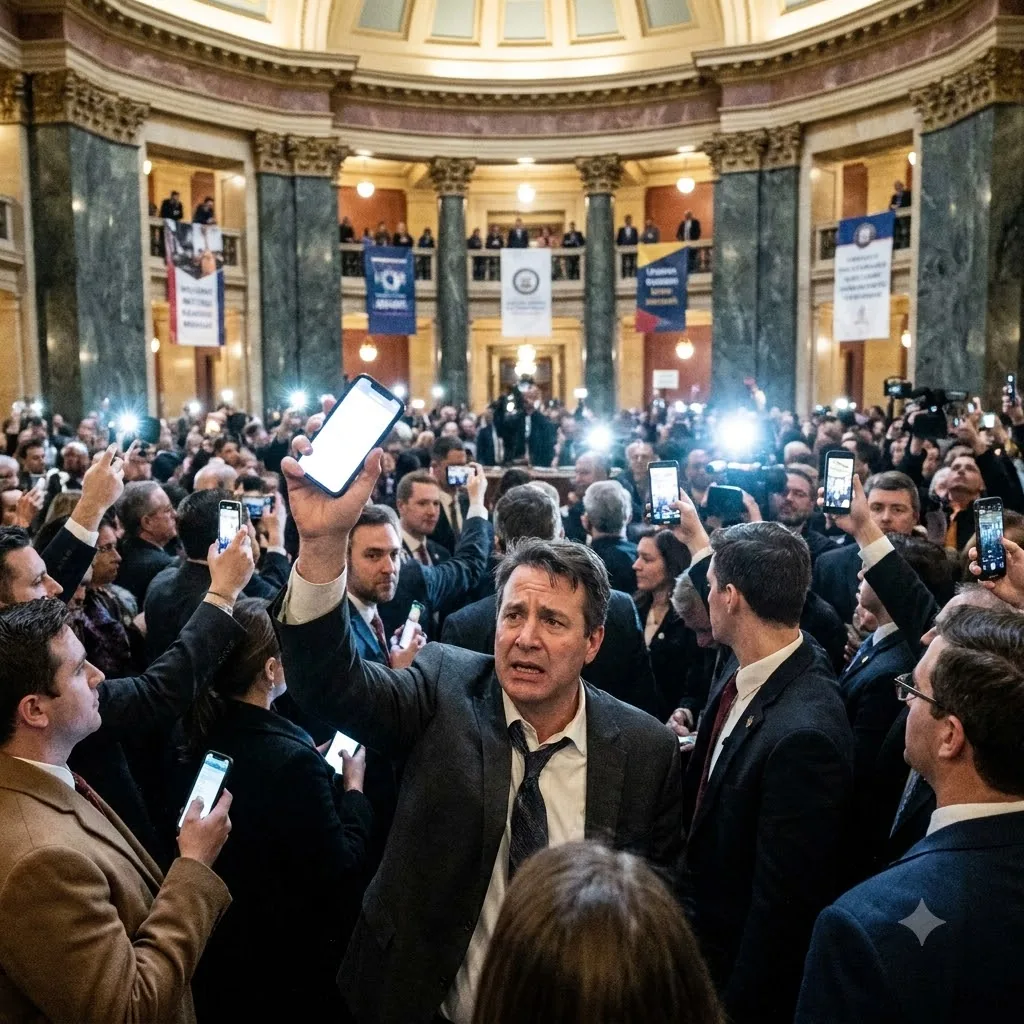
But the human ring remained impenetrable. The young staffer with the blue lanyard merely adjusted her stance, leaning closer to get a better angle of the Chairman’s bulging eyes. The middle-aged tourist who had glared at Arthur earlier was muttering a running commentary under his breath, narrating the congressman’s asphyxiation for an invisible online audience. The bystander effect had metastasized into a digital paralysis. They were all waiting for emergency services, or perhaps they simply viewed the suffocating politician as content rather than a human being.
Arthur’s heart hammered against his ribs. He had his mandatory corporate first-aid certification. He knew the Heimlich maneuver. He knew basic chest compressions. All he had to do was lower his phone, push through the line of tourists, and drop to his knees. He could save Sterling’s life. He could save the telecom bill.
But as he imagined himself crossing that invisible boundary, the terrifying reality of the optics crushed him.
If he broke from the crowd, he would become the center of the spectacle. Fifty cameras would instantly pivot to capture his face. Millions of people would scrutinize his every movement. What if he did the compressions wrong? What if Sterling choked to death anyway, right there in Arthur’s arms? He would forever be immortalized in a viral tragedy. The internet would dissect his panicked expressions. Partisan conspiracy theorists would claim the corporate lobbyist had intentionally botched the rescue, or worse, poisoned the Chairman to manipulate the market. The liability was astronomical. To touch a dying man in front of fifty live streams was an uninsurable risk.
Arthur remained frozen, his arm locked in the air, his camera lens focused on Sterling’s agonized face. He was trapped by his own survival instinct. Doing nothing was monstrous, but doing something meant surrendering his controlled anonymity to the vicious, unforgiving court of public opinion.
Through his phone screen, Arthur noticed the terrifying geometry of the crowd. Across the circle, directly opposite him, stood a row of teenagers in matching high school trip t-shirts. Their smartphones were held high, their wide-angle lenses pointed not just down at the Chairman, but slightly upward, capturing the faces of the bystanders across from them.
Arthur zoomed in on his own screen, zooming past Sterling’s convulsing body, focusing on the dark glass of a teenager’s phone across the way. He saw the faint reflection of the scene.
They were filming him.
Dozens of lenses were currently recording Arthur, a senior legislative strategist, standing perfectly still with a blank, calculating expression, filming Chairman Sterling as he choked to death. The realization hit him like a physical blow. The anonymity he sought within the crowd was an illusion. The internet would not just see the dying politician; they would see the ring of silent, apathetic watchers. They would identify the expensive suit. They would match his face to his corporate bio. The viral reality of his inaction would destroy his life and his legislation just as thoroughly as a botched rescue.
A low, terrible gurgle escaped Chairman Sterling’s lips. The violent thrashing weakened into a series of sluggish, desperate twitches. Sterling’s head lolled to the side, his bloodshot eyes staring directly into the gap in the crowd.
Directly at Arthur.
Arthur’s phone captured the moment perfectly-the Chairman’s terrified gaze locking onto the lens, silently begging the man behind it for salvation. The red recording dot blinked steadily in the corner of Arthur’s display, marking the passing seconds of his damnation.
Suddenly, a heavy hand clamped down on Arthur’s shoulder.
“Hey!” a woman’s voice shrieked directly into his ear, loud enough to cut through the heavy silence of the rotunda. “You’re just going to stand there and tape it? Do something!”
Arthur flinched, his camera jerking wildly as several glowing lenses abruptly pivoted away from the dying congressman and snapped directly onto his face.