Story code: ST-000380
Part 4: The Permanent Record
The heavy mahogany doors of the committee room closed behind Arthur, but the thick wood offered no barrier against the phantom sound of camera shutters. It echoed in the corridor, a relentless rhythm drumming against his temples. Two Capitol Police officers escorted him down the marble hallway, their posture rigid, deliberately keeping a full foot of distance between themselves and him. They did not speak to him. They treated him like a contagion.
Arthur clutched his leather briefcase, the once-supple handle feeling like a lead weight. He reached the security checkpoint, instinctively reaching for his navy-blue Capitol hard badge to swipe himself out. The scanner flashed a harsh, unforgiving red.
“Badge has been revoked, Mr. Vance,” the desk sergeant said, his voice flat and devoid of the customary deference Arthur had enjoyed for a decade. The officer reached across the turnstile and plucked the plastic card from Arthur’s numb fingers. “You’ll need to use the visitor exit.”
Stripped of his credentials, Arthur pushed through the heavy glass doors into the blinding midday sun. A waiting town car idled at the curb, but the driver, who usually greeted him with a warm smile and an open door, remained sealed inside behind dark tinted glass. Arthur opened the door himself and sank into the leather seat.
Before the car even merged onto Constitution Avenue, his smartphone vibrated in his breast pocket. He dreaded touching the device, the cold metal casing triggering a sickening muscle memory of holding it aloft in the rotunda. He pulled it out anyway. The screen lit up with an alert from the Senate majority leader’s office, blasted to the entire press list. The telecom subsidy bill had been indefinitely tabled. Without Chairman Sterling to champion the legislation, and with the toxic cloud of Arthur’s viral apathy suffocating the initiative, no senator would touch it. The fragile, multi-million-dollar coalition had shattered in a matter of minutes.
A second email arrived, this one directly from the board of directors at the telecom consortium that funded his lobbying firm. The subject line was barren. The body of the text was a single paragraph invoking the moral turpitude clause of their contract. They were cutting all ties. His massive retainer was terminated immediately.
A third notification popped up. It was from his own managing partner. His firm’s executive committee had convened an emergency vote while he was testifying. He was officially locked out of the company servers, his equity forcibly bought out at a fraction of its value, and his corner office was already being packed into cardboard boxes. In the span of a fifteen-minute Senate hearing, the architect of Capitol Hill’s most formidable lobbying strategies had been completely dismantled.
Arthur stared at the glowing rectangle in his palm. It was the same screen that had captured Sterling’s final, terrified gaze. The same screen he had prioritized over a human life.
The town car dropped him off in front of his Georgetown townhouse. He walked up the brick steps, unlocked the front door, and stepped into the cavernous, immaculate foyer. The silence of his home was immediate and suffocating. There were no assistants to field his calls, no political operatives seeking his counsel, no cable news producers begging for his spin. His curated universe of influence had been vaporized.
Arthur walked into the kitchen and dropped his briefcase onto the floor. He set his phone face-down on the polished marble island. He stared at the veins in the stone. The grey and white patterns twisted together, looking exactly like the grout lines on the Capitol rotunda floor. He closed his eyes, desperate to block out the image, but the darkness behind his eyelids offered no refuge.
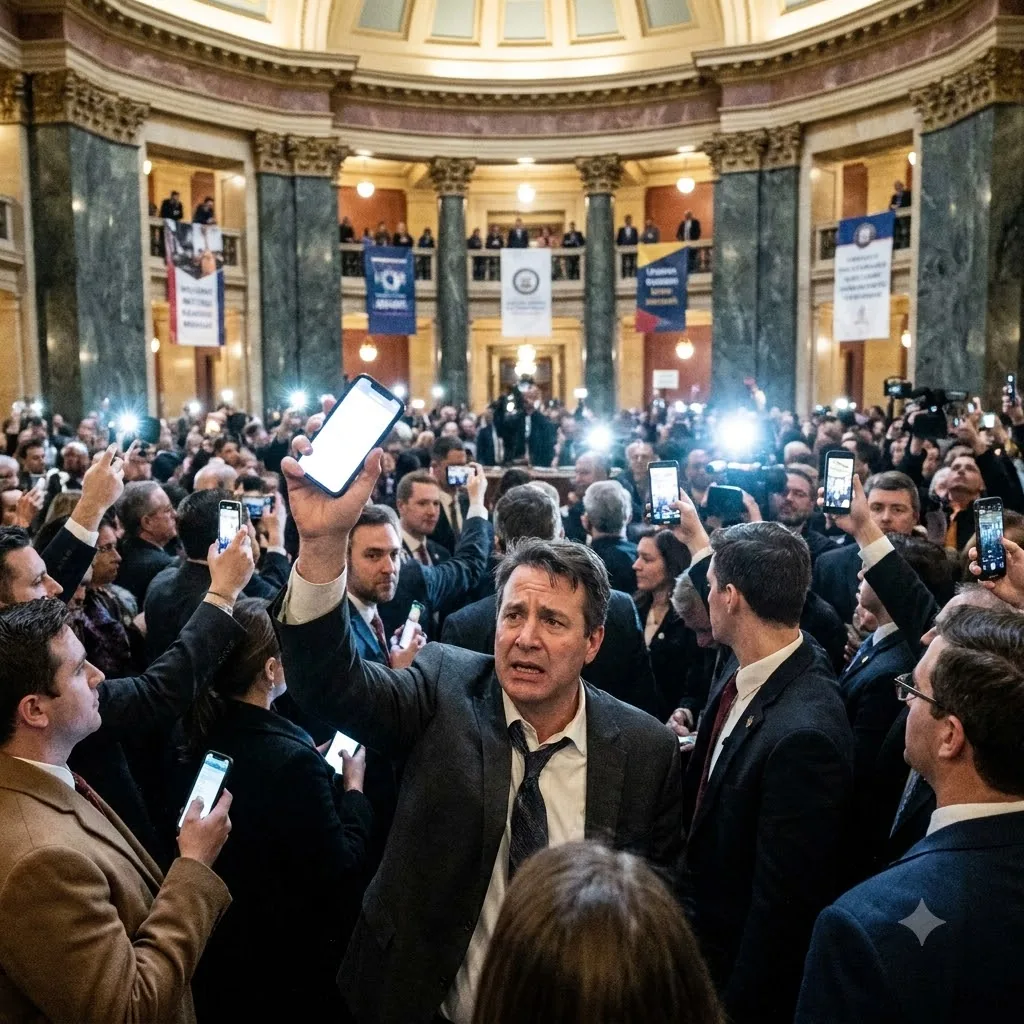
Instead, the memory played on an endless, inescapable loop. He was right back in the center of the dome. He could feel the claustrophobic press of the tourists and staffers around him. He could see the sickly blue luminescence of fifty screens illuminating the air. And there, at the bottom of his vision, was Chairman Sterling. The pronounced cheekbones. The shock of silver hair. The violent, desperate thrashing that slowly, agonizingly faded into nothing.
Arthur gripped the edge of the kitchen counter, his knuckles turning white. He remembered the exact fraction of a second when he recognized the gold lapel pin. He remembered the cold, lobbyist calculus that had overridden his basic humanity. He had believed that stepping back and blending into the digital vigil would protect him. He had believed that filming the tragedy would provide him with an alibi of anonymity.
A faint, vibrating buzz emanated from the phone sitting face-down on the marble. Another news alert. Another piece of his reputation being torn apart in the digital town square. Arthur did not reach for it. He simply stood alone in the silence of his empty house, permanently trapped inside the circle of screens, the phantom click of camera shutters echoing endlessly in his mind, drowning out the last gasp of the man he had watched die.