Story code: ST-001756
Part 4: The Price of the Surge
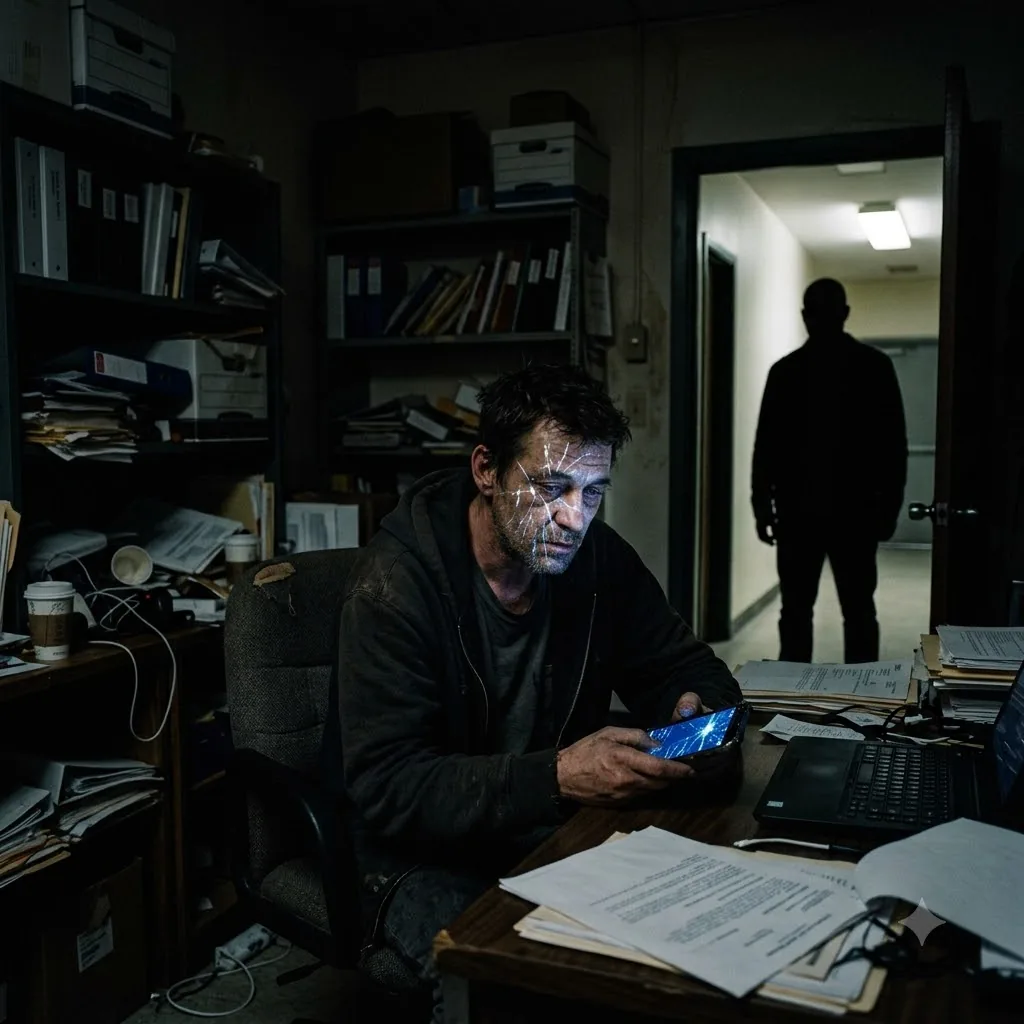
The silence in the small office was fragile, stretched so tight it felt ready to snap. On the desk, David’s phone began to vibrate against the wood. The screen lit up with another notification from the Mayor’s office, accompanied by an automated news alert. A thumbnail of the local broadcast popped up on the lock screen, automatically playing the compressed, viral clip of the assault on a silent, relentless loop.
Marcus stared down at the glowing rectangle. His breathing hitched in his throat. The hollow devastation in his eyes twisted into a sudden, blinding flash of self-loathing. He stepped forward. With an explosive sweep of his arm, Marcus violently swatted the phone. It launched off the desk and shattered against the far cinderblock wall. The glass face spider-webbed, the screen went black, and the agonizing loop finally ended.
The plastic casing clattered to the linoleum, leaving nothing in the room but the low hum of the computer tower.
Marcus staggered backward, his chest heaving, his hands clutching the fabric of his olive jacket. He didn’t apologize. He just stood in the dim light, entirely stripped of the righteous organizer persona he had worn like armor for a decade. He was just a man drowning in the shame of his own survival.
David didn’t look at his broken phone. He turned slowly back to his computer monitor. The raw, four-gigabyte video file-the undeniable proof of Marcus’s paralyzing terror-still sat in the open directory. The Chief of Police was waiting for it. The facial recognition software was primed. If David handed it over, Marcus would be crucified by the media, paraded as a hypocrite, and likely targeted by the same uniforms he was so terrified of encountering in the dark.
David reached for the mouse. He dragged the raw file into the digital trash bin and emptied it. He right-clicked the silver flash drive, safely ejected it, and pulled it from the USB port.
He stood up, the cheap chair groaning beneath him, and held the small metal drive out to his friend.
Marcus looked at the drive, then up at David, his eyes bloodshot and brimming. He took it with a trembling hand, slipping it back into his pocket. There was no relief in his expression, only the crushing, permanent weight of what he had allowed to happen in that alley. The raw footage was gone, but the ghost of his inaction would haunt him forever. Marcus had lost the illusion of his own courage, and with it, his place in the movement. Without a word, he turned and walked out of the office, the door clicking softly shut behind him.
David was alone. He gathered his coat, stepping over the shattered pieces of his phone on his way out.
The steps of City Hall were blindingly bright. By noon, the unseasonable heat beat down on the concrete plaza, reflecting off the sea of news cameras and restless bodies. The crowd was massive, angry, and grieving. Signs demanding justice for Mr. Chen waved erratically above the fray. David stood behind the podium, the hot metal of the microphones close to his mouth.
The Mayor’s press liaison glared at him from the shadows of the pillars, furious that David had arrived empty-handed, claiming the flash drive had been irreversibly corrupted. But they still needed him. They needed the respected community leader to bridge the gap.
David looked down at the front row. Mr. Chen’s daughter stood leaning against her husband, her face buried in a damp tissue, her shoulders shaking with the same violent tremors David had seen in the raw video. Behind her, the community-Black, Asian, Latino, the people David had spent ten years trying to protect-stared up at him with desperate, expectant eyes. They wanted a shield. They wanted him to tell them they would be safe.
David gripped the edges of the podium. His voice echoed across the plaza, heavy and hollow as it bounced off the stone facades. He spoke the words he had fought for years to prevent. He formally demanded a massive, immediate police surge. He asked for increased patrols, for tactical units on the corners, for the very occupying force he and Marcus had built their entire careers resisting.
The crowd erupted in a mix of exhausted cheers and angry validation. Camera shutters fired in a blinding strobe effect, capturing the exact moment of his capitulation.
But as David looked out over the flashing lights, his stomach turned to lead. He watched the faces in the crowd. He saw the elders who were too scared to walk to the store, the teenagers eyeing the approaching patrol cars with ingrained suspicion, and the neighbors watching each other with fractured trust. He had invited the sirens in to stop the bleeding, but the cost was absolute.
As the first squad cars pulled up to the perimeter of the plaza to secure the press conference, their lights painted the terrified, grieving faces of his neighbors in harsh flashes of red and blue. The heavy realization settled over David’s shoulders, suffocating him. He hadn’t made the streets safer. By flooding their blocks with the same systemic threat that had frozen his best friend in that alley, he had only ensured the paralysis would spread. He was just creating a neighborhood of terrified bystanders.