Story code: ST-000931
Part 2: The Amendment
Marcus blinked away the blinding purple spots from the press camera’s flash. The silence in the council chamber was absolute, heavy with the collective anticipation of two hundred gallery members and the glaring lens of the local media. He could feel Elena Rostova’s triumphant gaze pinning him to his leather chair.
He leaned forward, adjusting the angle of his microphone to buy a precious second. He arranged his face into a mask of thoughtful, measured gratitude.
“Elena,” Marcus began, his voice projecting a rich, resonant calm that he had cultivated over a decade in politics. “I want to thank you for bringing this forward. Your passion for our unhoused neighbors is exactly the kind of civic engagement this city needs.”
He paused, letting the gallery offer a smattering of approving claps. Under the heavy oak dais, his knee began to bounce rapidly.
“However,” Marcus continued, lowering his tone to project serious bureaucratic weight, “a project of this magnitude, in a residential enclave like Elmwood, requires extensive environmental impact studies. We have to consider traffic patterns, utility load limits, and historical zoning overlays. It is a complex logistical puzzle that simply cannot be rushed without risking catastrophic failure for the very people we are trying to help.”
He leaned back, satisfied. It was a classic administrative block. Death by committee.
Elena didn’t flinch. She reached into her canvas tote bag and produced a thick, spiral-bound document, slamming it onto the podium next to the easel.
“I anticipated that, Councilman,” she said, her voice ringing through the chamber without the need for the microphone. “Which is why I brought a copy of the Thorne Amendment. Your own legislation, passed last October, which explicitly waives environmental impact studies and zoning overlays for temporary emergency housing constructed on city-owned parcels.”
The gallery erupted into cheers. Someone in the back row whistled loudly.
Marcus stared at the spiral-bound document, feeling the blood drain from his face. The Thorne Amendment had been his crowning progressive achievement, designed specifically to force shelters into the conservative, suburban districts on the city’s east side. He had never imagined the weapon he forged would be pointed directly at his own front door.
“Furthermore,” Elena shouted over the applause, tapping the architectural rendering with her marker, “the Department of Public Works has already verified the utility load. This site is shovel-ready today. All it needs is a simple council majority to allocate the pilot funds.”
Marcus’s pocket vibrated again. A long, sustained buzz. Then another. Then a rapid succession of three.
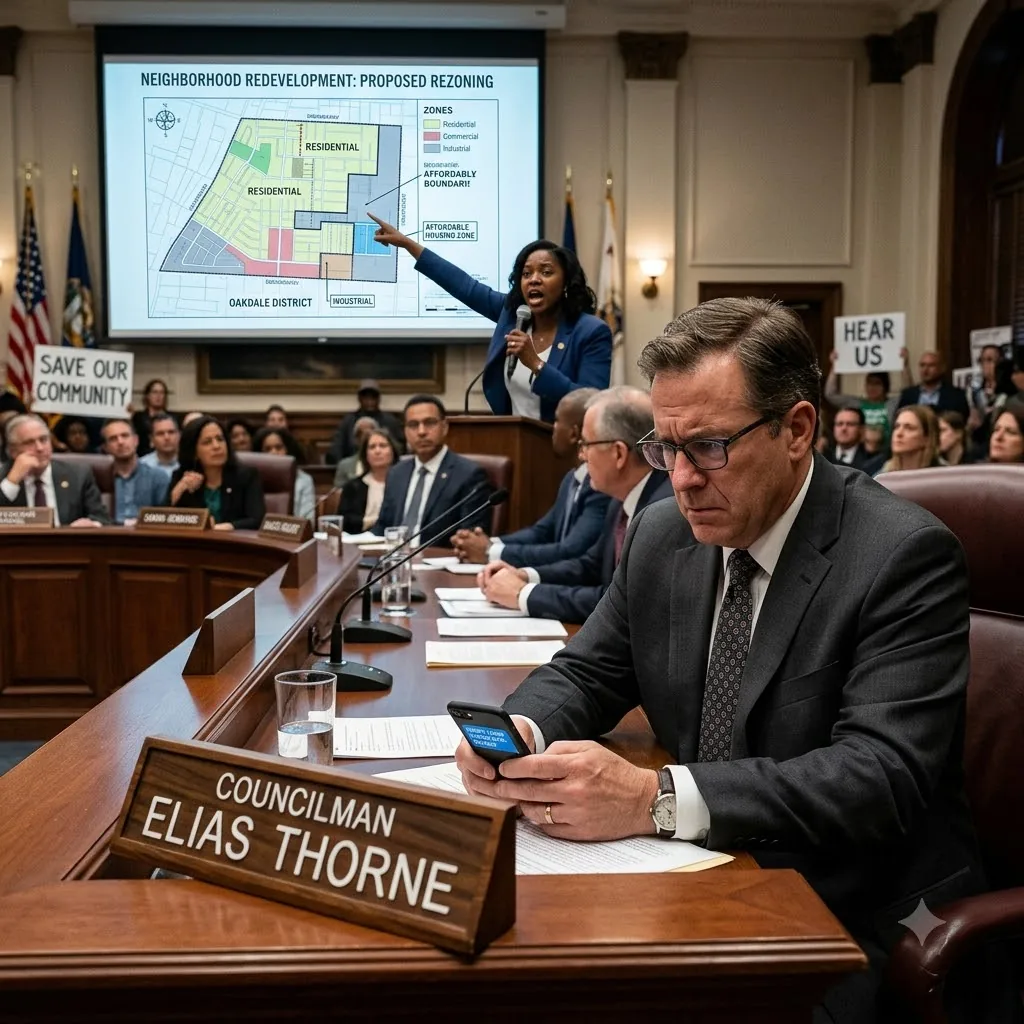
While the gallery clapped and Elena beamed, Marcus slipped his phone out and rested it on his lap, shielded by the dais. It was a barrage of text messages from his property manager at the Westside complex.
*Code enforcement is on site.*
*Water reached the main electrical room. Inspector is threatening to red-tag the building.*
*If they red-tag, tenants get displaced today. City will subpoena the LLC ownership records by end of business to assign relocation liability.*
*Contractor needs $40k wired in TWO HOURS to start emergency pumping and bypass. No credit. Cash only.*
Marcus felt a cold sweat break out along his hairline. He didn’t have forty thousand dollars in liquid cash. His entire net worth was tied up in his primary residence on Elmwood Drive and the heavily leveraged equity of his secret slum properties. His only immediate option was to trigger a fast-track Home Equity Line of Credit on the Elmwood mansion. He had already opened the application weeks ago for renovations; it just needed his final authorization and a clean automated appraisal.
But if Elena’s shelter proposal advanced today-even if it just went into a planning committee-the preliminary zoning variance would instantly hit the municipal database. The bank’s automated risk algorithms would flag the impending micro-shelter village across the street from his driveway. The algorithmic appraisal on his mansion would crater by twenty percent in an instant. The bank would freeze the equity line.
Without the equity line, he couldn’t pay the contractor. Without the contractor, the building gets condemned. If the building is condemned, his LLC is unmasked, and his political career and personal freedom both end in a firestorm of fraud and tenant abuse lawsuits.
He had less than two hours. He had to kill the Elmwood shelter proposal right now, permanently, in front of the press and his most loyal supporters.
Marcus pocketed the phone. He wiped his damp palms on his suit trousers. He leaned back into the microphone.
“Elena, the Thorne Amendment was designed for viable, integrated infrastructure,” Marcus said, his voice tightening. The smooth, resonant calm was gone, replaced by a defensive edge. “Elmwood Drive is… it is fundamentally unsuited for this. The character of the neighborhood, the property values of the residents who have invested their life savings-”
He stopped himself, but it was too late.
The phrase *property values* echoed through the vaulted chamber like a gunshot. The cheering in the gallery abruptly died. A tense, confused murmur rippled through the rows of organizers and tenant advocates. The young woman in the frayed denim jacket, who had praised him minutes earlier, stared at him with narrowing eyes.
Elena gripped the edges of the podium. “Did you just cite the property values of millionaires as a reason to keep people on the street, Councilman?”
“No,” Marcus stammered, his heart hammering against his ribs. He could see the local press photographer furiously typing on a laptop, no doubt drafting a devastating tweet. “I am talking about equitable distribution of municipal resources. Concentrating poverty in a hyper-affluent area without proper transitional services is highly irresponsible. It’s a safety issue. A severe safety issue.”
The murmurs in the gallery turned to hostile jeers. He was shredding his own legacy in real time, abandoning every talking point he had campaigned on for six years. He looked down at the dais, desperately trying to formulate a procedural motion to adjourn the meeting.
Before he could find the words, the microphone to his immediate left flared to life.
Council President Davies, a moderate who had despised Marcus’s progressive grandstanding for years, leaned forward with a predatory smile. Davies had spent his entire career being battered by Marcus’s self-righteous speeches. He recognized a drowning man when he saw one.
“Councilman Thorne raises some fascinating concerns,” Davies announced, his voice oozing with false sympathy. “But as Elena rightly pointed out, Councilman Thorne has also taught us that a housing crisis demands bold, immediate action. We cannot let NIMBYism stall progress.”
Davies turned to the municipal clerk.
“Madam Clerk, I recognize that this is not on the formal agenda. However, seeing as we have a quorum, and given Councilman Thorne’s previous commitment to fast-tracking emergency housing, I make a motion to suspend the rules. I move we vote on authorizing the Elmwood Shelter Pilot right here, right now.”
The gallery erupted into a deafening roar of approval, completely drowning out Marcus’s gasp.
“Seconded!” shouted another council member from the far end of the bench.
Davies looked at Marcus, his smile widening into a triumphant grin. “Motion seconded. We will proceed to an immediate roll-call vote.”
Marcus stared at the blinking red voting light on his console, his phone vibrating violently against his thigh as the two-hour clock on his total ruin began to tick down.