Story code: ST-000931
Part 3: The Denial
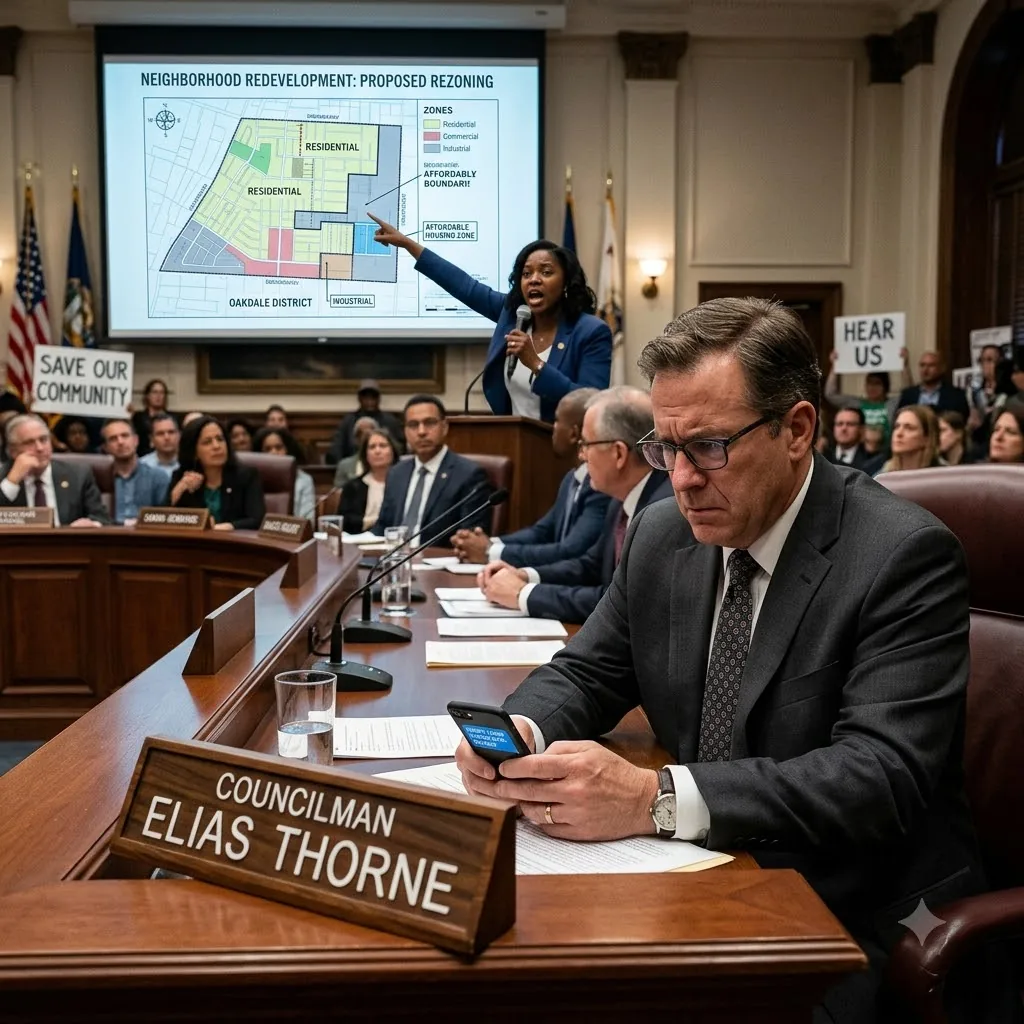
“Point of personal privilege,” Marcus barked, his voice cracking into the microphone. The red voting light pulsed on his console, a rhythmic countdown to his annihilation. “Council President, municipal charter section eight-C strictly prohibits a binding vote on un-agendized land use without a mandatory five-minute legal review by the City Attorney’s office. I demand that review.”
Davies’s triumphant grin tightened into a scowl. He looked at the municipal clerk, who reluctantly nodded. “Five minutes,” Davies clipped, slamming his wooden gavel against the sounding block. “Do not leave the building, Councilman. The roll call begins the second that clock hits zero.”
Marcus didn’t wait. He bolted from his leather chair, pushing through the heavy velvet curtains behind the dais and stumbling into the dimly lit rear corridor reserved for elected officials. The muffled roar of the angry gallery faded behind the thick plaster walls. His hands shook so violently he could barely unlock his phone screen. He had to call the bank. He had to verbally override the appraisal algorithm before the shelter variance hit the municipal ledger.
“I wouldn’t bother calling the equity loan officer,” a voice echoed from the shadows near the fire exit.
Marcus spun around, dropping his phone against his thigh.
A man stepped from the alcove, illuminated by the flickering overhead fluorescent light. It was the press photographer from the front row. He had slung his heavy digital camera over his shoulder and was holding a sleek black tablet. His press badge dangled from a frayed lanyard: *Elias Vance, City Desk*.
“This is a restricted area,” Marcus snapped, trying to summon the authoritative, resonant baritone of his office. He took a step backward toward the chamber doors. “You need to leave before I call security.”
“And you need to explain how a progressive champion of the working class is listed as the primary beneficiary of a shell corporation currently being red-tagged for slum conditions on the Westside,” Elias replied, his voice deadly calm.
The hallway seemed to violently tilt. Marcus felt the blood drain from his extremities, leaving a cold, prickling numbness in his fingers.
Elias tapped the screen of his tablet, stepping closer. “I was watching you out there, Councilman. You were sweating bullets before Elena even unrolled that map. So, while you were busy trying to stall the shelter vote, I ran a cross-check on the properties managed by your former campaign treasurer. Funny how the registered agent for Oakwood Holdings LLC matches the exact PO Box you used for your mayoral exploratory committee.”
Elias turned the tablet around. It displayed a digitized copy of the LLC’s articles of incorporation, cross-referenced with the emergency dispatch log from the Westside complex. Marcus’s signature, slightly blurred but unmistakable, anchored the bottom of the document.
“You’re a fraud,” Elias said, the righteous indignation rising in his chest, amplifying his voice in the empty corridor. “You block a shelter on your multi-million-dollar street to protect your property value, while you secretly squeeze every dime out of low-income tenants living with raw sewage in their basements. Your whole career is a lie. I’m publishing this the second the gavel drops.”
Marcus stared at the glowing screen. The polished, politically savvy defenses he had spent years perfecting evaporated. There was no procedural maneuver for this. The forty-thousand-dollar emergency repair bill, the algorithmic appraisal, the impending condemnation-it was all colliding right here on the scuffed linoleum floor.
“Please,” Marcus whispered. The word tasted like ash.
Elias scoffed, taking a step back as if Marcus’s desperation was physically repulsive. “Please? You want to beg? You’re going to face federal fraud charges, Marcus. You’re going to prison.”
“I don’t care about prison!” Marcus shouted, the sudden, raw volume of his voice startling Elias into silence. “I don’t care about the council seat. I don’t care about the career.”
Marcus shoved a trembling hand into his breast pocket and pulled out his leather wallet. He fumbled with the folds, his fingers slipping on the smooth material, until he extracted a crisply folded piece of heavy stock paper. He thrust it at Elias’s chest.
“Read it,” Marcus ordered, his breath coming in ragged, shallow gasps.
Elias hesitated, his eyes darting between Marcus’s hollow face and the paper. He took it, unfolding the letterhead. The logo for Apex Health Insurance dominated the top margin.
“It’s a coverage denial,” Elias muttered, skimming the bureaucratic boilerplate. “So what? Everyone gets denied-”
“Look at the figure at the bottom of the second paragraph,” Marcus interrupted, stepping into Elias’s personal space.
Elias’s eyes tracked down the page. He stopped. He read the sentence again, his jaw slackening. “Twenty-two thousand dollars. Denied as experimental. Effective retroactively.”
“That is the weekly cost of the clinical trial,” Marcus said, his voice dropping to a harsh, wet whisper. “Out of pocket. Cash. Due by Friday.”
Elias looked up, the righteous fire in his eyes flickering into confusion. “For who?”
Marcus bypassed the wallet and opened his phone. He ignored the dozen new frantic texts from his property manager. He opened his photo gallery and turned the screen toward Elias.
The photograph was taken under harsh hospital lighting. It showed a small, fragile girl, no older than six, swallowed by a massive, sterile pediatric bed. A thick plastic intubation tube was taped to her pale face, disappearing between her lips. A tangle of IV lines snaked from her thin arms to a towering rack of monitors, the screens glowing with jagged, artificial life. Her eyes were closed. She looked impossibly small, a tiny anchor holding down a mountain of crushing medical debt.
“Her name is Maya,” Marcus said, his voice breaking. He couldn’t look at the screen. He knew every pixel of that image by heart. “She’s my daughter. She’s been in the ICU for three months.”
Elias stared at the photograph, his mouth opening and closing without sound.
“The house on Elmwood?” Marcus continued, a bitter, broken laugh escaping his throat. “It was my wife’s family home. It’s leveraged to the absolute studs. There are three mortgages on it. I don’t own the walls, I don’t own the roof. The only equity left is tied to the neighborhood’s appraisal value. If that shelter goes in, the bank’s algorithm recalculates my debt-to-income ratio. They’ll freeze the equity line I absolutely need to close today. If they freeze the line, I can’t pay the contractor at the Westside complex. The building gets condemned. The LLC income evaporates.”
Marcus took a step forward, forcing Elias to look away from the phone and meet his eyes.
“I am bleeding those properties dry because I have to pay the clinic by Friday,” Marcus said, the tears finally spilling over his lower lids, tracking hot and fast down his cheeks. “If I miss the payment, they drop her from the trial. If they drop her, Maya dies. I am not protecting a retirement fund, Elias. I am buying my daughter’s breath.”
Elias looked down at the tablet in his left hand, displaying the undeniable proof of Marcus’s political corruption and tenant abuse. Then he looked at the twenty-two-thousand-dollar denial letter in his right hand, and the glowing screen of the phone showing the dying girl. The black-and-white narrative of the corrupt slumlord had just shattered into a million agonizing, jagged pieces.
Overhead, the harsh, electronic buzz of the chamber bell echoed through the corridor. The five-minute legal recess was over.
Marcus locked his phone and slipped it into his pocket. He wiped his face with his sleeve, straightening his tie with trembling, mechanical precision. He looked at Elias, standing frozen in the hallway, caught between the righteous truth he had hunted and the devastating reality he had found.
“The clerk is waiting,” Marcus said quietly.