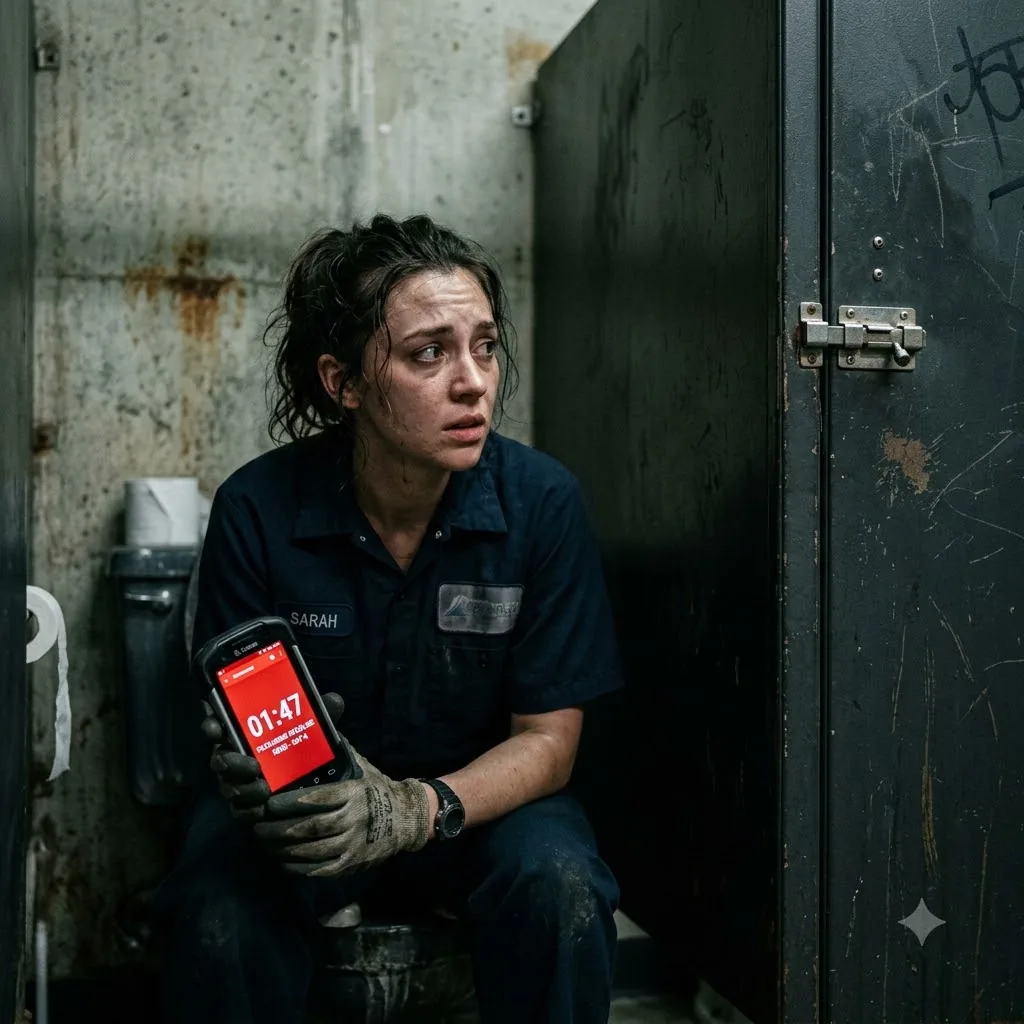
Story code: ST-001353
Part 3: Protected Concerted Activity
“Mr. Vance,” the guard at the security checkpoint asked, deferring to the Auditor standing beside me. “Do you want me to run her through the arch?”
Vance. So that was his name.
Vance shook his head, his cold eyes flicking down to my trembling, hunched posture. “No. She triggered a Class 4 anomaly. A standard magnetic scan isn’t enough. She’s concealing something. We use the secondary screening stall.”
The guard nodded and pointed a thick, black-gloved thumb toward a frosted-glass and brushed-steel enclosure bolted to the concrete floor just to the left of the main metal detector. The privacy stall. It was typically used for invasive pat-downs, strip searches, and interrogating suspected thieves away from the prying eyes of the fulfillment floor.
“Inside,” Vance ordered, shoving me forward by my shoulder.
I limped heavily toward the stall, dragging my right leg as if it could barely support my weight. Underneath my thick wool sock, the heavy black burner phone ground painfully against my ankle bone with every step. My mind raced in a panicked overdrive. If I walked through that main scanner archway, the magnetic pulse would fry the motherboard and destroy the drive instantly. But if Vance searched me inside the privacy stall and found the phone on my physical person, he’d just walk it over to the scanner himself. He would wipe it clean, claim it was unauthorized contraband, and I would be terminated and arrested. I had to separate myself from the device immediately, but I had to keep it within the stall.
I stepped into the cramped, windowless box. The walls were cold brushed aluminum that smelled faintly of industrial sanitizer. A single, heavy metal bench was bolted securely to the floor.
“Sit down,” Vance commanded, stepping in right behind me.
As he turned his back for a fraction of a second to slide the heavy metal door shut and engage the deadbolt, I dropped instantly to the floor.
I didn’t hesitate. I shoved two fingers aggressively down the collar of my right boot, gripped the hard plastic edge of the burner phone, and yanked it out of my sock. I jammed it hard into the narrow, dark gap between the back edge of the metal bench and the aluminum wall. It slid deep into the crevice with a soft, barely audible *clack*, dropping completely out of sight just as the lock clicked.
By the time Vance turned back around, I was sitting on the bench, clutching my knees tightly to my chest, rocking slightly back and forth, and letting out a pathetic, high-pitched whimper.
“Save the theatrics,” Vance said smoothly, pulling out a small black flashlight. “Warehouse shrinkage is up four percent this quarter. You took an unauthorized break to a blind spot. You’re stealing company inventory. Hand over the boots.”
I fumbled with the thick laces, letting my hands shake violently to sell the panic. I pulled off the left boot and handed it up to him. He inspected it thoroughly, shining the harsh beam of his penlight inside, running his thumb along the seams, and flexing the soles. He tossed it aside onto the floor.
“The right one.”
I handed it over. He tore out the foam insole, checked the reinforced heel, and frowned when he found nothing.
“Empty your pockets. Turn them inside out.”
I complied, producing nothing but gray pocket lint and a crumpled, faded protein bar wrapper.
Vance’s flat eyes narrowed. He looked down at my bare, socked feet, and then back up to my face. “You didn’t dump it in the restroom. You wouldn’t have risked the massive Time Off Task penalty just to flush a stolen smart watch or a memory card down the toilet. You brought it here.”
He stepped back and began systematically searching the small screening stall for stolen goods. He checked the hinges of the door. He ran his hands along the seams of the aluminum wall panels. Finally, he dropped down to one knee, sweeping his flashlight beam directly under the metal bench.
His hand paused.
He reached his arm up into the tight gap between the bench and the wall.
My heart hammered against my ribs, loud, frantic, and painful.
Vance stood up slowly, a tight, victorious smirk breaking through his robotic corporate exterior. In his hand, he held the black burner phone.
“Well, well,” Vance said, turning the primitive device over in his palm. “This certainly isn’t standard warehouse inventory. But it is definitely unauthorized electronics. A burner.”
He pulled out his sleek silver tablet with his other hand, preparing to log the confiscation. “You’re done, employee three-four-nine-two-seven. I’m taking this out to the magnetic scanner for evidence processing. We are going to wipe it, and then we are calling the police.”
This was it. The absolute edge of the cliff.
I let out a long, slow breath. I stopped rocking. I planted both of my socked feet firmly on the cold tile floor. I lowered my hands from my chest, rested them casually on my knees, and sat up perfectly straight.
The violent shaking stopped. The pathetic whimpering vanished. The exhausted, broken worker I had been successfully playing for the last two years evaporated in a single heartbeat.
“My name isn’t three-four-nine-two-seven,” I said. My voice was no longer a wet, ragged gasp. It was crisp, calm, and echoed sharply off the aluminum walls. “It’s Maya.”
Vance paused, his thumb hovering awkwardly over the screen of his tablet. He looked down at me, his brow furrowing in deep confusion at the sudden, jarring shift in my demeanor. “I don’t care what your name is.”
“You need to care, Vance,” I said, leaning forward. “Because touching that device just made you a central figure in a federal investigation.”
Vance let out a short, dismissive scoff, but I noticed he didn’t step toward the door. “Nice try. It’s contraband.”
“It’s not company property,” I said, locking my eyes fiercely onto his. “It is my personal property. And more importantly, it is currently connecting this warehouse to a floor-wide labor drive.”
Vance’s smirk vanished entirely. The blood drained from his face, leaving him looking sickly pale in the harsh fluorescent light.
“Under Section 8(a)(1) of the National Labor Relations Act,” I continued, articulating every single syllable with lethal, practiced precision, “it is a federal offense for an employer to interfere with, restrain, or coerce employees in the exercise of their right to organize. That phone isn’t just a piece of plastic. It contains the digital signatures of four hundred and twelve fulfillment workers on this floor.”
Vance looked down at the black plastic brick in his hand as if it had suddenly turned into a live, unpinned grenade.
“You’re bluffing,” he said, though his smooth, authoritative voice had gained a slight, undeniable tremor. “It’s a decoy.”
“Open it,” I challenged, keeping my eyes deadlocked on his. “Press the power button. Look at the live broadcast log. It’s streaming the wage theft data you tried to bury, directly to an external server operated by the National Labor Relations Board.”
I stood up. I was much shorter than him, but right now, looking at the pure hesitation in his eyes, I felt ten feet tall.
“Go ahead, Vance,” I whispered, gesturing openly toward the metal door that led to the active scanners. “Walk it through the arch. Wipe the drive. The exact second that connection drops, the NLRB gets an automated alert for the destruction of evidence by a corporate officer. You’ll be personally named in the federal subpoena. The company will throw you to the wolves to save their stock price. You won’t just be fired. You’ll go to federal prison for obstruction.”
Vance stood completely frozen, his back pressed tightly against the door of the screening stall. He gripped the burner phone in his fist, staring at me with a sickening realization dawning in his cold, camera-lens eyes. He was holding the very thing that could destroy him, and he legally couldn’t do a single thing about it.